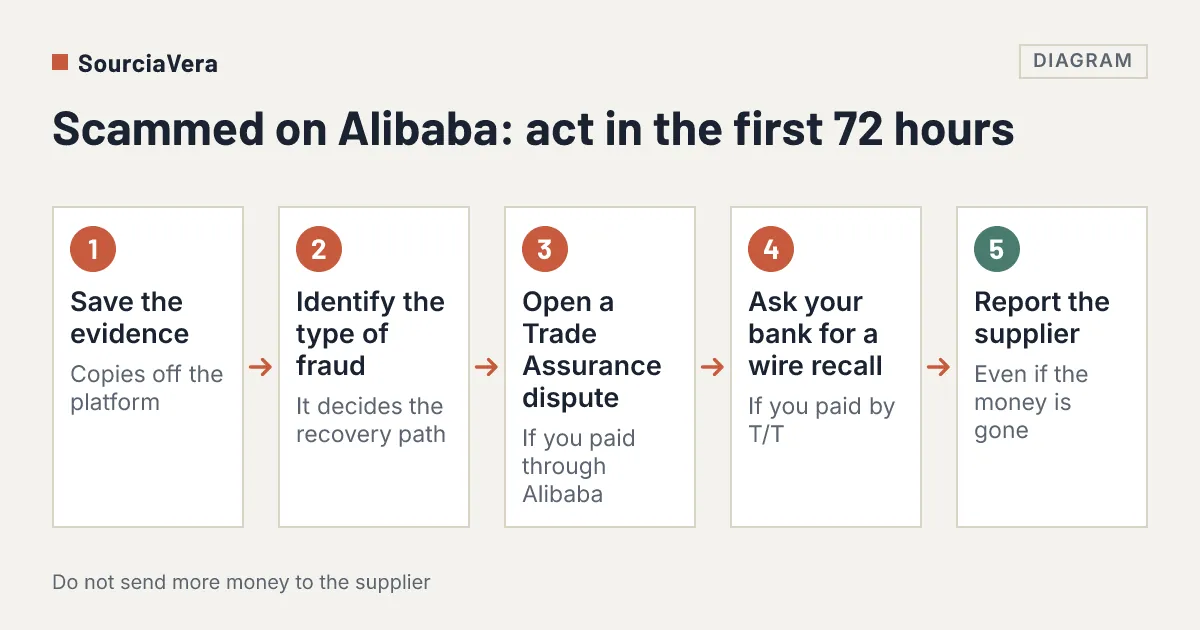
When buyers get scammed on Alibaba, the first thing most of them do is keep messaging the supplier. I think that's the wrong first move. The supplier is the one party who can't help you. Your evidence, your bank and the platform can, and all three work best in the first 72 hours.
The short answer: if you got scammed on Alibaba, stop paying the supplier, save all evidence off the platform, and act within 72 hours — open a Trade Assurance dispute if you paid through Alibaba, and call your bank's fraud department for a wire recall if you paid by T/T. Then report the supplier.
If you paid and the goods never arrived, or arrived as garbage: you're not alone, and there are still steps worth taking.
What Does a Typical Alibaba Scam Look Like?
From what our team sees on the ground, the most common pattern goes like this: a buyer pays a deposit, the supplier confirms production is underway, and then replies slow down. Sometimes no tracking number ever appears; sometimes the goods arrive looking nothing like what was agreed. Then comes a new message asking for money to "reship," a "customs fee," or a payment to "unlock" the stuck shipment.
Do not send more money under any circumstances. Those requests are secondary scam attempts that follow the original fraud. Here is what I'd do instead, in order.
Why Do the First 72 Hours Matter?
Three things work against you as time passes:
- The recall window is short. Bank recalls on wire transfers are only possible in a narrow window, and the attempt costs nothing.
- Evidence can disappear. A supplier can delete the account or block you, which is why you save everything off the platform first.
- Follow-up scams arrive. Requests for money to "reship" or "unlock" the shipment are secondary scam attempts, so the supplier is the one party who cannot help you.
Step 1 — What Evidence Should You Save First?
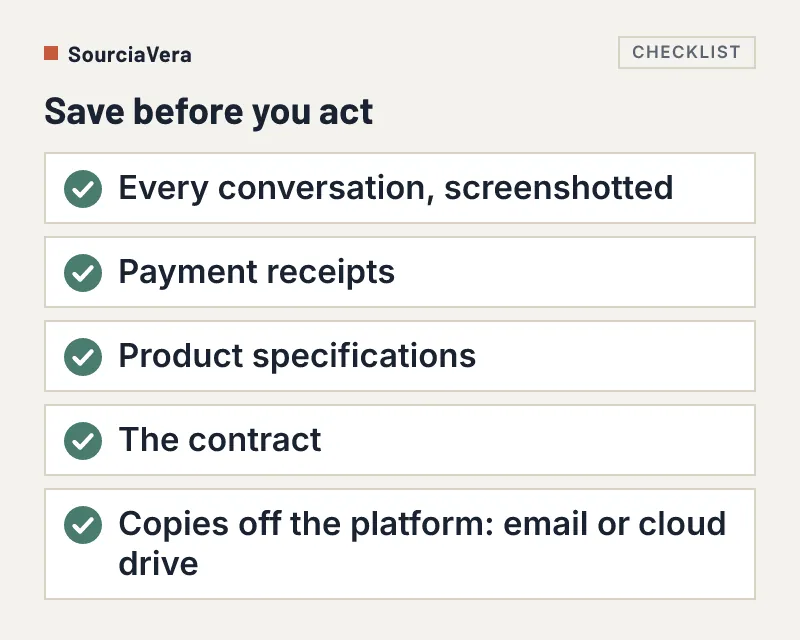
Before anything else: screenshot every conversation, payment receipt, product specification and contract you have. Save copies off the platform — email them to yourself, upload them to Google Drive — in case the supplier deletes their account or blocks you.
Do not try to negotiate with or threaten the supplier yet. Secure the evidence first, then act.
Step 2 — Which Kind of Alibaba Fraud Is It?
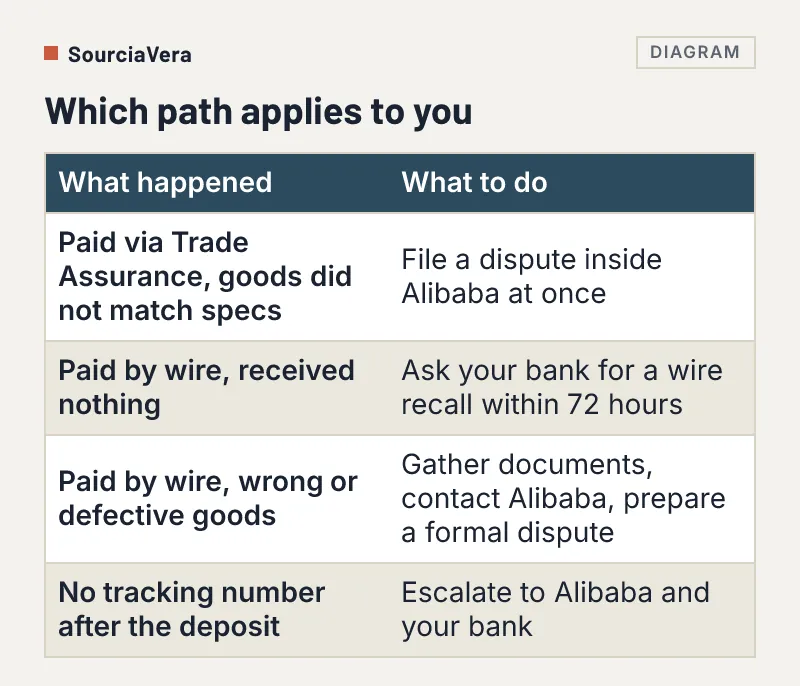
The recovery path depends on what actually happened:
- Paid through Trade Assurance, goods didn't match specs → file a dispute immediately within the Alibaba platform
- Paid via wire transfer and received nothing → contact your bank for a wire recall within 72 hours
- Paid via wire and received wrong or defective goods → gather documentation, contact Alibaba, prepare for a formal dispute
- Never received a tracking number after the deposit → this is typically a non-shipment scam; escalate immediately to Alibaba and your bank
Step 3 — How Do You File a Trade Assurance Dispute?
If you paid through Trade Assurance, this is your main avenue. Open a dispute from your Alibaba order page and upload evidence of the gap between what was agreed and what was delivered: the product specifications from the original contract, photos and video of the goods received (or evidence of non-receipt), and chat logs showing what the supplier committed to.
Alibaba's mediation team typically responds within 3–7 business days. If mediation fails, Alibaba can escalate to arbitration under its buyer protection terms. The more documentation you have, the stronger your case.
Step 4 — Can Your Bank Recall a Wire Transfer to China?
If you paid by wire (T/T), call your bank's fraud department today. Wire recalls are possible within a short window — sometimes as little as 24–48 hours after the transfer — and after that the odds drop sharply. Banks vary a lot in how hard they pursue recalls, but the attempt costs nothing and the window closes fast.
Credit card chargebacks are possible but harder for international B2B transactions. Your bank's dispute team can tell you whether your transaction qualifies.
If you paid from a bank in Mexico, remember that a payment to China does not travel through SPEI but as an international (SWIFT) transfer. Ask your bank to request the recall and keep the SWIFT confirmation at hand. If your bank does not follow up, you can file a complaint with CONDUSEF, although that does not oblige the Chinese bank to do anything.
Step 5 — Why Report the Supplier Even If the Money Is Gone?
Even if you can't recover the money, reporting matters. It gets the supplier off the platform faster, protects the next buyer in your position, and creates a documented trail if you pursue legal remedies later.
Use Alibaba's "Report a Supplier" function on their profile page. For amounts above $10,000, also consider reporting to your country's trade authority or an international fraud reporting body, or consulting a trade lawyer familiar with China disputes.
Be wary of anyone who contacts you offering to “recover your money” in exchange for an upfront payment: it can be a second scam aimed at someone who has already lost money.
Summary: Act Fast, and Close the Gap on the Next Order
In my experience, getting scammed rarely means a buyer was careless. Most of the time it means they relied on what a screen could show them — a profile, a badge, a friendly salesperson — and nobody checked the rest. Verifying a factory before payment isn't paranoia; it's standard practice in professional importing. A $449 verification visit on a $15,000 order costs about 3% of the order.
The gap between "I checked their Alibaba profile" and "I verified their factory in person" is where most of the sourcing disasters I hear about begin. If there's a next order, that's the gap I'd close first.
In short, act within the first 72 hours, save the evidence, and never send more money. For the next order, the gap to close is the one between checking a profile and verifying the factory. Without that check, the same pattern can repeat: a deposit paid on the strength of a screen, and nobody has looked at the rest. A $49 remote check covers the registration and payment-account questions, and our team can visit the factory before any deposit moves.
I provide supplier verification services, so you should treat my recommendation accordingly.