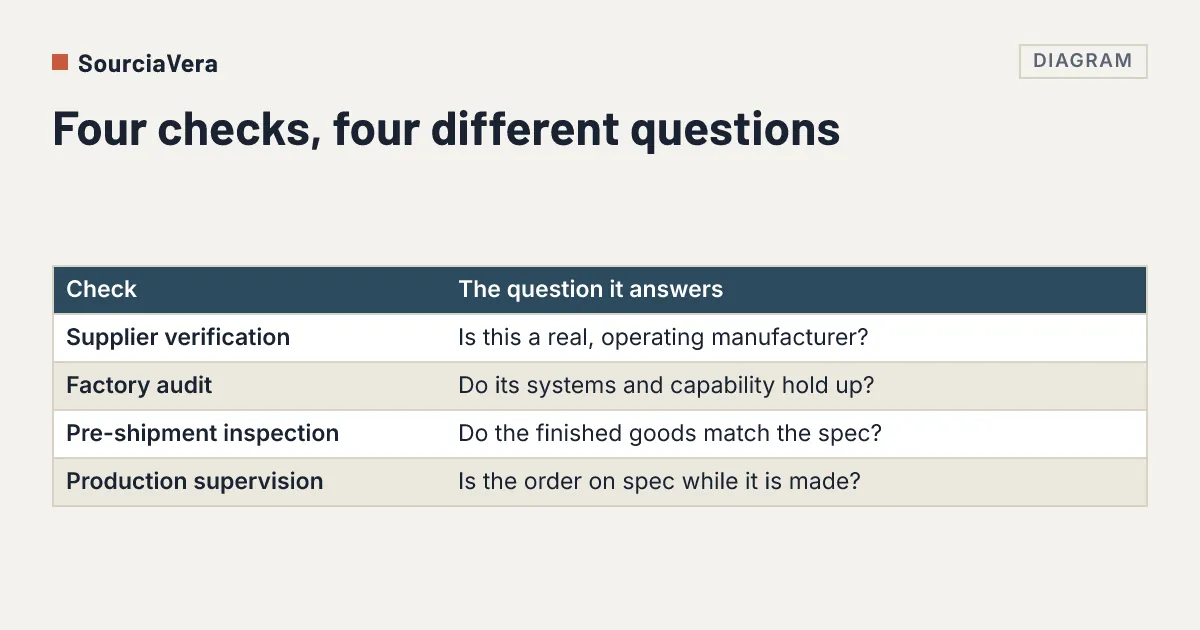
I think China sourcing has a vocabulary problem before it has a supplier problem. Terms like "verification," "audit," "inspection," and "supervision" get used interchangeably by suppliers, agents, and service providers — but they describe meaningfully different things. In my experience, many buyers who say "we already checked the factory" actually bought one of these and assumed it covered the others.
The short answer: supplier verification confirms a supplier is a real, operating manufacturer; a factory audit evaluates its systems and production capability; a pre-shipment inspection checks finished goods before they leave; and production supervision monitors the factory while your order is being made. A trading company resells rather than manufactures, and a sourcing agent finds and manages suppliers on your behalf.
A typical example: a buyer pays for a check that confirms a company exists, then treats it as proof the goods will be right. Or a supplier carries a "Verified Supplier" badge and the buyer reads it as "real factory." In one case our team handled, the problem was exactly that: four Alibaba suppliers all had the badge and all claimed in-house manufacturing. We checked their business licenses, and all four were registered as trading or import-export companies, not producers. The takeaway: the words mattered.
Below is what each term actually means, when I'd say you need it, and what it costs at SourciaVera.
Jump to term
Supplier Verification Factory Audit Pre-Shipment Inspection Production Supervision Trading Company Sourcing AgentSupplier Verification (Factory Verification)
Confirming that a Chinese supplier is a real, operating manufacturer — not a trading company, middleman, or shell entity.
Supplier verification is an in-person visit to a Chinese supplier's facility. A verifier checks the business license against government records, walks the production floor, inspects equipment, interviews staff, and delivers a written report within 48 hours. It answers one specific question: is this supplier who they say they are?
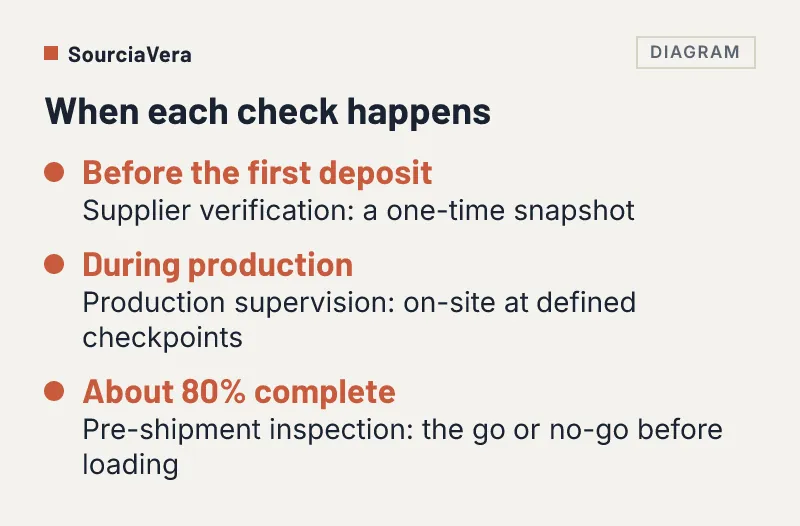
Verification is a snapshot in time — it's performed once, typically before a first order or first deposit. It doesn't monitor what happens during production.
Before wiring any deposit to a new supplier. Before placing a first bulk order. When a supplier's Alibaba profile looks too polished, their pricing is suspiciously low, or they're reluctant to share business license details.
Factory Audit
A structured, multi-point evaluation of a factory's systems, compliance standards, and production capability — deeper than a verification visit.
A factory audit assesses quality management systems (QMS), worker safety practices, equipment maintenance records, subcontracting practices, and sometimes social compliance. Audits are scored against a structured checklist — ISO standards, customer-defined criteria, or social audit frameworks — and produce a formal report with corrective action requests.
Unlike a verification visit (which confirms existence and legitimacy), an audit evaluates capability, consistency, and systemic risk. Audits typically take one to two full days on-site.
Before onboarding a strategic supplier for recurring orders. When your internal compliance team or a retailer/brand requires documented evidence of factory standards. When you're choosing between multiple qualified factories and need a systematic comparison.
Pre-Shipment Inspection
A quality check on finished goods before they leave the factory — typically performed when 80% of production is complete.
Pre-shipment inspection (PSI) involves sampling finished products from the batch and testing them against your agreed specifications: dimensions, function, materials, labeling, packaging, and quantity. The inspector follows AQL (Acceptance Quality Limit) sampling tables to determine pass/fail statistically. Results arrive within 24 hours.
PSI gives you the go/no-go decision before the container is loaded — the last checkpoint before your goods leave China. It won't prevent a bad factory from making bad products, but it stops you from paying for a bad shipment.
Before every shipment from a new supplier. Before high-value or high-volume orders from any supplier. When your previous shipment arrived with quality issues. When your supplier is manufacturing in a facility you haven't verified in person.
Production Supervision
Ongoing monitoring of a factory during active manufacturing — periodic on-site presence throughout your order's production cycle.
Production supervision means having a local representative physically present at the factory at defined checkpoints during manufacturing. The supervisor verifies that materials, components, and work-in-progress match your specifications at each stage — catching deviations before they become a batch of defective finished goods.
This is the key distinction from a one-time audit: supervision is continuous and intervention-capable, not a snapshot. The most expensive manufacturing problems — unauthorized material substitution, undisclosed subcontracting, progressive quality drift — typically appear mid-production, not during a pre-production audit.
For complex products with long production cycles (8+ weeks). When a previous supplier made unauthorized substitutions during production. For high-value orders where defects would be expensive or impossible to fix after the container is loaded.
Trading Company
A middleman that buys from factories and resells to international buyers — without owning or operating production itself.
A trading company (TC) maintains a product catalog sourced from multiple factories and handles export documentation and logistics. On Alibaba, many TCs present themselves as manufacturers — sometimes truthfully (some TCs are affiliated with factories), often misleadingly. The practical implications:
- Price: TCs add a margin on top of the ex-factory price; how much varies by product and supplier
- Quality control: TCs have less direct control over production quality — problems must be escalated through the TC to the factory
- Customization: TCs typically can't offer the same level of product customization as dealing directly with the manufacturer
- Accountability: When production defects occur, TCs have an inherent conflict of interest in representing your complaint to their supplier
Buying from a TC isn't always wrong. For small orders, niche products, or when a TC genuinely adds expertise, they can be appropriate. But knowing which you're dealing with is non-negotiable.
When price, quality control, and customization are priorities on your order. When you're making a large first purchase and want to understand exactly who is manufacturing your goods and who is accountable if they're wrong.
Sourcing Agent
A person or firm in China who finds suppliers, negotiates prices, and manages order logistics on behalf of a foreign buyer.
A sourcing agent works on your behalf in-country: identifying factories, comparing quotes, negotiating in Chinese, coordinating samples, and overseeing production and shipping. They typically charge a commission on the order value or a flat service fee; the percentage varies by agent.
The critical distinction from an inspection company: a sourcing agent is involved in finding and managing suppliers, while an inspection company is a neutral third party that evaluates them independently. I offer both — supplier sourcing (10% commission) and independent verification, inspection and audits (priced per visit or per man-day, from $399) — which is exactly why I keep these services explicitly separate in how I quote them: a sourcing agent who also "verifies" their own supplier recommendations has an obvious conflict of interest, even when they mean well.
When you don't have established supplier relationships in China. When the language barrier or time zone difference makes direct negotiation impractical. When order volumes justify paying for dedicated in-country management.
Summary: Name the Question, Then Pick the Check
The expensive mistakes I see rarely come from choosing a bad service. They come from choosing the right service for the wrong question — an inspection when the real doubt was whether the supplier was a factory at all, or a one-time verification when the risk was what happens mid-production. If you can name which question you're trying to answer, you're already most of the way to picking the right check.
In short, verification, audit, inspection and supervision answer different questions, and the expensive mistakes come from buying the right service for the wrong question. If you assume one check covers the others, you may find out after the deposit that the supplier was a trading company, or after production that nobody was watching the line. A $49 remote check covers the basic identity question, and if you are not sure which of these you need, tell us about your product and supplier and we will give you an honest view.
I provide supplier verification services, so you should treat my recommendation accordingly.