Almost every buyer who contacts me asks the same question first: "Is this supplier a factory or a trading company?" I think it's usually the wrong question to lead with. Being a trading company is not the problem. Being lied to about it is.
Some of the best-run supply relationships I know go through traders. Some of the worst go through "factories" that turned out to be a sales office with a borrowed photo album.
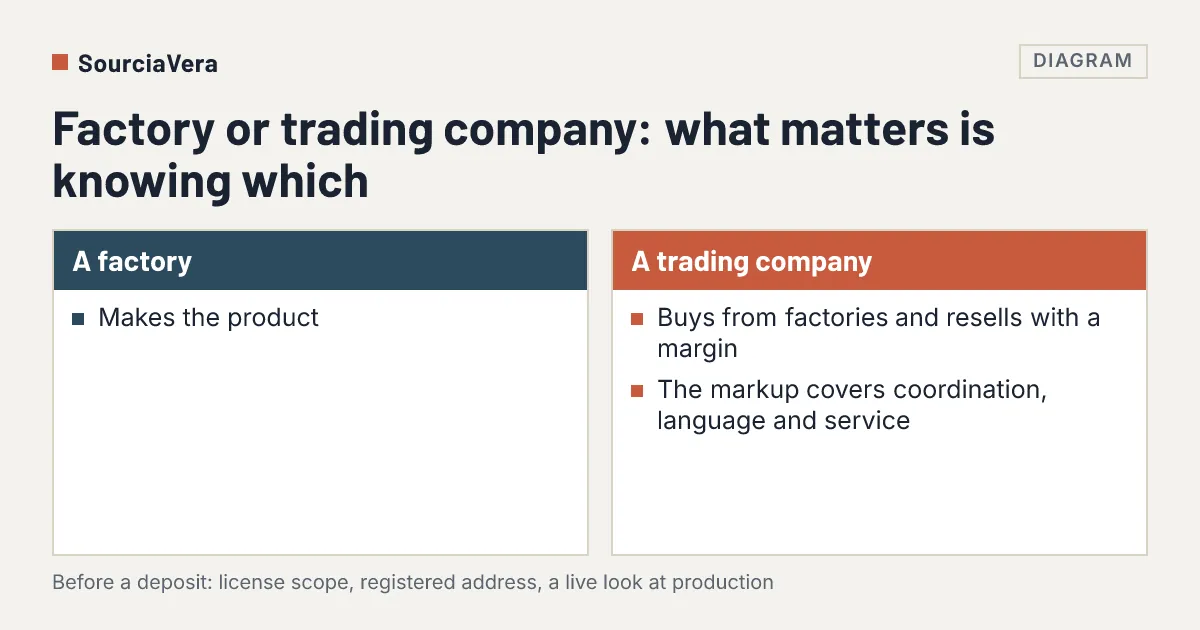
The short answer: a factory makes the product; a trading company buys it from factories and resells it with a margin; how much varies by product and supplier. Either can be a good partner. What matters is confirming which one you're dealing with (business license scope, registered address, a live look at production) before you pay a deposit.
SourciaVera is a factory verification and sourcing service in China, with a team in Guangzhou, that helps importers in Mexico and Latin America verify suppliers, inspect factories and buy from China with less risk.
Why Does Knowing Which One You Are Paying Matter?
A factory controls production and quality, while a trading company adds a margin to cover its coordination and relies on factories it does not own. Either can be a good partner. The harm comes from paying for one while believing you are buying from the other: you negotiate on the wrong basis, expect control that does not exist, and ask the wrong party to fix problems.
What Is the Difference Between a Trading Company and a Factory?
A factory manufactures the product. A trading company buys from factories and resells to buyers, typically with a markup that covers their coordination, language, and service overhead. Some trading companies represent a dozen factories across unrelated categories; others specialize tightly in one product area and build deep relationships with a handful of reliable manufacturers.
In Chinese: 工厂 (gōngchǎng) = factory. 贸易公司 (màoyì gōngsī) = trading company. Some suppliers list as factories when they're actually traders. Alibaba says its Verified Supplier audits record whether a company is a trading company, a manufacturer or both, but it also says it doesn't guarantee the accuracy of that information (Alibaba's Verified Supplier page), so check the business license yourself.
In Mexico the same thing goes by three names: comercializadora, “trading company” and intermediario. On an Alibaba listing it appears as “Manufacturer” or “Trading Company”, and for suppliers without Verified Supplier status the supplier declares it itself. Geography helps: Yiwu is best known as a wholesale market for small commodities, where many sellers are trading companies; furniture, ceramics and aluminum-profile factories tend to cluster in the industrial parks of Foshan, and electronics and hardware factories in Dongguan and Shenzhen. A “factory” whose address is an office tower in downtown Guangzhou deserves a second look.
Does Alibaba's Verified Supplier Badge Prove It's a Factory?
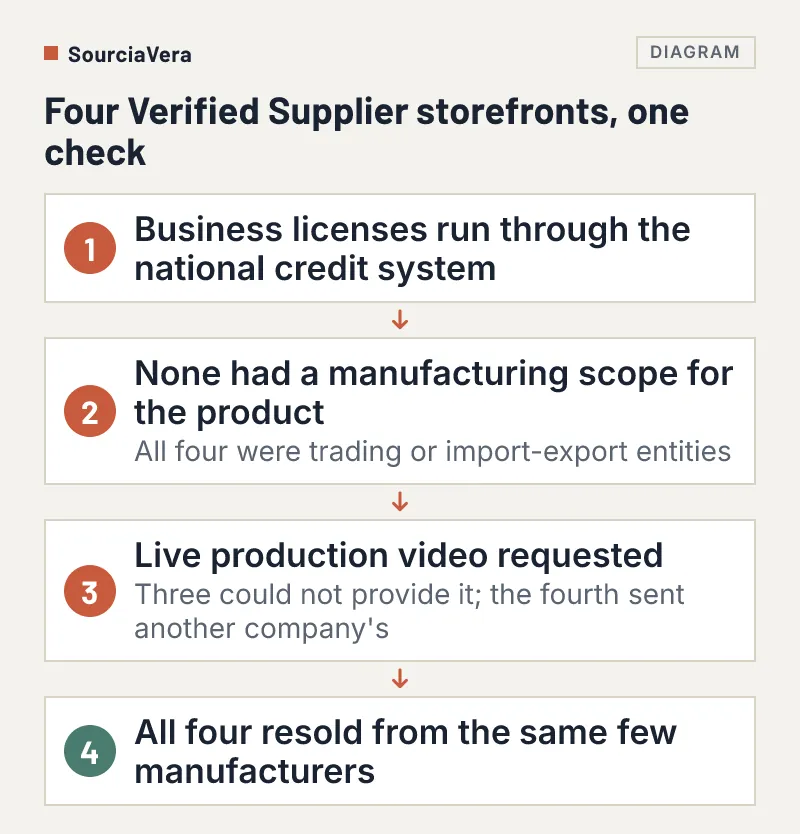
The problem: a client came to us with a shortlist of four Alibaba suppliers, all offering 50% hydrogen peroxide, all with the "Verified Supplier" badge, all claiming in-house manufacturing. Similar prices, similar photos. The client was preparing a 30% deposit to one of them.
What we checked: our team ran each business license through China's National Enterprise Credit Information Publicity System, then asked every supplier for live production video.
The outcome: none of the four had a manufacturing scope covering hydrogen peroxide. All four were registered as trading or import-export entities. When we asked for live production video, three couldn't provide it, and the fourth sent an old promotional video that belonged to a different company. All four storefronts were reselling from the same handful of real manufacturers.
The takeaway: the problem wasn't that they were traders. It was that the client thought they were comparing four factories, not four markups on one supply.
Why Do Trading Companies Pose as Factories?
Trading companies often present themselves as factories because buyers see direct factory relationships as preferable. I understand the motivation, but it creates an information gap that hurts you the moment something goes wrong. When there's a quality issue, a delay, or a spec mismatch, you can't see whether the problem started at the manufacturer or in the trader's own instructions to them.
You're also negotiating blind on price, and your "supplier's" ability to fix a problem depends on how much control they have over production, which for a trader may be very little.
When Is a Trading Company the Right Choice?
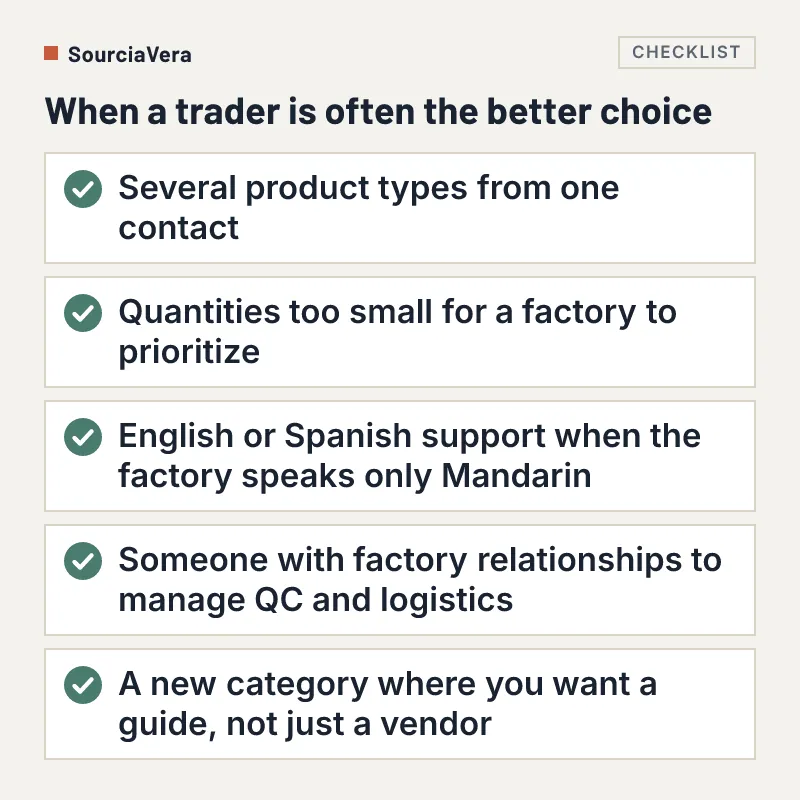
In my experience, a trader is often the better choice when:
- You need multiple product types from a single point of contact
- Your order quantities are too small for a factory to prioritize
- You need English or Spanish support and the factory only speaks Mandarin
- You want someone with existing factory relationships to manage QC and logistics
- You're entering a new product category and want a guide, not just a vendor
A good trading company has product knowledge, verified factory relationships, and the accountability to act as your agent in China.
When Does Buying From a Trader Go Wrong?
Scenarios that go wrong tend to look like this:
- You're told you're buying direct-from-factory but you're not, so the price premium isn't earning you anything
- A quality issue arises, the trader blames the factory, the factory blames the trader's specs, and you're stuck in the middle with no recourse
- The trader doesn't really know your product; they just resell it from whoever quotes lowest that quarter
- The MOQ they give you doesn't match reality, because they need enough volume to make their own batch viable with the factory
- You can't change the specification, because you have no direct access to the manufacturer
How Can You Tell If a Supplier Is a Factory or a Trader?
No single check settles it. Our team uses these together on every supplier:
- Request the business registration (营业执照): factory licenses list "manufacturing" as business scope; trader registrations list "trading" or "consulting". It is a public document, and a legitimate supplier has no reason to refuse to share it
- Check the factory address on Baidu Maps / Amap: does it match an industrial park? A residential address or office building is not a factory
- Ask production-specific questions: a factory knows its machine specs, lead times by volume, and raw material sourcing; a trader has to "ask the factory". If you send a drawing with tolerances and the answer takes two days and comes back vague, someone is often just forwarding your message to somebody else
- Ask about a factory visit or a live video call: real factories say yes; traders often hedge, redirect, or say the manufacturer doesn't allow visitors
I explain the step-by-step process in how to tell if your supplier is a real factory or a trading company, and the full pre-payment list is in the due diligence checklist for Chinese manufacturers.
Should a Factory Cost Less Than a Trading Company?
Usually. Factory pricing is lower than trading company pricing for equivalent products, because the trader's margin covers their overhead and service; how much lower varies by product and supplier. That's a fair cost if you're getting real service in return: language support, QC coordination, logistics management.
The problem is paying trading-company prices while believing you're dealing with a factory. If it's a trader's service you're buying, decide whether the service is worth the premium. If you want factory-direct pricing, verify that it really is a factory.
Summary: Know Which One You Are Paying
The only way to know for certain is to see the facility. A verification visit can confirm within a few hours whether a company manufactures or resells, and show you its production capacity, equipment, and quality control. This matters most in construction materials, automotive parts, and industrial goods, where specs are tight and production substitution is common. A company that says it makes steel brackets may make every component, or may buy them from a sub-supplier and assemble. Only a visit tells you which.
For importers in Mexico, Colombia or anywhere else in Latin America, flying to Guangzhou for every new supplier is not realistic. Our team is here: we visit, verify and report to you in English or Spanish, so you do not have to choose between trusting blindly and not importing. What it costs is explained in what it costs to verify a factory in China.
After many of these visits, my own and our team's in Guangzhou, my view is simple: I don't mind a trader, and I don't automatically trust a factory. What I care about is that the buyer knows which one they're paying, and why.
In short, a trading company is not the problem; not knowing is. If you pay a deposit without confirming who is behind the quote, the usual consequences are a margin you did not expect and quality problems nobody on your side can act on directly. An on-site verification by our team answers the question within hours, and a $49 remote check is a lighter first step if you only need the registration and the address.
I provide supplier verification services, so you should treat my recommendation accordingly.