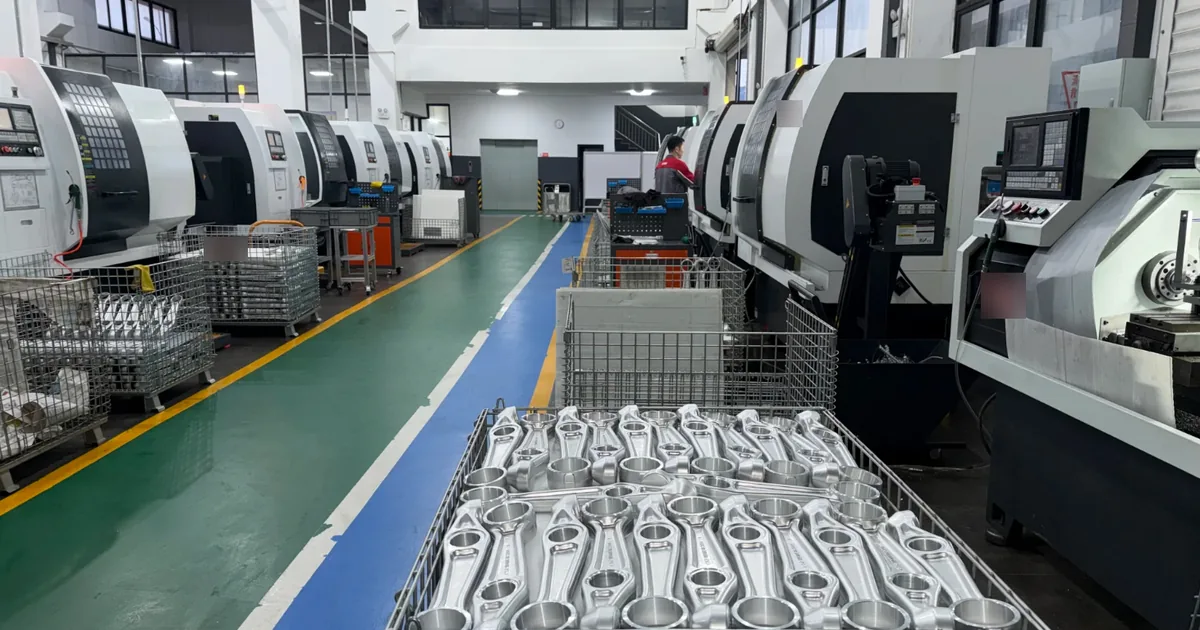
The short answer: you can't tell from what a supplier says, only from what it can prove. Check the company name on the business license, the breadth of the catalog, the registered address, and whether they'll show your product's line on a live video call. When three or four of these clues point the same way, they're rarely wrong.
Most buyers try to find out whether a supplier is a factory by asking, "Are you a factory?" I think that's the least useful question you can ask. Everyone says yes. Trading companies use professional photos taken at real factories, quote prices that look competitive, and describe "our production line" with total confidence. Their margin still comes out of your pocket.
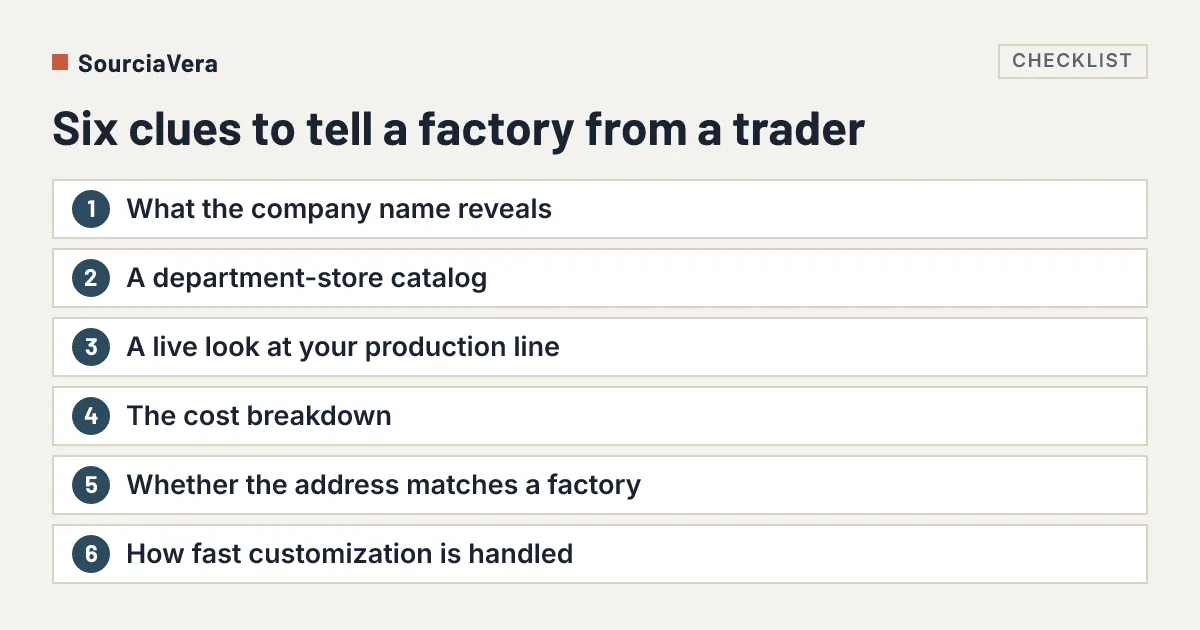
My view: stop asking what they are, and start testing what they can do. A factory can prove things a trader can't. The six clues below are the ones I rely on before I ever get in the car to visit.
Why Does It Matter Whether Your Supplier Is a Factory?
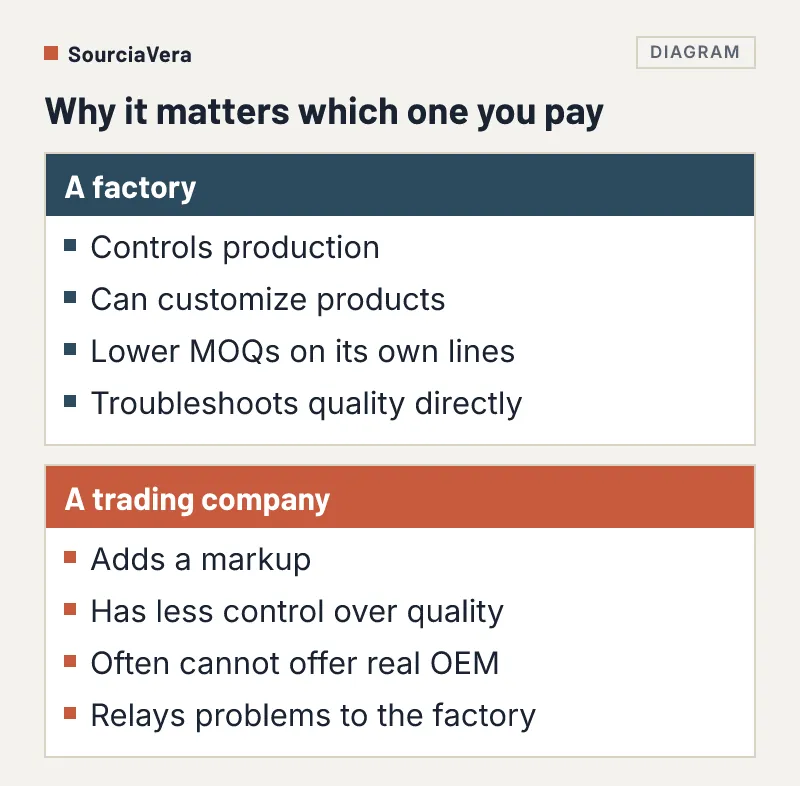
Factories control production, can customize products, offer lower MOQs on their own lines, and can troubleshoot quality problems directly. Trading companies add a markup, have less control over quality, and often can't offer real OEM options. Knowing which you're dealing with changes your negotiation strategy entirely.
When an order goes wrong (a defect, a delay, a spec mismatch), a factory can act on it immediately. A trading company has to relay the problem through its own relationship with the factory. That adds time, miscommunication risk, and often less urgency, because the financial pain is on your side, not theirs.
What Happens When One of Six Quotes Is Far Cheaper?
The problem: a buyer in Guatemala wanted two expandable container homes. He already had one quote and asked for more options to compare.
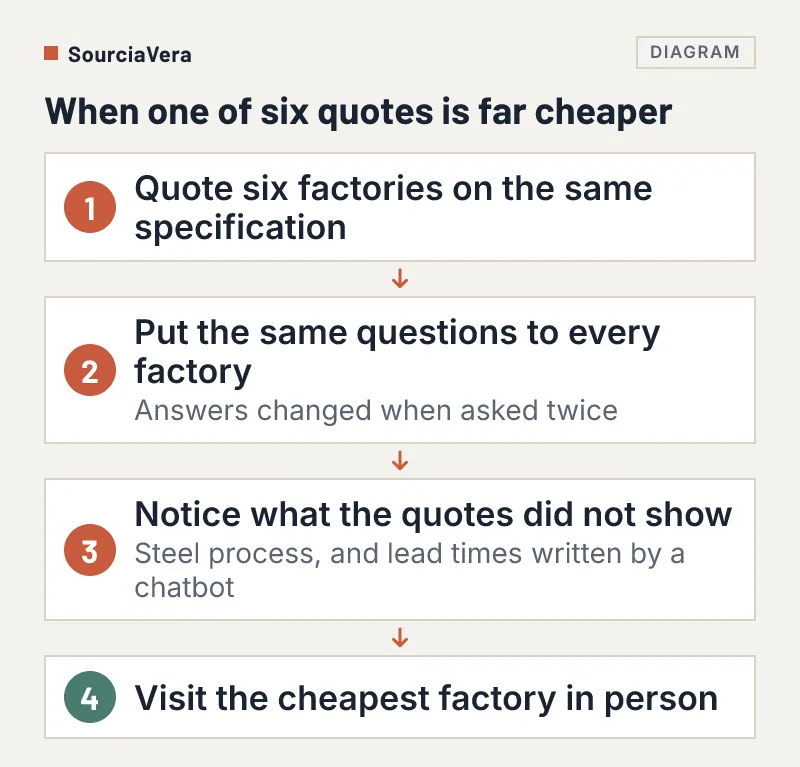
What we checked: we quoted six factories on the same specification. One came in significantly cheaper than his original quote, even fully upgraded. A gap that large can mean efficiency, thinner steel, or a trading company reselling someone else's production, so we put the same specific questions to every factory instead of trusting the price.
The outcome: the answers changed when we asked twice, and at least two factories had given lead times that turned out to be written by an AI chatbot, not by anyone in production. The cheaper factory first said its steel was cold-galvanized; pressed further, the load-bearing chassis was hot-dip and the thinner frames cold-galvanized, a real process limit rather than a shortcut. We then visited the factory in person (full case).
The takeaway: none of that was visible in the quotes. It came out only when the same questions were put to every candidate and the cheapest one was visited. Here are the clues worth checking:
| Clue | Real Factory | Trading Company |
|---|---|---|
| Company name | Contains 制造 (manufacturing), 实业 (industry), or 科技 (technology) | Contains 贸易 (trade) or 商贸 (commercial trade) |
| Product range | Narrow and deep — one product category they've built molds and machines for | Broad and shallow — unrelated categories in the same storefront |
| Live factory tour | Says yes, schedules a specific time, shows raw materials and QC area | "Our factory partner doesn't allow visits," or sends a generic video |
| Cost breakdown | Gives real numbers for material, labor, and margin | Vague round numbers — they only know the wholesale price they pay |
| Registered address | Matches an industrial compound with loading docks, visible on satellite view | A shared office building in a commercial center |
| Customization requests | Responds within hours because they own the machines | Goes silent for days while they relay the request to their own supplier |
Clue 1 — What Does the Company Name Reveal?
Chinese company names reveal a lot. A name containing 贸易 (màoyì = trade) or 商贸 (shāngmào = commercial trade) is almost certainly a trading company. A name with 制造 (zhìzào = manufacturing), 实业 (shíyè = industry), or 科技 (kējì = technology) plus a factory product category is more likely a manufacturer.
It isn't definitive, but it's a fast first filter. Ask for the business license, read the company name carefully, and verify the full name on China's company registration system at gsxt.gov.cn.
Clue 2 — Does the Catalog Look Like a Department Store?
A real LED headlight factory makes LED headlights, maybe a few closely related products, and that's it. If an Alibaba supplier sells LED lights, car seats, steering wheel covers, and phone holders, it is almost certainly a trader buying from several factories and reselling to you.
Genuine manufacturers have deep but narrow ranges, because they've invested in machines, molds, and know-how for one category. If the catalog looks like a department store, it's a trader's catalog.
Clue 3 — Will They Show Your Production Line Live?
Ask directly: "Can I see the production line for my specific product on a live video call?" A factory says yes and schedules it. A trader says "our factory partner doesn't allow visits" or sends a generic video that doesn't show your product being made.
Then push further: ask to see raw materials arriving, the intermediate assembly stages, and the quality control area. A factory has all of these and can walk you through them. A trader has none of them and will deflect.
Clue 4 — What Do the Price Quotes Tell You?
Traders often quote a price close to, or slightly above, a factory's price, because they need a margin but also need to look competitive. If one of three quotes is notably lower, that supplier might actually be the factory. If one sits oddly in between, it may be a trader undercutting another trader. And, as the expandable-home case showed, a quote far below everyone else is a reason to look closer before you call it a bargain.
Ask for a breakdown: raw material, labor, packaging, and factory margin. A factory answers with real numbers. A trader gives vague round numbers, because they only know the wholesale price they pay.
Clue 5 — Does the Registered Address Match a Factory?
The "registered address" on the business license should match a physical factory, not a shared office building in the commercial center of Shenzhen or Shanghai. Look it up on Google Maps Street View: factory compound or office park?
Industrial zones in Guangdong typically have compound walls, loading docks, and row buildings with skylights. Office parks have lobbies, parking lots, and floor directories. The difference is usually visible from satellite view.
Clue 6 — How Fast Can They Handle Customization?
Real factories can adjust molds, packaging, colors, and labeling because they own the machines. Traders have to ask their factory partner, which takes time, introduces errors, and limits your options. If a supplier says "all customization is possible" but goes silent for three days every time you ask for a sample adjustment, they're not in control of production.
Test this early with a small, specific request: a logo on the packaging, a color variant, a dimension change. Time how long a real answer takes. A factory responds within hours. A trader disappears to negotiate with its supplier.
Summary: Test What They Can Do, Then Decide
Short of visiting in person, the most reliable method is a third-party factory audit: someone goes to the address, confirms the production equipment exists, checks the business license, and confirms the supplier makes what it claims. Some auditors charge $200–$400 per factory visit, and our own standard rate is $499 per man-day: small next to a container of goods worth tens of thousands of dollars ordered from the wrong type of supplier.
What I've learned, on my own visits and from what our team sees on the ground, is that no single clue is proof. A trader can have a factory-sounding name; a factory can be slow to reply. But when three or four clues point the same way, they're rarely wrong. Compare suppliers side by side, test instead of asking, and let the evidence decide.
Back to the short answer: you cannot tell from what a supplier says, only from what it can prove. If you place the order without testing the clues, you may pay a middleman's margin and find out only when a defect or a delay has to be relayed through a third party. Testing costs little by comparison: a $49 remote check covers the registration and the registered address, and an on-site verification by our team shows whether your product's line really exists.
I provide supplier verification services, so you should treat my recommendation accordingly.