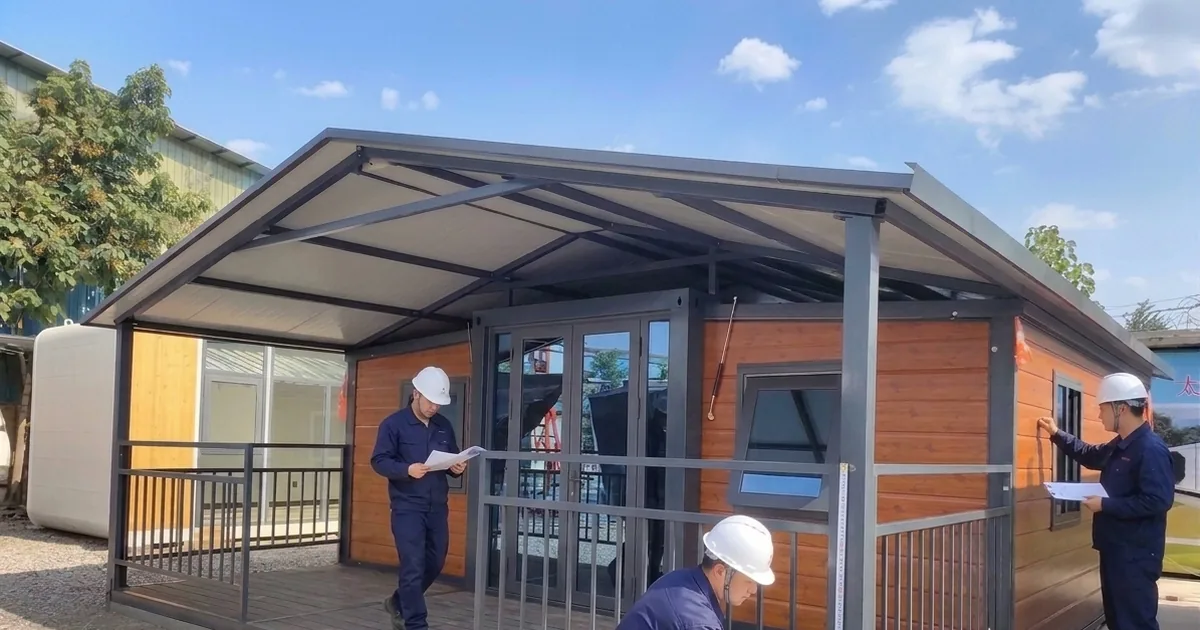
A real sourcing case, shared with names and prices removed.
In short: a buyer in Guatemala wanted two 20ft expandable homes as a first, test order for resale. What shaped the order was the climate (electrical standard, insulation, roof), one hard limit (a single shipping container) and a factory quote far below the others, which we checked before trusting it. The practical lessons are at the end.
Most of what we publish here answers a question: how to verify a supplier, what to check before paying a deposit, how to tell a factory from a trading company. This one is different. It's the story of one client, two expandable container homes, and two very different ways of thinking that met somewhere between Guangzhou and Guatemala.
I'm sharing it because the technical lessons are useful, but also because the human part taught me more.
The First Message
The client reached us through ChatGPT. He told me this later, and laughed about it.
His first message was short and clear. He already had one quote from a Chinese manufacturer, but he wanted three or four options to compare. The first order would be two 20ft expandable homes, for resale in Guatemala. This first order was a test: of the product quality, and of the Guatemalan market. If it went well, much larger orders would follow.
How I read it, as a Chinese sourcing person: two units is a small order, so the factory won't fight hard for it. The risk is that he compares three quotes that look similar but describe completely different products. My first job was to make sure every quote described the same house.
How he was thinking: these two homes would be the first thing his customers in Guatemala would see. He wasn't buying two houses. He was buying a reputation for whatever he sold next.
I only fully understood that second part later.
Climate First, Catalog Second
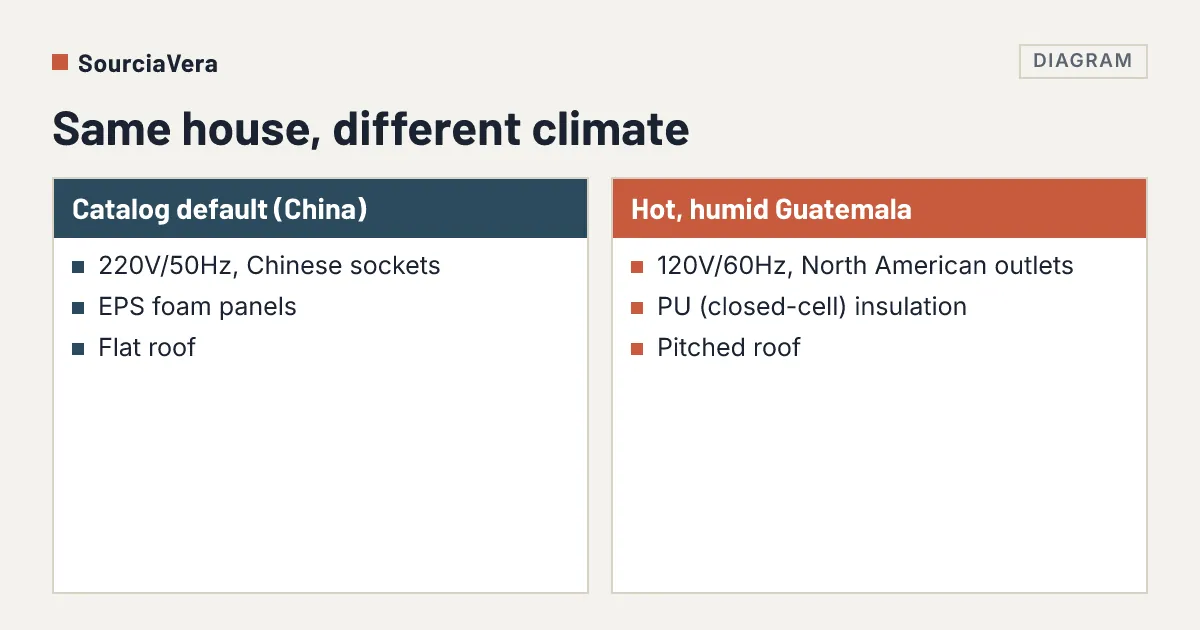
Chinese factories quote from a catalog. The default configuration is built for the Chinese domestic market: 220V/50Hz electrical, Chinese sockets, EPS foam panels, flat roof.
He told me the homes would be installed in a hot, humid climate. That one sentence changed almost everything:
- Electrical: Guatemala runs 120V/60Hz with North American-style outlets. A house wired to Chinese standard would need rewiring on arrival. This was the cheapest upgrade on the list and the most important.
- Insulation: EPS foam is the standard panel core. PU (polyurethane) has roughly 40% lower thermal conductivity (around 0.022 vs 0.038 W/m·K) and, being closed-cell, handles humidity better. In a hot climate, that's the difference between a house that feels like a home and a house that feels like a metal box, and it shows up every month on the air-conditioning bill.
- Roof: a flat roof under tropical rain means water pooling and eventual leaks. A pitched roof sheds water and creates a ventilated air gap above the ceiling. It also simply looks more like a real house, which matters when you're selling it.
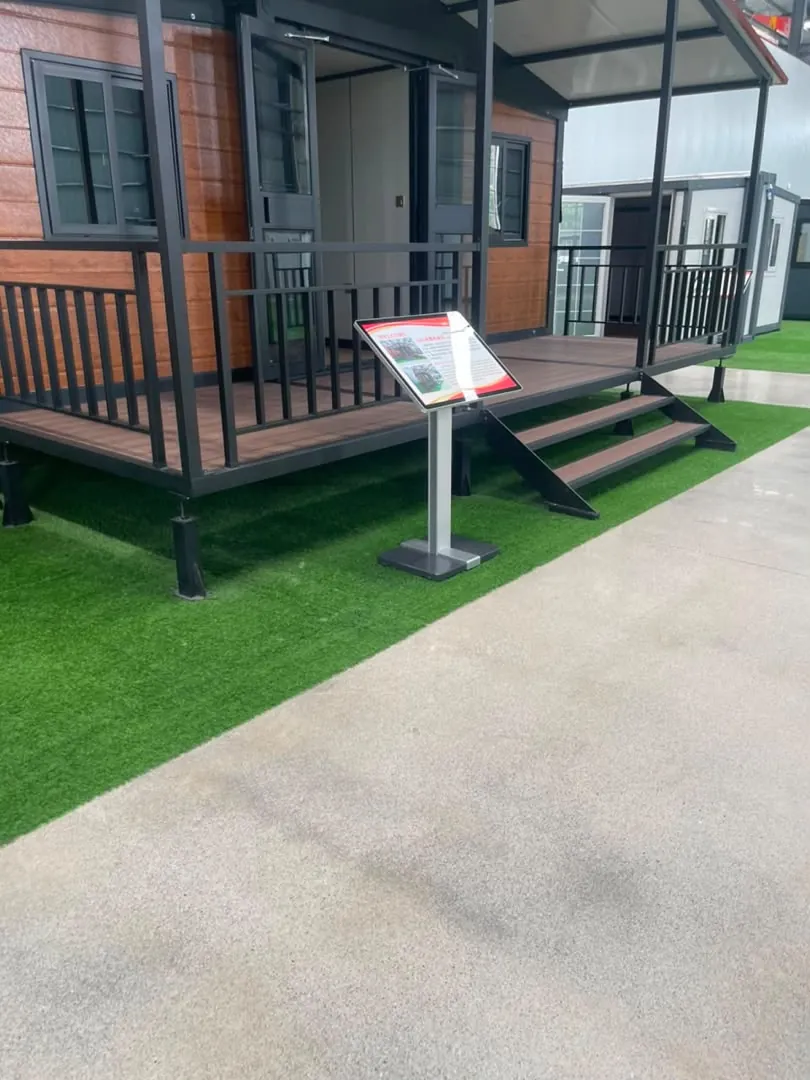
His reply is one I now quote to other clients: he wanted the upgrades that provide the greatest benefit without unnecessarily increasing the final price.
That's not a buyer looking for the cheapest option. That's a buyer looking for the smartest one. So we sorted every upgrade into "do it," "your call," and "skip": thermal-break windows and a decorative terrace went into "skip."
One more thing I flagged early: in Guatemala, import duty and the 12% IVA are calculated on the CIF value. So every upgrade costs noticeably more once it lands than its factory price suggests. An upgrade isn't priced at face value.
The Dealbreaker Was a Container, Not a Price
Early on, he drew one hard line: if the two homes with the upgrades needed two shipping containers, the answer was no.
He was right. Freight was already a large share of his landed cost (our FCL vs LCL vs air comparison shows how the options differ). A second container would cost more than all the upgrades combined.
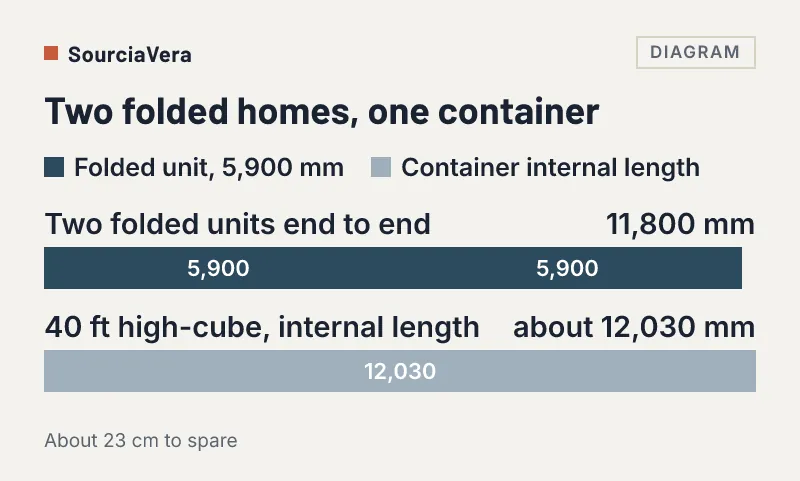
So we did the math. Two folded 20ft units are each about 5,900mm long. End to end, that's 11,800mm, inside a 40ft high-cube container with roughly 12,030mm of internal length. They fit with about 23 centimeters to spare.
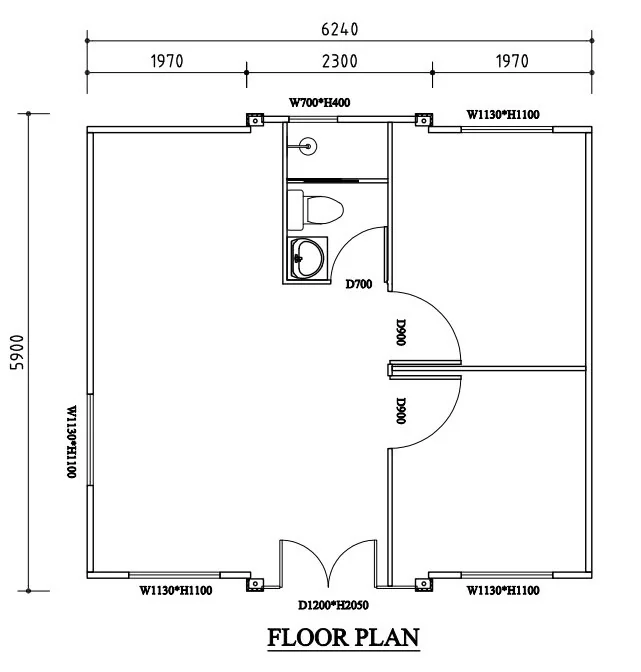
The question was whether the pitched roof parts would fit too. I refused to accept "yes" on the phone. We waited for loading photos from a previous shipment showing the roof components packed in the middle section between the folded units. Only then did I tell him it worked.
What I learned about his thinking: state the dealbreaker early, and the whole negotiation gets simpler. Many buyers only discover their real limits after the order is placed.
“Cheaper Usually Means Something”
After quoting six factories, I found one significantly cheaper than his original quote, even in the fully upgraded configuration.
This is the moment where a sourcing agent can make a mistake. A big saving makes the client happy and makes you look good. But I told him the truth: a gap that large is exactly the kind of gap that makes me want to see the factory with my own eyes. Cheaper can mean efficiency. It can also mean thinner steel, or a trading company reselling someone else's production.
I wrote to him: I'm not going to tell you this factory is safe based on a PDF.
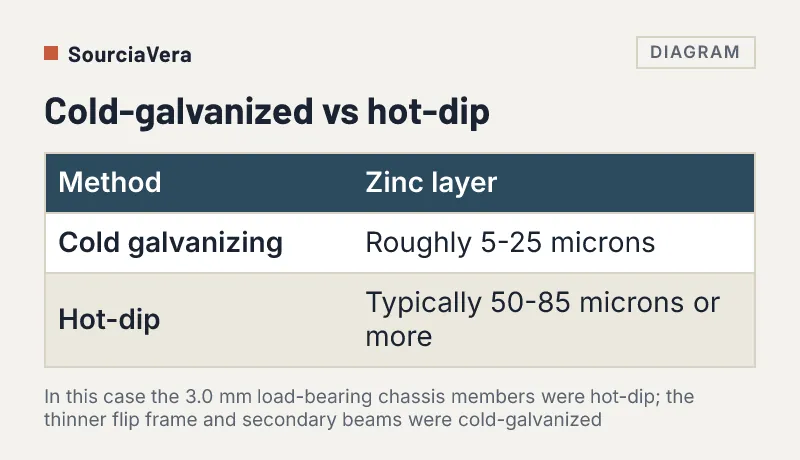
The questions that followed turned up something important. The factory first said the steel was cold-galvanized, not hot-dip. Cold galvanizing leaves a zinc layer of roughly 5–25 microns; hot-dip is typically 50–85 microns or more. In a humid climate, that matters.
When I pressed further, the real picture was more nuanced: the load-bearing chassis members (3.0mm steel) were hot-dip galvanized. The thinner flip frame and secondary beams were cold-galvanized, because thin-wall sections warp in a 450°C hot-dip bath. That's a genuine process limitation, not a shortcut, but it's also something a buyer in a coastal climate deserves to know before paying.
One more detail from this stage: when I asked factories the same question twice, the answers often changed. At least two of them had given me lead times that turned out to be generated by an AI chatbot, not by anyone in production. So my rule is simple: the first answer is a starting point, not a fact.
His Team Sent Me a Better Checklist Than Mine
A few days later he sent a document his team had prepared: a 16-point scope for a preliminary factory audit. Legal identity, production lines, PU panel batch traceability, electrical and plumbing verification for Guatemalan standards, water-spray tests, loading evidence, a full written technical specification. (Our own supplier verification checklist covers the general version.)
I told him honestly: I think you just did my job for me. It was more thorough than our standard verification, and it would take nearly two days on-site.
His response is the part I admire most. He didn't argue about price. He picked the eight points that mattered most at this preliminary stage, suggested the factory prepare documents, panel samples and a comparable unit in advance, and asked whether it could be done in one day at a fixed price.
That's a very structured way of buying. It's also very different from how many first-time importers work, sending one vague message and hoping for the best. It is the same idea as matching the checks to the order.
One requirement on his list would never have occurred to a Chinese factory: no glass entrance doors, because of security concerns in Guatemala. Chinese expandable homes often ship with an aluminum-and-glass double door as standard. In his market, that's not a feature. It's a risk. The factory had two solid aluminum options, and he chose from the videos.
The Factory Day
The factory turned out to be a production park so large you take a shuttle bus from the gate to the production lines. He saw that in the first video and wrote back: it looked gigantic.
Because of the 14-hour time difference, I was walking the factory in the middle of his night. I sent photos and videos as I went and called him so he could see it live. I filmed more than the exact unit we were quoting, on purpose: if he ever wants to customize something else with this factory, he already knows what they can build.
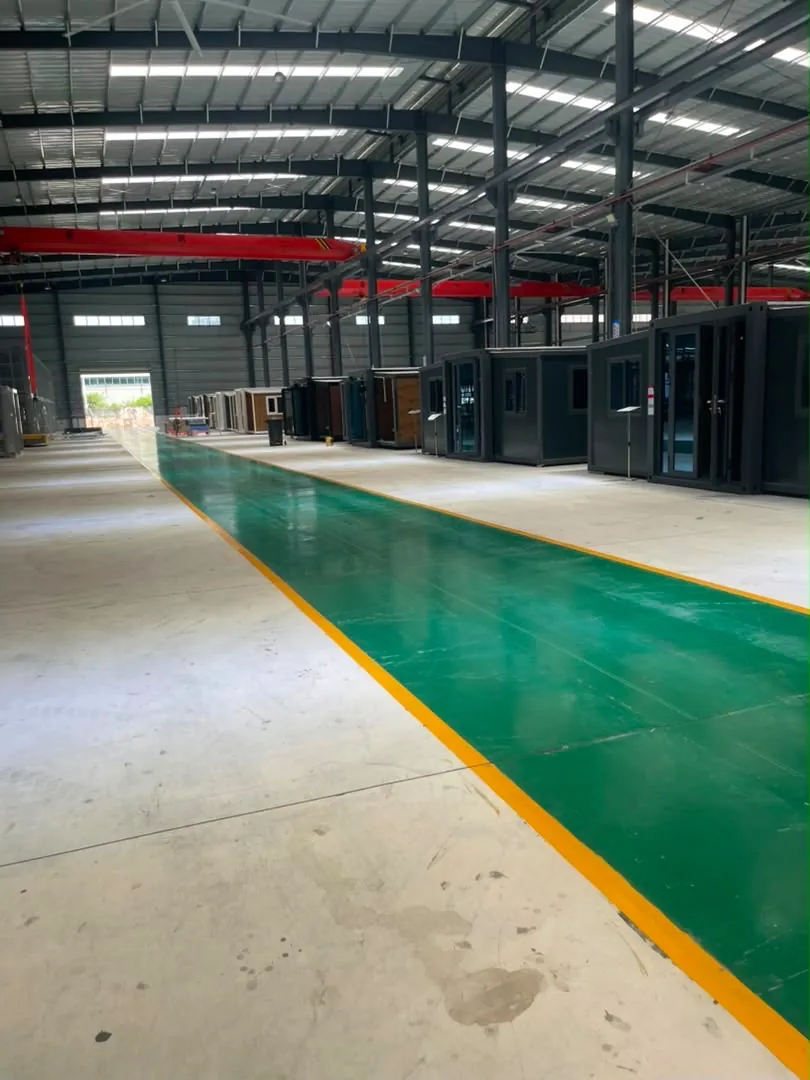
Not everything went to plan. The factory couldn't demonstrate the folding mechanism live that day because no unassembled unit was available. I told him before the visit, not after, and offered alternatives: a recorded demonstration, plus a static inspection of the hinges and rails. He agreed, and asked for one more thing: close-up videos of the outlets and switches. That's someone who knows what will actually be checked when the house arrives.
The Small Things in Between
Some of my favorite moments in this project had nothing to do with steel.
When he told me he found us through ChatGPT, I confessed that I write my messages in Chinese and use AI to polish my English. His answer: you do a good job. We agreed we're both people who use AI to solve problems, and moved on.
When his card wouldn't work with an international payment, I told him that international banking is sometimes more complicated than assembling a container house. He went to his bank the next day and sorted it out.
When he got sick in the middle of the project, I told him the houses could wait. Health first. I meant it.
What I Learned About How We Think Differently
The Chinese side of this, which is me: we move fast. Factories answer WeChat at 10pm. If something is unclear, we ask again, right away. We think in specifications, dimensions and process. We assume that a quick reply is a sign of respect.
The Guatemalan side, which is him: decisions are made with partners, not alone. Relationships come before transactions. Security is a design requirement, not an afterthought. Every dollar should have a reason. And a slow reply doesn't mean a lack of interest. It means life is happening.
Both ways of thinking were necessary. Without his clarity on dealbreakers and priorities, I would have optimized the wrong things. Without the on-the-ground checking, he would have been choosing between PDFs.
Practical Lessons for Any Buyer Importing From China
- Tell your supplier the climate, not just the size. Insulation, steel treatment and roofing all depend on it.
- Check the electrical standard first. Rewiring a house on arrival costs far more than ordering it correctly.
- State your dealbreaker early. Ours was one container. Yours might be lead time, door type or certification.
- Ask whether your quote is the public list price. Ours was, exactly. That usually means there's room.
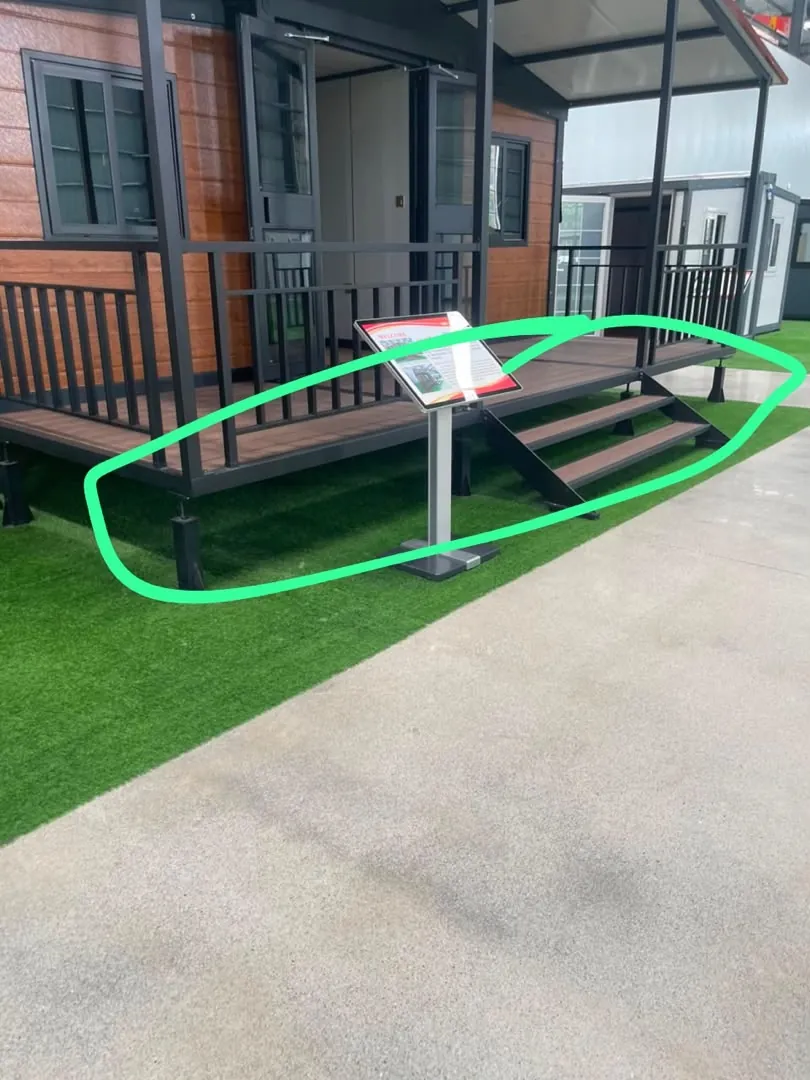
- Confirm what is and isn't included. The pitched roof included the canopy and posts, but not the terrace or the entry steps. These details are easy to assume and expensive to discover.
- Ask how the steel is galvanized, and which parts. "Galvanized" alone tells you very little.
- Don't accept the first answer. Ask twice. Ask for photos of a previous shipment, and remember that a showroom unit shows what a factory can build once, not what your order will look like (Sample Looks Great, Bulk Order Is Garbage).
A note on the figures: the thermal conductivity of PU and EPS, the zinc-layer ranges for cold and hot-dip galvanizing, and the internal length of a 40ft high-cube container are general industry reference values, not measurements of this factory's products. The panel and steel specifications (such as the 3.0mm chassis steel), which parts are hot-dip or cold-galvanized, and the folded dimensions were supplied by the factory; they are not my own measurements or lab results. Ask your own supplier for test reports and the written specification, and read 10 things to check before paying a Chinese supplier deposit before any money moves.
Where Things Stand
At the time of writing, he's reviewing the drawings, videos and quotes with his partners. He said the drawings were perfect and the videos would help them a lot. When they decide, we'll do the final inspection before loading, as his own checklist already planned.
Frequently Asked Questions
What voltage do expandable homes need for Guatemala?
Guatemala runs 120V/60Hz with North American-style outlets. A catalog house from a Chinese factory is usually built for the Chinese domestic market: 220V/50Hz and Chinese sockets. Specify the electrical standard before you order, because rewiring a house on arrival costs far more than ordering it correctly.
Is PU or EPS better insulation for an expandable home in a hot, humid climate?
PU (polyurethane) is the upgrade worth asking about. It has roughly 40% lower thermal conductivity than EPS foam (around 0.022 vs 0.038 W/m·K) and, being closed-cell, handles humidity better. In a hot climate that shows up every month on the air-conditioning bill. The conductivity figures are general industry reference values, not measurements of one factory's panels, so ask which core the factory uses and for its test reports and batch records.
Can two 20ft expandable homes fit in one 40HQ container?
In this case, yes, with a small margin. Two folded 20ft units are each about 5,900mm long, so end to end they take 11,800mm of the roughly 12,030mm internal length of a 40ft high-cube container, leaving about 23 centimeters. The extra parts, such as pitched-roof components, also have to fit in the middle section between the folded units, and we confirmed that from loading photos of a previous shipment before telling the client it worked. The folded length is the factory's figure and the internal length is a general reference value, so check both against the factory's drawings.
What is the difference between cold-galvanized and hot-dip galvanized steel?
Cold galvanizing leaves a zinc layer of roughly 5-25 microns; hot-dip is typically 50-85 microns or more, which matters in a humid climate. Thin-wall sections can warp in the 450°C hot-dip bath, so a factory may hot-dip the load-bearing members (here, the 3.0mm chassis) and cold-galvanize thinner parts. Ask which parts get which treatment, and ask for its coating test reports. The zinc-layer ranges are general reference values; the treatment of each part and the 3.0mm chassis steel are what this factory told us.
How do I decide what to check first when I can't audit everything?
Start from the full list and pick the points that matter most at the preliminary stage. In this case the buyer's team wrote a 16-point scope for a factory audit, then picked the eight most important points, asked the factory to prepare documents, panel samples and a comparable unit in advance, and asked whether it could be done in one day at a fixed price.
How are import duty and IVA calculated on upgrades when importing a container home to Guatemala?
In Guatemala, import duty and the 12% IVA are calculated on the CIF value, so every upgrade costs noticeably more once it lands than its factory price suggests. An upgrade isn't priced at face value.
One Last Confession
In Guangzhou, if a client hasn't replied in two hours, we start wondering whether we said something wrong. By the next morning, we've drafted three follow-up messages.
My client was on a business trip. Then busy with his other businesses. Then sick. Then waiting to meet his partners. Meanwhile, I was sitting in Guangzhou refreshing WhatsApp, doing what Chinese people do best: worrying efficiently.
I've learned that in Guatemala, silence is not a "no." It's just life moving at a human speed.
Still, amigo, if you're reading this: the factory is still asking whether you want the doors in white or the original color.

If you are planning a first order of expandable homes or other construction products from China and want someone on the ground to look at the factory before you pay, that is the work SourciaVera does, and we have a page for Guatemalan importers. I provide supplier verification services, so you should treat my recommendation accordingly.
To sum up the case: quotes only compare when they describe the same house, a hard limit such as a single shipping container can matter more than price, and a quote far below the others should be checked before it is trusted. Without those checks, a first test order can end with a product that does not fit the container, the climate or the budget, and a delay before the larger orders the buyer had in mind. Tell us what you are buying and where it ships, and we will say which checks matter most before you pay.