The short answer: you cannot remove the risk of buying from China, but you can shrink it by matching the checks to what a failed order would cost you. A small order can often stay on a platform's protected checkout, with a written specification and a sample. A large order, one that depends on an exact specification, or the start of a long relationship deserves a closer look at who the supplier really is, and at the factory or the goods, before the money that matters leaves your account.
You may already like a supplier and still feel uneasy about sending money to someone you cannot see. That is reasonable: from another country, much of what decides the outcome is hard to see, such as who is really behind the listing and whether you and the supplier mean the same thing by the specification. It does not mean China is a dangerous place to buy. It means you are deciding with incomplete information.
What Is Actually at Risk?
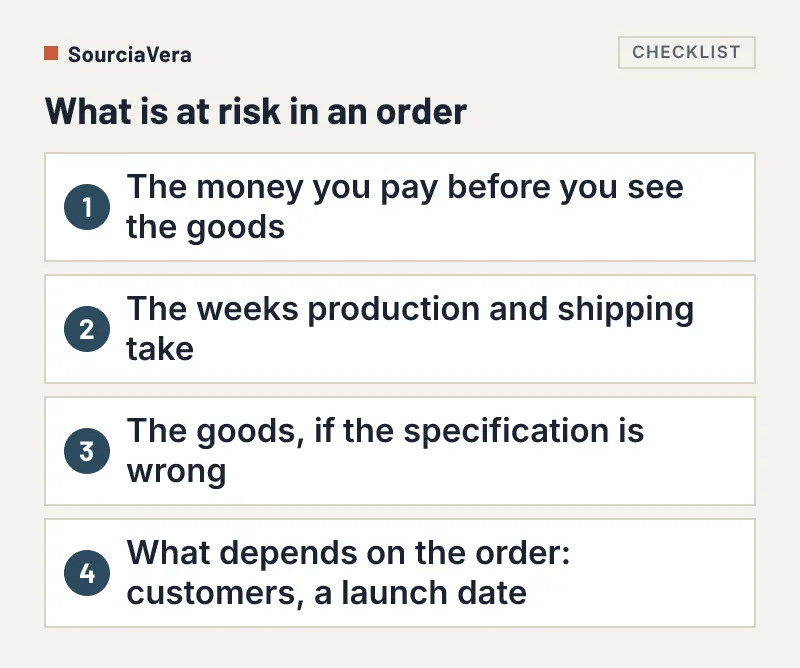
Four things: the money you pay before you see the goods, the weeks that production and shipping take, the goods themselves if the specification is wrong, and whatever depends on the order, such as your customers or a launch date. Write down what a failed order would cost you across all four. That number, not a rule from a blog, decides how much checking is worth paying for.
Where Can an Order Go Wrong, and What Is the First Check at Each Stage?
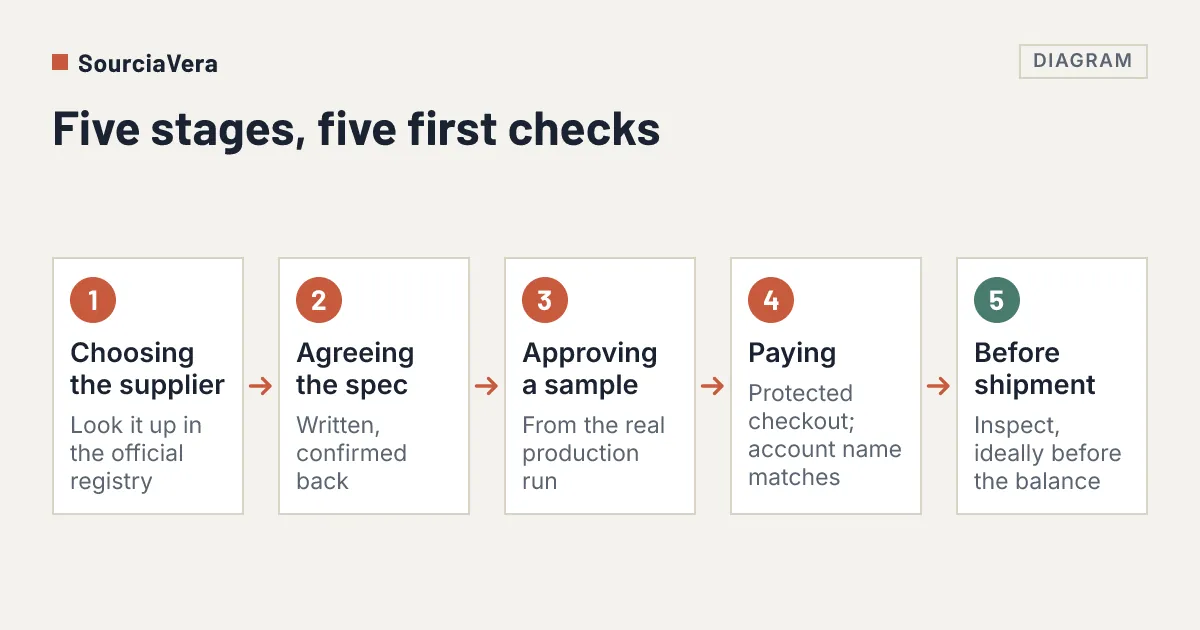
| Stage | What can go wrong | A check worth doing first | What it cannot tell you |
|---|---|---|---|
| 1. Choosing the supplier | The company is not what the listing suggests, such as a trading company presented as a factory. | Look the company up in China's official registry, compare its name and business scope with the listing, and ask who makes the product (stages 1 and 2 of the China Supplier Verification Checklist). | Whether the factory is good at your product. |
| 2. Agreeing the specification | You and the supplier mean different things by the same words, numbers or units. | A written specification the supplier confirms back, with the unit and MOQ spelled out (see "set" versus "piece"). | Whether production will follow it. |
| 3. Approving a sample | The sample is not what the production run will look like. | A sample from the real production run and a check partway through production (see our sample guide). | What 1,000 pieces will look like: a sample shows that the factory could make it once. |
| 4. Paying | Money leaves before you have any leverage, or goes to an account that is not the supplier you checked. | A protected checkout where one exists, not everything up front, and a bank account name that matches the company you verified (10 things to check before paying a deposit). | Whether the goods match the order. |
| 5. Before shipment | The goods are not what was approved, and you find out after they arrive. | An inspection before shipment, ideally before the balance is paid (what an inspection costs). | What happens in transit and after delivery. |
Shipping and customs are a risk of their own and are not covered here; our guide to FCL, LCL and air freight compares the options.
What Do These Problems Look Like in Practice?
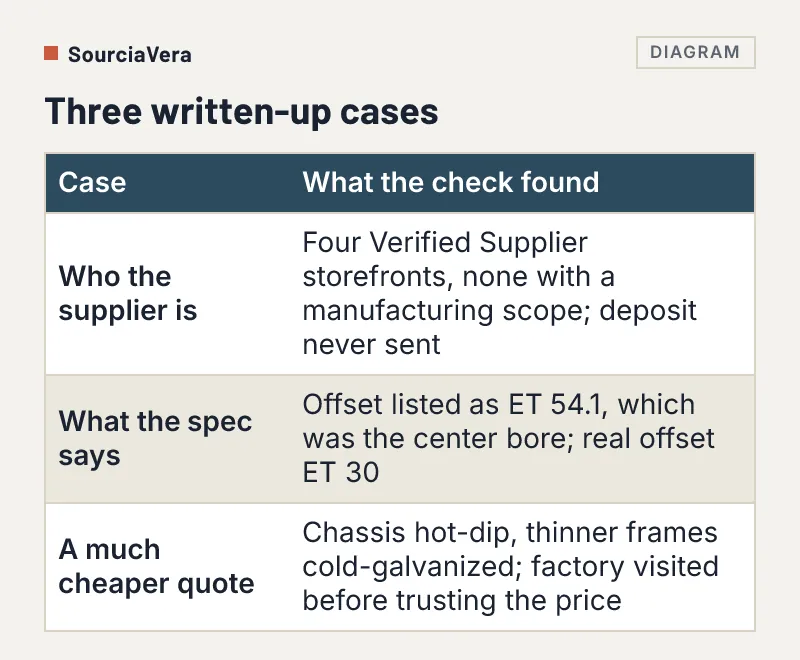
Three cases we have written up show how ordinary they are, and how little a badge or a photo tells you.
- Who the supplier is. A client came to us with four Alibaba suppliers of 50% hydrogen peroxide, all with the "Verified Supplier" badge and all claiming in-house manufacturing, and was preparing a 30% deposit to one of them. In China's company registry, none of the four had a manufacturing scope covering the chemical; all were trading or import-export entities reselling from the same few real factories. The deposit was never sent (full case: Trading Company vs Factory).
- What the specification says. For a Latin American client's spare-wheel kit, the supplier's first spec sheet listed the offset as ET 54.1, which is actually the center bore. We asked for a formal, stamped spec sheet, and the supplier corrected it to the real offset, ET 30 (full case).
- What a much cheaper quote leaves out. On a first order of two expandable homes for a Guatemalan buyer, one factory quoted well below the others. We asked how the steel was galvanized, found that the load-bearing chassis was hot-dip but the thinner frames were cold-galvanized, and visited the factory before trusting the price (full case).
Does a Platform's Buyer Protection Cover It?
Partly, and with conditions. Alibaba's Trade Assurance page (read on Oct 9, 2026) says it applies to online orders paid through Alibaba.com and can help, including with a refund, when quality or ship date differs from the online order. Refund requests must be made within 30 days of delivery, it relies on your order and your messages with the supplier, and you should inspect the goods as soon as they arrive. So agree the specification in writing inside the order, and look at the goods the day they arrive. A supplier who asks you to pay outside the platform is asking you to give up this protection, which deserves a direct question.
How Much Checking Does My Order Deserve?
What I would do. This is my own rule of thumb from our Alibaba trust guide, not a statistic, and I can be wrong about where the lines fall. For small orders under $2,000, the math often works: use Trade Assurance, stay on the platform, document the specification carefully and accept some quality risk. For orders over $5,000, recurring relationships, or products where the specification matters, I'd close the gap with a factory verification before committing. In between, the other two triggers are the ones to weigh: whether you will reorder, and how exact the specification has to be.
What I would not do is interrogate every supplier on every order. Spend the five minutes on the ones about to receive real money, before the money moves (the 7 questions to ask before you wire money are a start).
To apply the rule, add up what leaves your account before anyone has looked at the goods. Illustrative numbers, not a real order: on a $3,000 order with a 30% deposit and the balance paid before shipment, $900 is out when production starts and $3,000 when the goods ship; if the balance waits for an inspection, only the $900 is out before anyone has looked at the goods. Our wholesale guide lists 30% / 70% as a common structure for verified factories and 100% up front as high risk.
What Can You Not Reduce?
No list of checks guarantees a clean transaction, including ours. Checks before you pay reduce specific risks: who the supplier is, whether the factory is where it says it is, whether you agree on the specification, and whether the goods match it before they ship. They do not predict how a supplier will behave next year or remove delays, and a third-party check is one input to your decision, not a guarantee.
What Should You Do Next?
- Write down what a failed order would cost you.
- Pick your level with the rule of thumb above.
- Find out who you are buying from: the full Chinese company name as printed on the license, and whether it is a factory or a trading company (stages 1 and 2 of the China Supplier Verification Checklist). Still choosing between suppliers? Start with our guide to how many suppliers to contact and how to compare them.
- Put the specification in writing, have the supplier confirm it, and decide how you will check the production run, not only the sample.
- Pay in a way you can get help with: inside the platform's checkout if it has one, never everything up front, and only to the company you checked. On larger orders, have the goods inspected before you pay the balance.
Frequently Asked Questions
Is it safe to buy from China?
It depends on the supplier, the product and how much you check, and I cannot give you a safety rate without making one up. The problems described on this site, such as a trading company presented as a factory or a misread specification, are the kind that checks before payment are meant to catch.
Does Alibaba Trade Assurance remove the risk?
No. Alibaba says it applies to online orders paid through Alibaba.com, expects refund requests within 30 days of delivery and relies on your online order and messages, so the specification needs to be in writing inside the order.
Should I pay 100% up front to a Chinese supplier?
I would avoid it, because you have no leverage if the goods do not match the specification. Our wholesale guide lists 100% up front as high risk and a 30% deposit with 70% before shipment as a common structure for verified factories.
Do I need to visit the factory or pay for verification?
Not for every order. By my rule of thumb, orders under about $2,000 can stay on a protected platform checkout with a written specification. Above about $5,000, for repeat orders, or when the specification must be exact, I would have the factory checked before paying. I provide verification services, so weigh that accordingly.
Summary and Next Step
Reducing the risk of buying from China is less about finding a perfect supplier and more about knowing what you stand to lose and checking in proportion. You don't have to know everything about Chinese manufacturing to do that. You just need to know what you can't see from where you are, and decide which of those things are worth paying someone to look at.
In short, reduce risk by checking in proportion to what you stand to lose. If you check nothing on a large order, the realistic outcome is a first batch that does not match what you ordered, with cash tied up and the next order delayed. A $49 remote check fits a smaller order, and for larger ones our team can inspect and follow production through our procurement service.
If you would rather have someone on the ground check the supplier before the money moves, understanding who is behind each quote before investing money can reduce unnecessary risks. SourciaVera helps international buyers verify Chinese suppliers, understand manufacturing capabilities, and make safer sourcing decisions. I provide supplier verification services, so you should treat my recommendation accordingly. The $49 Remote Check looks at the basics — company registration, manufacturer vs. trader, address, and whether the payment account matches the company name — before you place an order.