Most buyers treat a good sample as proof that the order will be good. I think that's the single most expensive assumption in China sourcing. A sample proves that the factory can make your product once, by hand, when it knows you are watching. It says almost nothing about what 1,000 units off the line will look like.
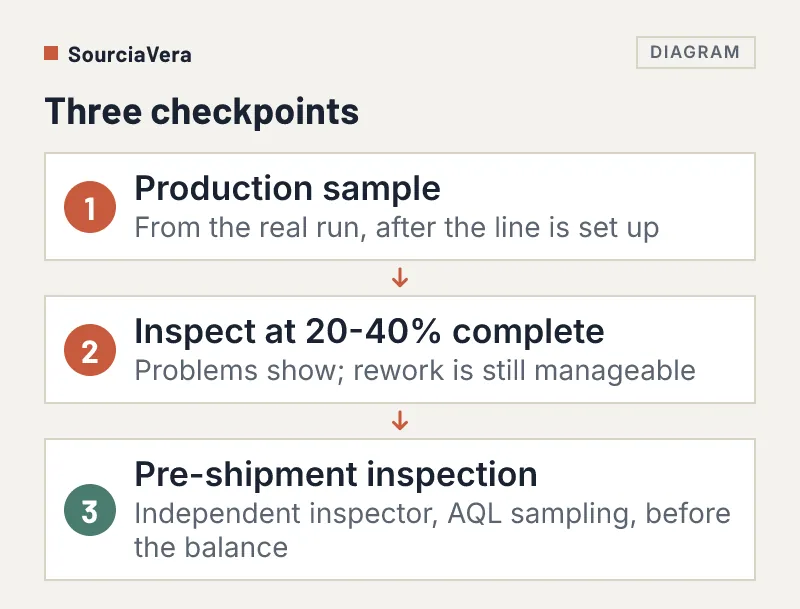
The short answer: bulk orders drift from the sample because samples are hand-built outside the production line, and nobody enforces the approved standard once mass production starts. You prevent it with three checkpoints — a production sample from the real run, an inspection at 20–40% completion, and an independent pre-shipment inspection before you pay the balance.
From what our team sees on the ground, the result of skipping those checkpoints is familiar: a beautiful sample, a large order, and a bulk shipment that arrives with the wrong color, different materials, poor assembly or missing features. The buyer is out $10,000 and has a warehouse full of product nobody can sell. In nearly every case, it was preventable.
Why Does the Bulk Order Look Different from the Sample?
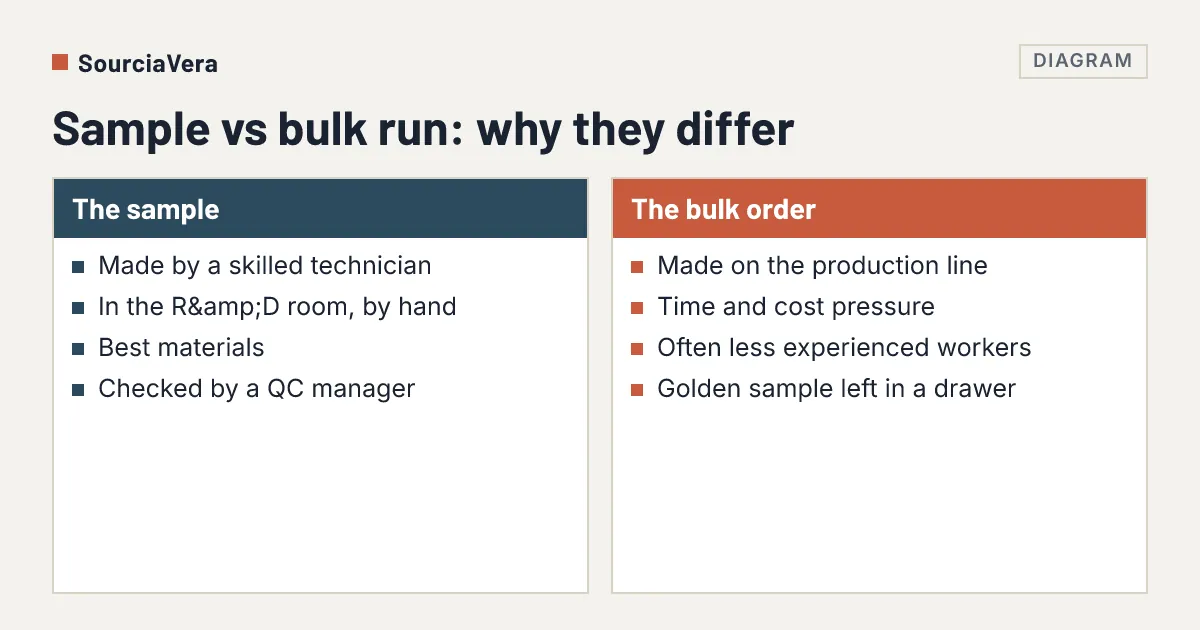
Samples are almost never made on the production line. Our team visits factories in person, and the founder still joins many of the visits. The pattern is a familiar one: samples are usually made by a skilled technician in the R&D room, with the best materials, assembled by hand, and often finished by a QC manager who knows the unit will be scrutinized. The production line runs under time and cost pressure, often with less experienced workers.
I don't think this is always deliberate fraud. Factories face genuine cost pressure and production constraints. But whether it's negligence or intentional corner-cutting, the buyer ends up in the same place: they paid for something they didn't get.
A Typical Case: The "Golden Sample" Left in a Drawer
The problem: a buyer and a supplier agree on a "golden sample" — the approved unit that defines what the bulk should look like. Then the golden sample goes into a drawer at the factory and is never seen again. The workers never get it. The production manager never references it.
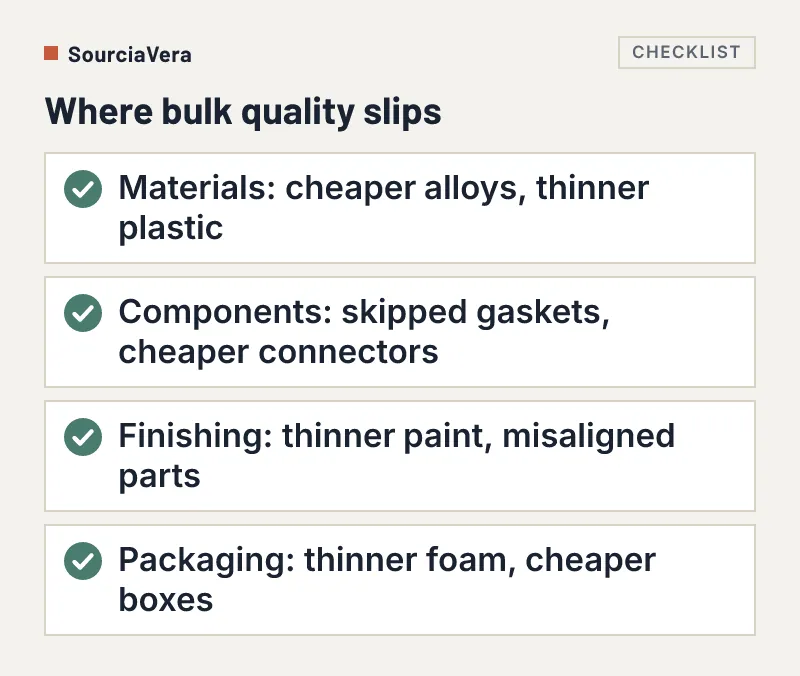
What gets checked: when our team compares finished units against the approved sample, the gaps are rarely dramatic on their own. Quality slips in small, cumulative ways:
- Material substitution: cheaper steel alloys, thinner plastic walls, lower-grade LEDs, recycled foam instead of virgin foam
- Component shortcuts: skipping internal gaskets, using cheaper connectors, reducing the number of fasteners
- Finishing quality: thinner paint coats, skipped quality checks, rushed assembly with misaligned parts
- Packaging downgrade: thinner foam inserts, cheaper corrugated boxes, missing inner packaging
The outcome: each change saves fractions of a cent per unit. At 1,000 units, they add up to a meaningfully different product — one that customers notice, return and leave bad reviews about.
The takeaway: a golden sample only works when someone enforces it at the production level — which means being there, or having an inspector there. A piece of paper saying "match this sample" doesn't make it happen.
How Do You Stop Sample-to-Bulk Quality Drift? Three Checkpoints
1. Ask for a production sample, not just a sample
Before approving bulk production, I ask for a "production sample" — a unit taken from the actual run after the line is set up, not the initial piece made by the R&D team. The production sample shows you what the batch really looks like under real conditions.
If it doesn't match the golden sample, stop production immediately. That is far cheaper than stopping a finished batch. Most factories will push back, citing schedule concerns — which is exactly why I insist on it for a first order with any new supplier.
2. Inspect during production
The point I like best for an inspection is when 20–40% of the order is complete. Enough units exist to reveal systematic problems, but not so many that rework becomes a disaster. Catching a material substitution or an assembly defect early can save the whole order.
A during-production inspection typically costs the same as a pre-shipment inspection ($399/man-day at SourciaVera). That is small next to a container of goods worth tens of thousands being rejected by your customer — and for quality-critical orders it delivers more value, because you can still change course.
3. Inspect before shipment
When 100% of the goods are ready, have an independent inspector — not the factory's own QC department — run a random sampling inspection using AQL standards: pulling random units from across the batch, measuring them, testing function and comparing them against your approved sample.
If the defect rate exceeds your threshold (typically AQL 2.5 for major defects), you can reject the shipment and require rework before you authorize the remaining balance. This is your last line of defense before the goods board a vessel.
Should the Approved Sample Be in Your Purchase Order?
Yes. Some experienced buyers add a clause like this to their purchase order: "If goods do not match the approved sample (Ref #[number]) in quality, specifications, and materials, buyer reserves the right to reject the shipment and request replacement or full refund." Then they ask the factory to sign the PO with that clause.
It creates a clear paper trail and a quality standard the factory has explicitly acknowledged. Enforcing it through Chinese courts is complex, but in my experience a signed document changes the tone of a negotiation when a dispute comes up — and often keeps the dispute from happening at all.
What If Your Bulk Order Already Arrived Different from the Sample?
- Photograph bulk units next to the golden sample so the differences are obvious, and compare measurements against your spec sheet.
- Contact the supplier in writing, citing specific defects with photos and referencing the purchase order specs.
- If you paid through Alibaba Trade Assurance, open a dispute on the platform.
- Keep every exchange in writing and don't agree to anything verbally.
Summary: Decide in Advance Where Someone Will Check Real Units
After enough factory visits, I stopped being surprised when bulk didn't match the sample. What surprises me now is how rarely anyone checks. The buyers who don't get burned aren't luckier or better negotiators — they simply decide in advance at which point someone will look at real production units, and they stick to it. The sample is where the conversation starts, not where the checking ends.
To sum up, a good sample proves the factory can make your product once, not that the bulk run will match it. If nobody checks production units, the realistic outcome is a bulk shipment with the wrong color, different materials or poor assembly, cash tied up in stock you cannot sell, and a delay to your next order. We can inspect at the factory and send unedited video before you pay the balance, per man-day or as part of our procurement service.
I provide supplier verification services, so you should treat my recommendation accordingly.