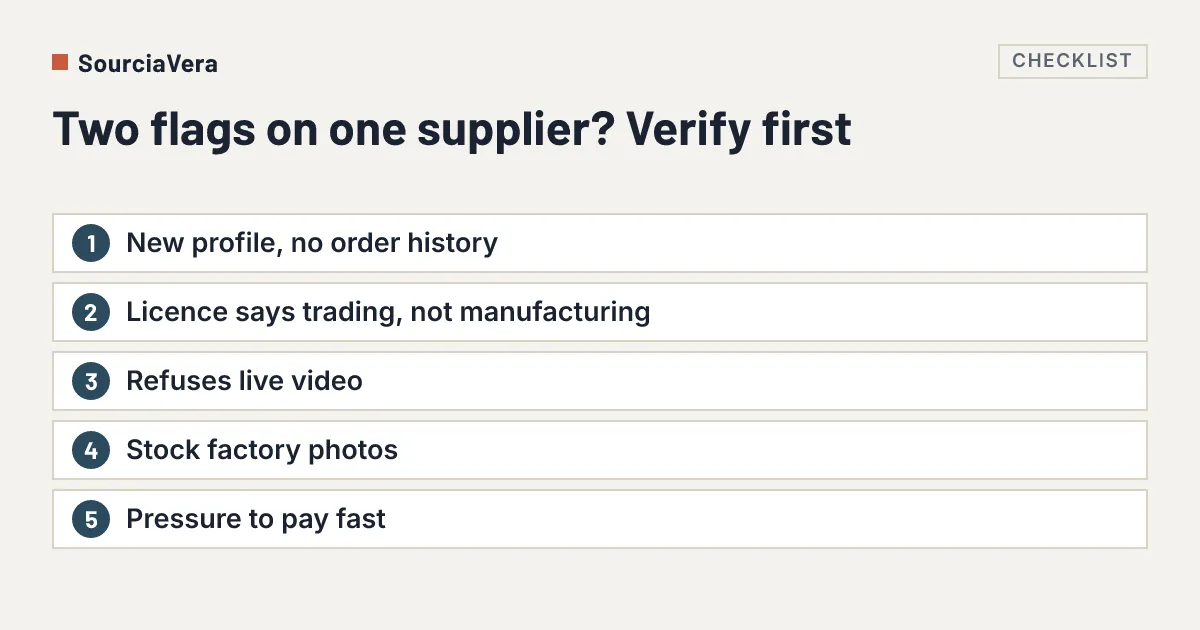
The short answer: the biggest Alibaba supplier red flags are a new profile with no order history, a business license that says trading instead of manufacturing, refusal of live video, stock factory photos, and pressure to pay fast. No single flag proves fraud, but any two on the same supplier mean you should verify the factory before a deposit moves.
| # | Red Flag | What Gives It Away |
|---|---|---|
| 1 | Profile created recently | No verified orders, no transaction history, no accumulated reviews |
| 2 | Claims to manufacture everything | Catalog spans 12+ unrelated categories — real factories specialize |
| 3 | No verifiable business registration | Won't share the 营业执照, or the name doesn't match their Alibaba profile |
| 4 | Can't answer basic technical questions | "Let me check with the factory" on a question about their own product |
| 5 | Slow response during China business hours | No reply within 4 hours, 9am–6pm UTC+8, Monday–Friday |
| 6 | Stock or duplicated factory photos | A reverse image search finds the same photos on other storefronts |
| 7 | MOQ far below industry standard | Offers 10 units when the category standard is 500 |
| 8 | No written contract, just chat | Resists a formal order confirmation on the platform |
| 9 | Artificial urgency around payment | "Price increases next week," deadline pressure tied to a transfer |
Most buyers look for red flags as if they were hunting for a scammer. I think that's the wrong frame. In my experience, the more common problem isn't an outright fraud — it's a real company that is simply wrong for your order: wrong scale, wrong equipment, wrong quality tier, or not a factory at all. The same warning signs catch both.
So I don't treat this list as a fraud detector. I treat it as a filter. The nine flags below follow the order you'd actually hit them: first when screening a profile, then in early conversation, then when you get to photos, paperwork and payment terms.
None of these nine, on its own, proves fraud. Any two of them together on the same supplier is where due diligence stops being optional.
Why Do These Flags Matter If Most Are Not Fraud?
Three reasons:
- The common problem is a company that is wrong for your order. Wrong scale, wrong equipment, wrong quality tier, or not a factory at all. The same warning signs catch both that and outright fraud.
- No single flag proves anything, but two on the same supplier do. That is the point at which you verify the factory before a deposit moves.
- The flags are invisible from the storefront. In the real case below, they were obvious as soon as someone looked at the license and asked for live video.
How Do Red Flags Stack Up in a Real Case?
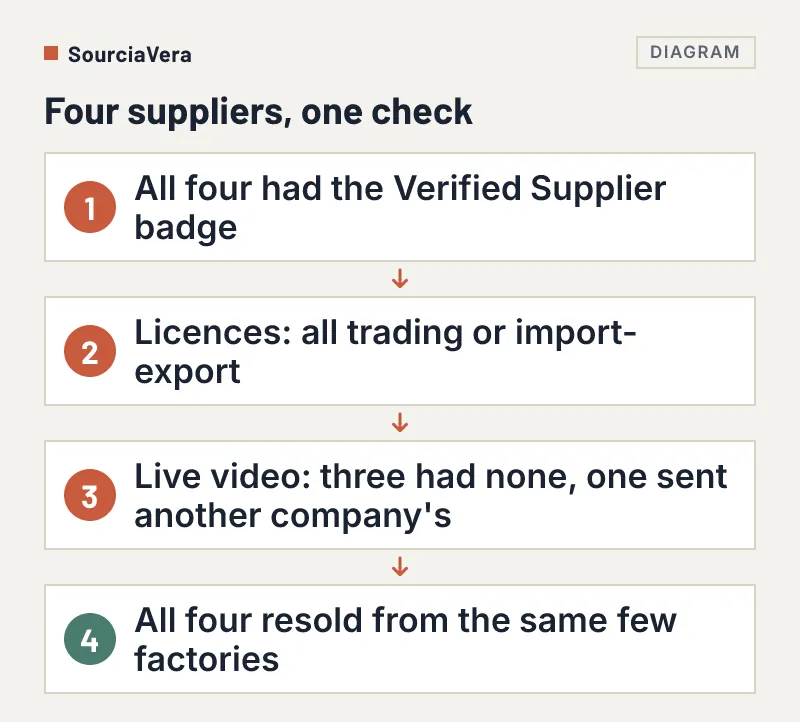
The problem: a client came to our team with four Alibaba suppliers for 50% hydrogen peroxide. All four had the "Verified Supplier" badge, similar pricing, similar photos, and each claimed in-house manufacturing. On the platform, nothing separated them. The client had been preparing a 30% deposit to one of them.
What we checked: each business license against China's National Enterprise Credit Information Publicity System, and live production video from each supplier.
The outcome: none of the four had a manufacturing scope covering hydrogen peroxide — all four were registered as trading or import-export entities. When we asked for live production video, three couldn't provide it; the fourth sent an old promotional video that turned out to belong to a different company. All four storefronts were reselling from the same handful of real manufacturers.
The takeaway: that's flag #3 (a registration that says trading, not manufacturing) and flag #6 (a factory video that belonged to someone else) on the same supplier — invisible from the storefront, obvious once someone looked. Here's why each flag earns its place.
What Should You Check on a Supplier's Alibaba Profile?
Red Flag #1 — The Profile Was Created Recently
New storefront, aggressive pricing, no order history. Real manufacturers build Alibaba profiles over years — transaction history, response-time records, accumulated buyer reviews. A profile created in the last 6 months with no verified orders should be treated as completely unproven, whatever its self-written description says.
Gold Supplier is a paid membership, so it says nothing about the company's history. A record of real transactions is harder to invent than a badge, but it is not proof on its own either.
Red Flag #2 — They Claim to Manufacture Everything
A factory in Guangzhou that makes electronics, furniture, textiles and automotive parts doesn't exist. Specialization is the rule in Chinese manufacturing — clusters of factories in specific regions focus on specific product categories. If the catalog spans 12 unrelated categories, you're dealing with a trading company sourcing from multiple factories, and it may not vet its own supply chain any more carefully than you're vetting it.
Red Flag #3 — No Verifiable Business Registration
Every legitimate Chinese manufacturer has a business registration (营业执照) you can request. If they won't share it, or the name doesn't match their Alibaba profile or payment account, stop. China's National Enterprise Credit Information System allows basic public company lookups — a real factory will be there. The registration should show manufacturing in the registered business scope. If it shows trading or consulting, you're not dealing with a factory.
You can run this check yourself at gsxt.gov.cn, and cross-reference real export history on Panjiva or ImportYeti — a supplier with zero import history despite claiming years of experience is worth a second look.
One pitfall is comparing only the English name. In China the official company name is in Chinese; the English name of a storefront is not registered anywhere. Compare the Chinese characters on the licence with the name of the bank account holder. If the payment goes to an individual, or to a Hong Kong company under a different name, ask why before you transfer anything.
Which Warning Signs Show Up in the First Conversation?
Red Flag #4 — They Can't Answer Basic Technical Questions
Ask something product-specific: "What alloy grade do you use for this bracket?" "What LED chip brand do you source?" "What lumen output tolerance do you hold in production?" A factory that makes your product answers immediately and specifically. A trading company has to "check with the factory" — which tells you exactly where you sit in the supply chain, and how much visibility you'll have if something goes wrong.
Red Flag #5 — Slow Response During China Business Hours
A real factory's sales team handles inquiries during Guangzhou working hours (UTC+8, 9am–6pm Monday–Friday). If replies consistently come only outside those hours, or never within a 4-hour window during business hours, the seller may be a part-time operation, a reseller in another timezone, or someone running multiple storefronts from a laptop. Responsiveness is one of the few things you can verify from a screen.
If you buy from Mexico: Guangzhou is 14 hours ahead of Mexico City, so factory hours run from 7 pm to 4 am Mexico City time. Many Chinese sellers answer WhatsApp or WeChat at odd hours, and that is not a bad sign by itself. What should worry you is silence during factory hours.
What Red Flags Appear in Photos, Contracts and Payment Terms?
Red Flag #6 — Factory Photos Are Stock or Appear on Multiple Profiles
A factory proud of its operation sends photos of its actual floor — specific machines, specific workers, specific products in progress. If a reverse image search finds the same photos on other storefronts, competitor profiles or stock photo sites, the "factory" you're looking at isn't the operation you'd be sending money to. Ask for a live walkthrough video at a specific time instead.
Red Flag #7 — MOQ Is Much Lower Than Industry Standard
Minimum order quantities exist because production runs have real setup costs. If the industry standard is 500 units and this supplier will do 10, either they're liquidating overstock or they're not actually manufacturing. Low MOQ can be a genuine feature in some contexts — or a sign that the "factory" is a trader with no production floor.
Red Flag #8 — No Written Contract, Just Chat
A supplier that resists putting order terms in writing on the Alibaba platform is avoiding the documentation trail Trade Assurance needs to process a dispute. Legitimate suppliers have no reason to avoid documentation — it protects them too. Insist on a formal order confirmation with product specifications, quantity, quality standards, packaging requirements and delivery timeline. If they won't do it, walk.
Red Flag #9 — They Create Artificial Urgency Around Payment
"Prices increase next week." "We only have capacity for one more buyer this quarter." "Our manager approved this deal, but only until Friday." Real urgency exists in manufacturing — production slots and material prices do move. But urgency tied to a payment deadline from an unverified supplier is almost always pressure designed to get you past your own due diligence.
How Many Quotes Do You Need to Spot a Scam Price?
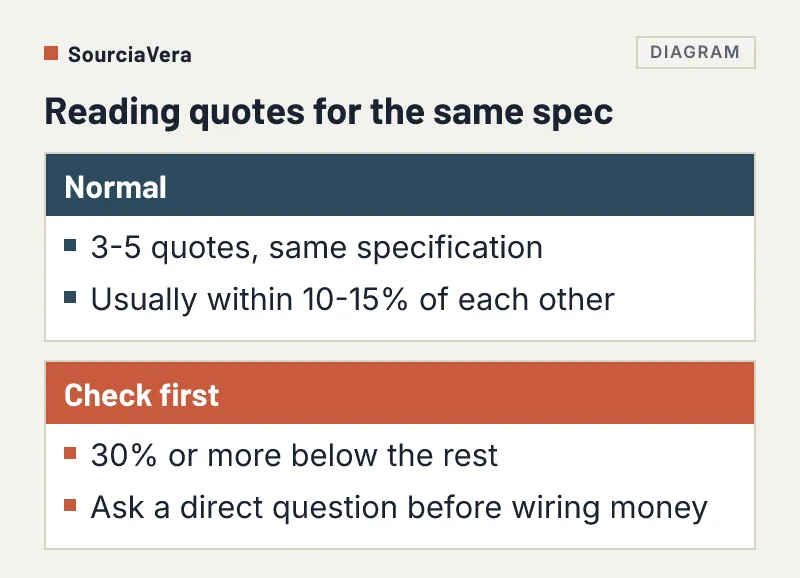
An isolated price tells you nothing. Request quotes from 3–5 suppliers for the exact same specification, and a natural range usually emerges — typically within 10–15% of each other. A quote 30% or more below the rest is a strong signal to check. It often means one of three things: a "hook" price meant to secure your deposit before material substitution, an outright scam where the deposit is collected and the seller disappears, or a counterfeit operation ignoring material costs or IP compliance.
The lowest price isn't automatically the worst option — but when it's far from the rest of the group, it deserves a direct question before you wire anything.
Do You Need to Re-Verify a Supplier After the First Order?
Yes — and it's the part most guides leave out. A supplier who passes verification today can look very different a year from now, and the buyers who avoid repeat losses treat verification as a recurring check, not a box ticked once. Four things worth re-checking on every order, not just the first: inspect every shipment, not only the first one; re-confirm business registration status periodically, since ownership transfers and license issues don't always get announced to buyers; watch for new legal disputes or enforcement records that didn't exist at your first check; and keep a running quality record across orders, because gradual decline is easy to miss order by order.
That's the difference between a one-time factory check and ongoing oversight. Our factory verification is a single on-site visit with a written report. Staying on top of an order during production works two ways: on-site supervision and pre-shipment inspection can be booked on their own by the man-day, at the rates listed under Our Services, or they are included when we handle the order through our procurement service.
Frequently Asked Questions
How do I verify a supplier on Alibaba?
Check five things before you pay: the business license, which you can look up in China's National Enterprise Credit Information Publicity System; whether its registered scope covers manufacturing your product and not just trading; live video of the production floor, not stock or recycled photos; the factory address; and that the name on the license, the Alibaba profile and the payment account match. The Verified Supplier badge is a starting point, not a guarantee: Alibaba says its checks are done by third-party inspectors and that it does not guarantee the accuracy of that information.
How do I check an Alibaba supplier's factory address?
Ask for the address in writing and compare it with the address on the business license, look the company up in China's National Enterprise Credit Information Publicity System, and ask for live video from the production floor. The sales office and the factory can be in different places: in one case we checked, the sales team was in Shenzhen while production was in a factory more than a hundred kilometers away in Zhaoqing. If the address matters for your order and you can't be there, someone on the ground can go and confirm it.
Is it a red flag if an Alibaba supplier asks for payment by Western Union or USDT?
It is a reason to stop and ask why. Alibaba says Trade Assurance applies when you pay through Alibaba.com's secure payment platform, so a request to pay by Western Union, by cryptocurrency such as USDT, or straight into a personal or company bank account asks you to leave that protection. It does not prove fraud, but ask for an order on Alibaba.com instead, and read red flag #9 on pressure around payment.
What should I do if a supplier raises the price after I pay a deposit?
Don't pay more under pressure. Before any money moves, put the agreed price, specifications, quantity and delivery timeline into a formal order confirmation on Alibaba.com. If the supplier changes the terms afterwards, ask for the change in writing and keep the original order and the messages. Pressure tied to a payment deadline, such as "prices increase next week", is red flag #9.
What should I do if I think I've been scammed on Alibaba?
Stop paying the supplier and save every message, invoice and payment record. If you paid through Trade Assurance, open a dispute from your order page; if you paid by wire transfer, call your bank's fraud department right away, because recalls are only possible within a short window. Then report the supplier to Alibaba. Our guide to getting scammed on Alibaba walks through the steps.
Summary: Two Flags Mean Verify Before You Pay
These flags don't always mean fraud. Some mean inexperience; some mean mismatched scale. But from what our team sees on the ground, I've come to trust one rule: when two of them show up on the same supplier, you either walk away or get someone's eyes on the factory before any money moves.
And I've noticed something about the factories themselves. The good ones don't take due diligence as an insult — they expect it, because every experienced importer does it before every significant order. The factories that welcome it are the ones worth working with.
SourciaVera is a factory verification and sourcing service in China, with a team in Guangzhou, that helps buyers in Mexico and Latin America verify suppliers, inspect factories and buy from China with less risk.
To sum up, when two of these flags show up on the same supplier, either walk away or get someone's eyes on the factory before any money moves. If you pay anyway, the realistic outcome is a deposit with a supplier you could not identify and a first batch that does not match what you ordered. A $49 remote check covers the registration and trader-versus-manufacturer questions, and our team can visit the factory to check what a screen cannot show.
I provide supplier verification services, so you should treat my recommendation accordingly.