Most manufacturer shortlists get built on three data points: price, sample quality, and how convincing the video call looked. None of those three predict whether the factory will still be reliable, financially solvent, and compliant with your target market's regulations a year into your production run — and the questions that actually do predict that almost never get asked until something has already gone wrong.
- Capability to build your specific design at your volume is not the same as general experience in your product category — ask for proof of both, separately.
- A factory that looks fine today can become unshippable overnight if it's financially unstable, embargoed, or sitting in a shifting conflict zone.
- Certifications and ISO registration are claims until someone confirms the certificate number matches the exact production line making your product.
- Get recall and warranty liability for the factory's own defects in writing before production — not after a claim.
- Workforce and compliance standards are increasingly the buyer's legal and reputational problem too, not just the factory's.
Can They Actually Build Your Design, at Your Volume?
General experience in your product category is not the same as experience with your specific design. A factory that's made a thousand injection-molded enclosures may never have built the exact wall thickness and tolerance your part needs.
Ask for photos or video of a comparable past project close to your actual spec — not general catalog photos.
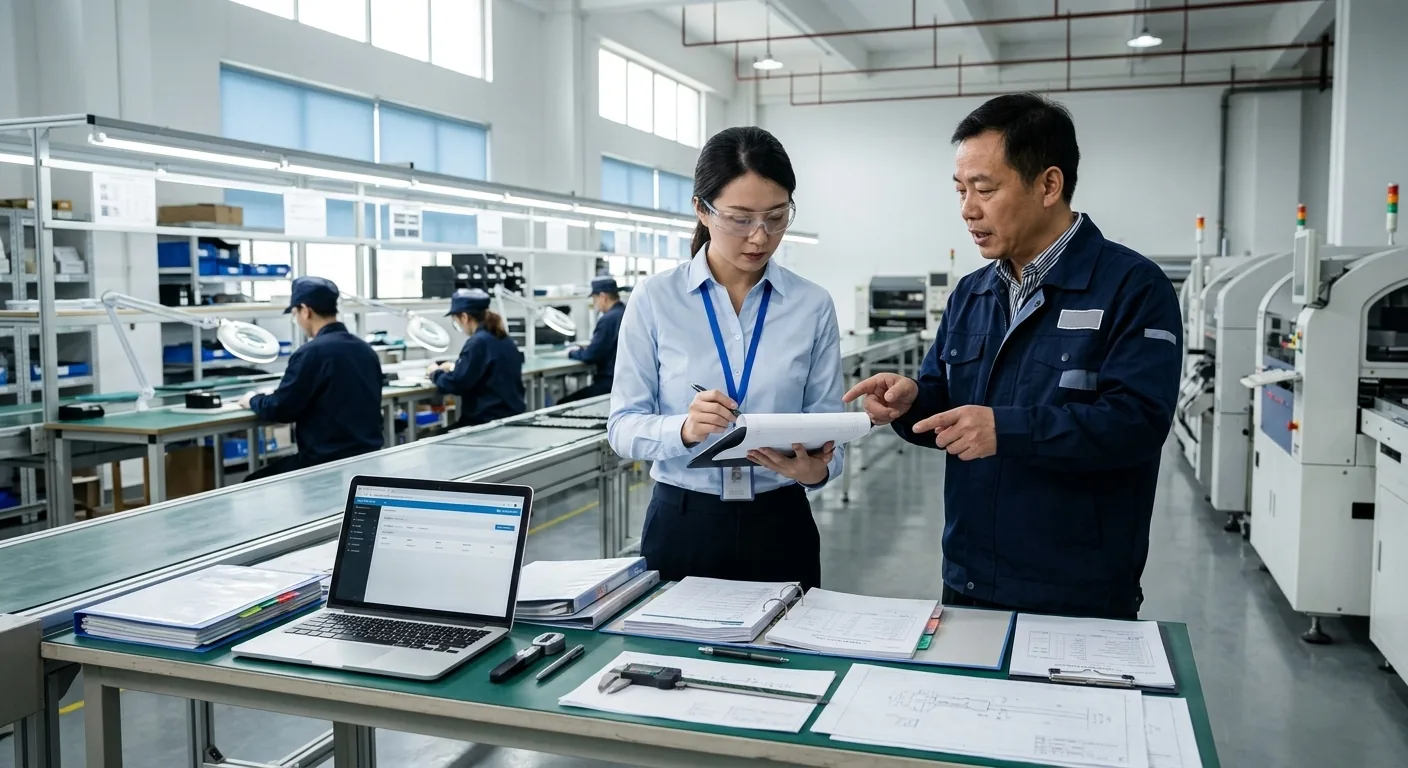
We confirm the equipment and workforce on the floor actually match what your specific design requires, not just a plausible claim from a sales call.
Beyond the design match itself, four related questions decide whether the capacity they're quoting is real or theoretical:
- Spare production capacity for your target volumes — a factory quoting confidently at a number that would consume nearly all of one line carries different risk than one with slack to absorb delays.
- Who sources raw materials, you or them — this affects your cost control and, more importantly, who's accountable when a material substitution shows up in the finished part.
- What you'd need to invest in tooling or staff training before they can start, and what you actually get to keep if the relationship ends.
- Likely turnover on the specific line trained on your product — high turnover quietly erodes the process knowledge that made your approved sample good in the first place.
Will They Still Be in Business When Your Order Ships?
A factory that's fine today can become unshippable or unreliable for reasons that have nothing to do with quality:
- Financial stability — not just for this order, but through your whole campaign. A factory operating on thin margins is more likely to substitute materials quietly or fold mid-production.
- Conflict-zone exposure or embargo status in your target market — trade restrictions can shift faster than a sourcing decision does.
- Logistics — do they sit on a clear, secure shipping lane, or are you dependent on a single long, fragile route with no fallback if it's disrupted?
Ask how long they've operated at their current scale, and whether their volume has been growing, flat, or declining.
We check China's National Enterprise Credit registry for financial irregularities and confirm the factory floor matches the production volume they're claiming — a shrinking operation quoting growing capacity is a specific warning sign.
Are Their Compliance Systems Real, or Just Claimed?
ISO certification, health & safety systems, and environmental policy all sound the same on a sales call whether they're actively enforced or exist as a framed certificate nobody's checked since it was issued.
- ISO registration and audit history — ask for the certificate number and certifying body, not just the logo on their website.
- Competence to affix market-specific labels like CE marking — getting this wrong is a legal liability that lands on you, not them, once the product is in your target market.
- Health & safety systems and environmental policy — worth asking about directly, and worth noticing if the answer is vague or rehearsed.
Ask for the ISO certificate number and the name of the certifying body.
We confirm the certificate is current and covers the specific production line making your product — not a different line in the same building.
Most of this can't be confirmed from a sales call or a certificate photo.
A factory audit checks capability, financial and compliance signals, and workforce conditions in person — and gives you a dated report before you commit a deposit.
Who's on the Hook When Something Goes Wrong?
Two questions almost nobody asks before placing an order, both of which matter far more after a defect ships:
- Will the factory fund recalls, warranty claims, or replacements caused by their own defects — not yours? Get this in writing before production starts, while you still have leverage, not after a claim is already in dispute.
- Will your own business insurer sign off on this supplier, or exclude losses caused by them? This is a question for your insurer, not the factory — but almost nobody asks it before the order is already placed.
Workforce and Ethics Standards Are Increasingly the Buyer's Problem Too
Modern slavery policy, equality practices, and how a factory actually treats its workforce used to be treated as the factory's business alone. Import regulations in several markets now hold buyers accountable for supply chain labor practices — which makes this due diligence, not just ethics.
- Ask whether the factory has a modern slavery policy and a compliance reporting system, and whether they publish anything beyond a policy statement.
- Ask about their equality practices and whether they have any external reporting on record.
- A scripted factory tour will show you a calm floor regardless of what's actually happening day to day — an unannounced or third-party visit tells you more than a tour a sales team prepared for in advance.
Vetting a new manufacturer and want someone physically at the factory?
A supplier verification covers capability, financial and compliance checks, and workforce conditions — for any product category, before you commit a deposit.