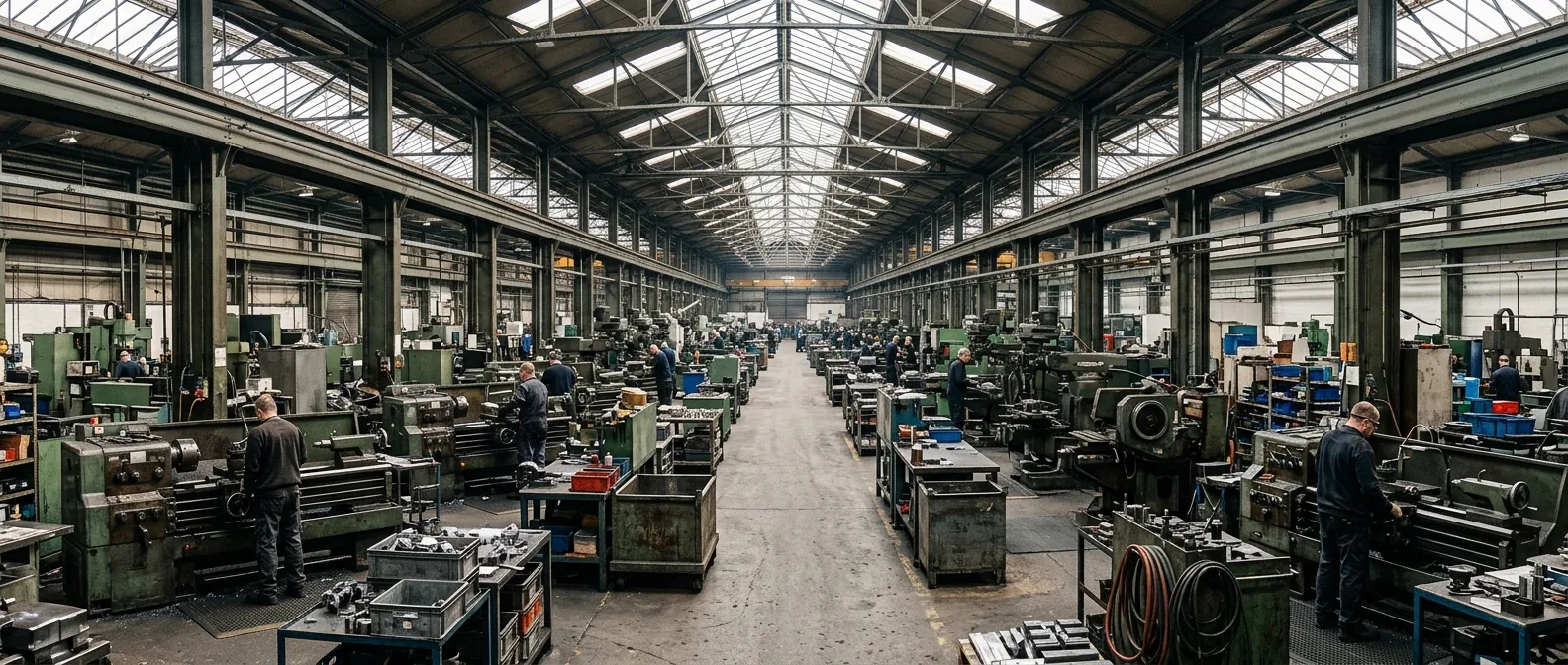
The deposit is where sourcing decisions get made in a hurry. You've compared quotes, picked a supplier, and the only thing left is sending 30% — or 50%, or the full amount — so production can start. That's exactly the moment most buyers stop checking, because everything up to now has felt like enough due diligence already. It usually isn't.
Quick answer: before sending a deposit to a Chinese supplier, verify who legally owns the factory, confirm it's an actual manufacturer and not just a trading company reselling someone else's production, match the sample against the mass-production plan, make sure payment goes to the company's registered account (not a personal one), and get the inspection process — who checks, and when — in writing. The 10 checks below cover each of these in order, plus a few most checklists skip.
1. Verify the company behind the listing
Start with the basics: registered company name, business license number, and factory address — not just the storefront name on Alibaba or 1688. We've written before about exactly how to ask for this without it sounding like an accusation; the short version is that a supplier who hesitates more than a day is telling you something. If you can read the characters, cross-check the license number yourself against China's national enterprise registry. If you can't, have someone who can.
2. Confirm you're dealing with a factory, not a trading company
This is the check most buyers skip, and it's the one that changes everything else on this list. We've seen the pattern often enough to recognize it fast: a supplier's sales team operates out of Shenzhen, complete with a polished showroom and fast WhatsApp replies, while the actual production happens at a factory over a hundred kilometers away in Zhaoqing — a factory that has never spoken to the buyer directly and doesn't control its own quality decisions on that order. Neither arrangement is illegal on its own. A trading company can be a perfectly good partner. But you should know which one you're paying a deposit to, because it changes who's actually accountable when something goes wrong on the production floor. Ask directly: "Is this the factory, or do you work with a factory?" A real factory answers that question in one sentence, not a paragraph. If the answer is vague, ask for the factory's own business license — not the trading company's — and check whether the address on it matches where your product is actually made.
3. Ask for a live video walkthrough — not recycled photos
Photos get reused across dozens of storefronts. A live walkthrough, on request, on a specific day, is much harder to fake. Ask to see the production line for your specific product, workers actually present and working (not an empty floor), and the finished-goods warehouse — not just a tour of the front office and a sample shelf. We've covered what a video call can actually reveal that photos can't — worth five minutes before you schedule one.
4. Request a sample before the bulk run
A sample tells you what's possible. It doesn't tell you what you'll get from a 2,000-unit run made under time pressure, on a cheaper batch of raw material, by a different shift than the one that hand-built your sample. Get their answer, in writing, to what happens if the bulk shipment doesn't match the approved sample — a rework, a discount, a reshipment — before you pay, not after a mismatch has already shipped. We go deeper on this exact scenario in our 7 questions to ask before wiring money.
5. Sanity-check their production capacity against your order
If your order alone exceeds their stated monthly output, ask why. The honest answer might be subcontracting to a second workshop — which isn't automatically a dealbreaker, but it is something you should know about and inspect, not discover after a shipment underperforms. A factory claiming 5,000 units a month off one visible assembly line and a dozen workers is a number worth questioning before you commit to 3,000 of them yourself; a factory that can walk you through which lines run which SKUs, and when, usually isn't guessing.
6. Get the payment structure in writing — not just the percentage
"30% deposit, 70% before shipment" is a starting point, not a full answer. Confirm three things: which account the deposit goes to — it should match the registered company name, not an employee's personal account — whether the balance is due before or after your own pre-shipment inspection, and whether you're covered by Alibaba Trade Assurance or an equivalent, versus a direct wire with no platform protection at all. The split matters less than what triggers each payment and who's holding the risk in between. Get it in the on-platform order contract if you're using Alibaba, not just a chat message — a term you agreed to verbally is much harder to enforce than one sitting in a contract both sides signed.
7. Ask who inspects the product, and when
"We have quality control" means nothing on its own — every supplier says this. Ask specifically: who does the inspection (in-house staff, or is it self-reported), at what stage (during production, after, or both), and what their rejection rate looks like on a typical order. Ask, too, whether they inspect against an AQL sampling standard or just eyeball a handful of units off the top of a carton — the difference matters a lot more on a 5,000-unit order than it sounds like it should. A supplier who can describe their own QC process in specific terms is a different category from one who just tells you not to worry.
8. Check their track record shipping to your market
A factory that's never shipped to Mexico, the U.S., or wherever your goods are headed may not know the certifications your market actually requires — DOT and FCC markings for the U.S., NOM certification for Mexico, CE for the EU. Ask for shipping or export documentation to your specific region, not just "we export worldwide," and ask for a certificate of origin or testing report from a previous shipment to a comparable market if one exists. This is a gap that tends to show up at customs, which is a far more expensive place to find it than before you pay a deposit.
9. Protect your product design before it's in their hands
If you're sending a custom design, drawing, or mold specification, get an NNN agreement in place first — not a generic NDA written for a different legal system, but one enforceable specifically under Chinese law (non-disclosure, non-use, non-circumvention). Confirm who owns the tooling and mold once it's paid for, and what happens to it if you switch suppliers later. This is the check buyers most often skip because it feels like it's slowing down a deal that's already moving — which is exactly why it needs to happen before the deposit, not after your design shows up on someone else's storefront, or on a competitor's, with your mold number still stamped into the part.
10. Have someone check before the final balance goes out
Everything above can be done remotely — by phone, by document, by video call. None of it fully replaces someone physically walking the production floor before your money does: confirming the company on the license is the company making your product, that the line photographed is the line running your order, and that what's sealed in the sample room matches what's about to ship. If you can't be there yourself, that's what a third-party factory audit exists for.
We've Seen Buyers Skip Six of These and Get Lucky — and Skip One and Lose Everything
There's no version of this list that guarantees a clean transaction. A determined trading company in Shenzhen can perform most of it convincingly for a single meeting — the flowers, the confident answer about the office, the WeChat replies that come back in ninety seconds. What changes the odds is running all 10 together instead of trusting whichever ones happened to come up naturally in conversation. We've had a buyer skip everything except the video call and still get burned, because the video call itself was of a rented line, not his line. We've had another skip nine of them and still be fine, because the one he didn't skip — the business license cross-check — happened to be the one that mattered for that supplier. You can't know in advance which check is load-bearing for your specific order, which is the actual argument for doing all 10, not the ones that feel most comfortable to ask.
If you don't have the week or two it takes to run this list properly from outside China, that week is what a factory audit is for.
Want These 10 Things Verified in Person?
SourciaVera checks company records, production capacity, and quality control on-site in Guangzhou — before your deposit goes out, not after.
Request a Factory Audit