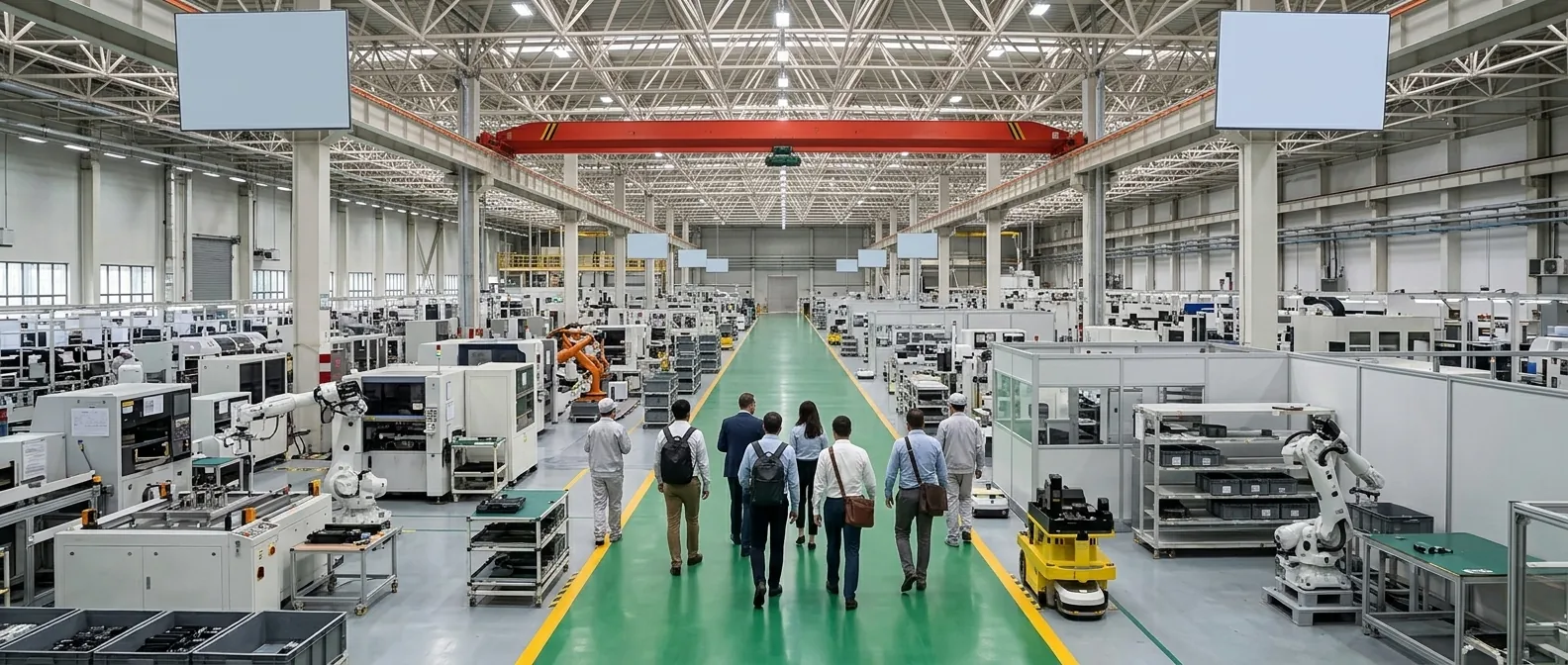
Photos can be staged, borrowed from a competitor, or years out of date. A live video call is harder to fake — but only if you use it to actually check something, instead of just nodding along to a screen tour. These 5 checks turn a video call from small talk into real evidence.
1. Whether the Scale Matches the Claim
A "200-worker factory" should visibly have workstations, not one busy corner filmed at a flattering angle.
This came up almost word for word in a case we worked last year. A buyer sourcing 500 sets of 18-inch alloy wheel rims for a used-car export business had a supplier's Alibaba page listing "200+ employees, own casting and CNC facility." On the video call, the rep walked maybe fifteen meters, passed two polishing stations and a stack of finished rims, then said the rest of the floor was "in another building, closed today." No CNC lathe ever appeared on camera — the machine that actually cuts a wheel's offset and bore to spec, not just polishes the face. A factory that casts and finishes its own rims has that machine sitting in plain sight; a reseller repackaging generic wheels from three different casters doesn't, because it doesn't need one. The buyer never got past that call, and later found the same rim listed under two other company names at two different price points — the usual sign of a trading company moving someone else's stock, not a manufacturer selling its own.
On the call, ask them to walk to the far end of the production floor and count visible workstations as they go.
We physically walk the same floor and count equipment against the claimed capacity, no camera angle to manage.
2. Whether Workers and Machines Match the Product Category
A factory that makes your product should be able to point a camera at a machine actually producing it — not a generic assembly line.
LED headlight assemblies are where this gap shows up most often, because the number printed on the box and the number a headlight actually produces are frequently two different things. A supplier's spec sheet for a $28-per-unit LED headlight assembly claimed 12,000 lumens — a figure that turned out to be the raw output of the two LED chips inside, added together and rounded up, not a measurement of the finished, lensed assembly. A buyer placing a 3,000-piece container order asked the rep on camera to walk to wherever they test finished units and show a reading. There was no integrating sphere on the floor — the enclosed, light-sealed chamber that measures true lumen output from an assembled housing — only a handheld lux meter aimed at a bare bulb from about a foot away, which reads brighter than reality and can't test a sealed housing at all. The rep switched to reciting the chip manufacturer's datasheet numbers instead of answering. That's the difference between a factory that engineers headlights and one that solders chips into a housing and copies the chip's spec sheet onto the retail box.
Ask them to show the specific machine or line producing your product type, live.
We identify equipment by make and model and confirm it's actually suited to your product's manufacturing process.
3. Proof It's Not Recorded Footage
Pre-recorded "live tours" are common enough that a simple test is worth running every time.
A buyer sourcing polyurethane suspension bushings for three different sedan models ran this exact test after noticing the factory's "live tour" looked suspiciously identical to a clip already sitting on the company's own YouTube channel from eight months earlier. Asked to hold up a note with the date and the word "Toledo," the rep hesitated, said the connection was lagging, and the feed cut out for ninety seconds before resuming with the same walking pattern past the same molding machines. Once the call reconnected, the buyer asked instead to see the bushing molds for the specific bolt pattern and bore diameter in the PO — the fixture that determines whether the part actually fits the mounting bracket it's sold for. The rep pointed the camera at a shelf of unlabeled molds and couldn't say which one matched which application. Buyers of suspension and brake hardware run into this constantly: a mold built for one bolt pattern gets used to mass-produce parts sold under several different vehicle fitments, and the mismatch only shows up after installation.
Ask them to hold up a handwritten note with today's date and a word you choose on the spot.
We record dated video during every visit as standard evidence included in your report.
4. How the Rep Handles Unscripted Questions
Sales pitches are rehearsed. Real production knowledge shows up when a question falls outside the script.
An exhaust systems buyer placing a $40,000 order for mandrel-bent stainless exhaust kits asked a supplier's rep, mid-call, what wall thickness of tubing they were running and why. The rep, who up to that point had smoothly narrated the tour in fluent English, paused for several seconds and then said he would "check with the workshop and send it in chat." A production manager who actually runs mandrel-bending equipment answers that question in under five seconds, because wall thickness sets the bend radius and is dialed into the machine every shift. It came out over the following messages that the company's Alibaba showroom also sold garden tools and lithium battery packs — a product spread that, on its own, is close to a guarantee of a trading company rather than a factory, since real manufacturers tend to specialize in one process instead of sourcing three unrelated categories from three unrelated workshops. The business license, requested afterward, listed a "Room 6B" office address with no workshop unit number at all.
Ask something not in their usual pitch — a defect rate, a recent production issue, a technical spec.
We ask harder questions in Mandarin, in person, where evasive answers are easier to catch than through a translated video call.
5. Whether Inventory Matches "Ships Immediately" Claims
"In stock, ready to ship" should be provable in about ten seconds on a video call.
A buyer who needed 1,200 sets of front brake calipers within three weeks to cover a seasonal parts-store order had been quoted "in stock, ship within 48 hours" in the chat. On the call, the rep first pulled up a product photo already saved on his phone and started describing it before the buyer stopped him and asked to see the actual pallets. It took over four minutes of walking, two phone calls to someone off-camera, and a stop at a shelf holding maybe 80 units before he found anything resembling the calipers in the PO — nowhere near 1,200. The honest answer, which came out only after the buyer pushed, was two to three weeks of production still ahead, not an existing stockpile. That's a fixable timeline problem if you know about it before wiring a deposit against a 48-hour promise; it's a much worse problem if the seasonal order is late and the parts store has already committed shelf space.
Ask them to walk to the actual warehouse shelf holding your product — not a saved photo they already have.
We check physical stock counts against what's promised in the listing before you commit to a ship date.
Why This Matters More Than It Seems
None of these 5 checks require special equipment or fluent Mandarin — just a willingness to ask for something specific instead of accepting a general tour. Suppliers who fake video calls are betting that buyers won't push past the polite version. Pushing past it costs you nothing and tells you almost everything.
Want the In-Person Version of This Check?
SourciaVera runs exactly these checks physically in Guangzhou — scale, equipment match, live proof, technical questioning, and inventory — with a dated report you can act on.
Request a Supplier Verification