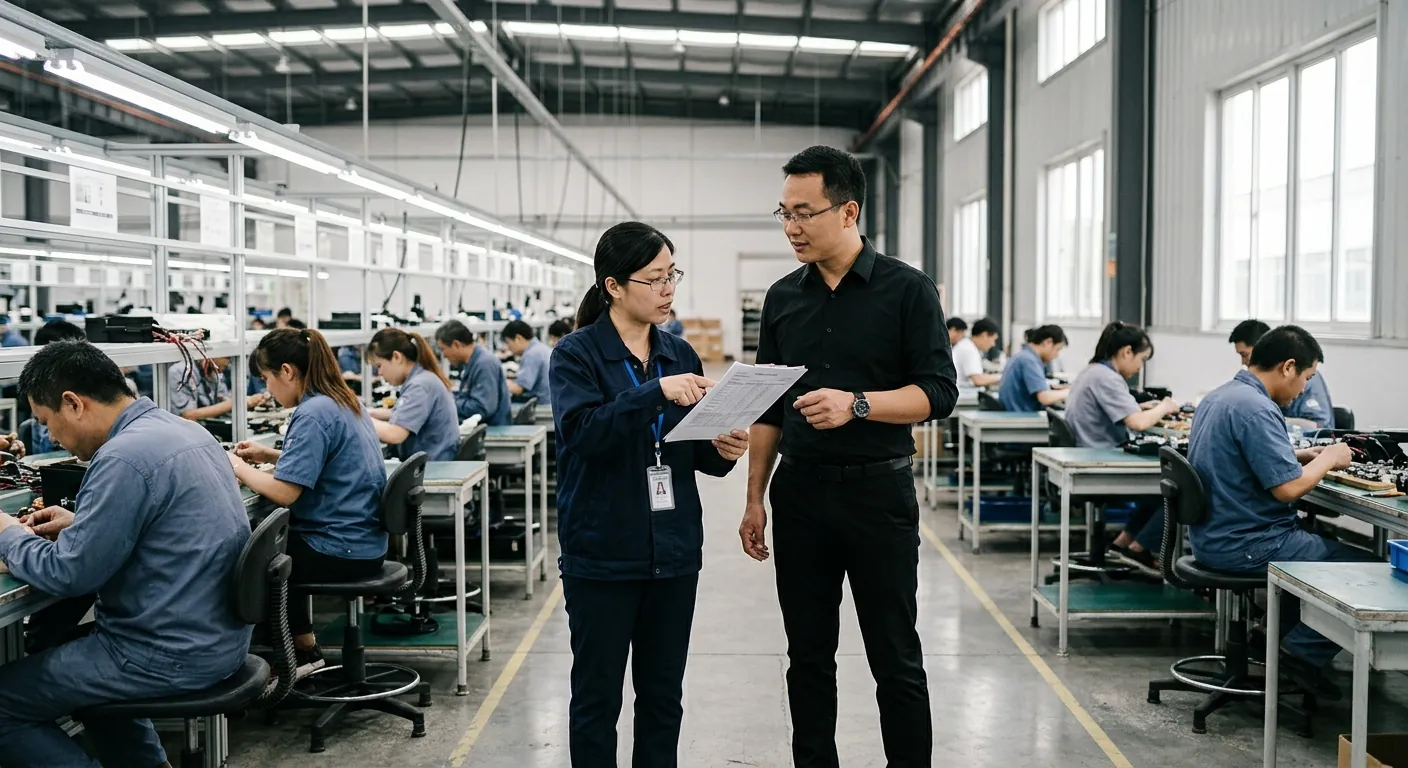
The moment you're ready to pay a deposit is exactly when due diligence usually stops — right when it matters most. These 7 questions take five minutes to ask and separate suppliers who answer directly from ones who dodge. Next to each one: what you can judge yourself from their answer, and where an in-person check actually changes the picture.
1. "Can I see your business license number?"
Ask directly, in writing, and note whether they answer in the same conversation or go quiet for hours.
This matters most in categories where the same photos get reused across dozens of storefronts, and wheels are one of the worst offenders. A buyer sourcing 400 sets of aftermarket wheel rims and hub caps for the BYD platform found a supplier with sharp photos and a $14,000 quote — a 30% deposit, $4,200, due before production start. Asked for a business license, the supplier went quiet for three days, then sent a blurry photo of a license registered to a different company in a different province. The deposit itself carried a second flag: payment to a personal bank account under an employee's name, not the company's registered account. The buyer wired anyway. Replies slowed to one line a day around week four, then stopped entirely at week six, right when the shipment should have been ready. The same rim photos later turned up on three other storefronts under three other company names. A Trade Assurance dispute recovered part of the deposit months later; the rest was written off, because Alibaba's own protection only covers what the order contract actually names, and this one never got past chat messages.
Whether they hand it over immediately or start explaining why they "usually don't share that."
We run the number against the government registry and confirm the manufacturing scope during our visit.
2. "What's your monthly production capacity for this exact product?"
Compare their answer against your order size. If your order alone exceeds their stated monthly capacity, something doesn't add up.
The mismatch is easy to miss when the number sounds impressive on its own. A buyer needing 3,000 LED headlight assemblies for the U.S. aftermarket got a quoted capacity of 5,000 units a month from a supplier whose factory photos showed one assembly line and what looked like fifteen or twenty workers. The order went ahead anyway. Production slipped past the promised date twice, each time blamed on a holiday or a component shortage — reasons that turned out to mean the overflow had been quietly subcontracted to a second, unlisted workshop with no quality control of its own. The shipment that eventually arrived had LED drivers failing within 30 days of installation, a color temperature closer to 5000K than the 6000K on the purchase order, and DOT markings that didn't match any registered certification. None of that shows up in a capacity number. It shows up in whether the number was physically possible in the first place.
Whether the number is oddly round, or specific enough to sound like it comes from a real production schedule.
We count production lines and workers on the floor to confirm the stated capacity is physically possible.
3. "Who else has ordered this exact product from you in the last 6 months?"
Ask for a reference you can actually contact — not a testimonial screenshot that could belong to anyone.
A screenshot doesn't survive a phone call, which is exactly why suppliers offer them instead of a name. On a $22,000 order for 500 brake caliper sets, the supplier's first response to a reference request was a testimonial graphic with a logo and no company name attached. Pressed again, the supplier offered something that should have raised more concern than it did: a 10-day turnaround on custom-machined calipers, a timeline that leaves no room for the heat-treating and hardening steps that keep a caliper from cracking under load. No real contact ever materialized. The buyer walked, and a few months later found a nearly identical listing — same photos, same product codes — under a different company name. Whoever was behind it hadn't stopped selling. They'd just stopped answering that one account. A real reference — even one phone call to a buyer who'd taken delivery — would have surfaced the 10-day promise as the outlier it was before any money moved.
Whether they offer a name at all, or pivot to "we have a great reputation" without specifics.
We can request and inspect recent shipping records on-site, which most buyers can't get access to remotely.
4. "Can we do a live video walkthrough this week?"
Propose a specific day and time. Vague "sure, anytime" answers followed by repeated delays are a signal on their own.
How many times the scheduled call gets pushed back, and for what reason.
We show up in person, which no amount of video call preparation can fully substitute for.
5. "What happens if the sealed sample doesn't match the bulk shipment?"
Get their answer in writing before you pay — not after a mismatch has already shipped.
The sealed sample is only worth what happens after it's approved. A buyer who tested and signed off on a suspension bushing sample paid 30% down on a 2,000-set order — $2,700 of a $9,000 total — with the balance due before the container shipped. The bulk production that followed used a visibly softer rubber compound than the sample, something that doesn't show up on a packing list or a photo. Bushings from that shipment started cracking within weeks of installation, reported back by the buyer's own customers. The supplier's response pointed at humidity during ocean transit — not a rework offer, not a partial refund, not an explanation with any specifics attached. Getting the remedy in writing before the deposit clears doesn't prevent a bait-and-switch on materials. It just means there's something to hold them to instead of an argument about whose fault the weather was.
Whether they offer a concrete remedy (rework, discount, reshipment) or just reassurance.
We inspect the bulk production against the sealed sample directly, before it ships — not after.
6. "Is this price negotiable, and why or why not?"
A supplier who can explain their cost structure — materials, labor, MOQ tiers — is more credible than one who just discounts on request.
This one's on you — no site visit changes what a real cost explanation sounds like versus a blanket "I'll give you a special price."
Not applicable. We'd rather tell you where a visit doesn't add value than sell you one anyway.
7. "Can we put these terms in a written contract on the platform?"
Insist on Alibaba's on-platform order confirmation — not just an agreement reached in chat messages.
Whether they resist formalizing terms that they already agreed to verbally.
We review contract terms in Chinese and English and flag ambiguous clauses before you sign.
What to Do With the Answers
One dodged question is worth a follow-up. Two or more, and the pattern is the answer — a supplier with nothing to hide doesn't need five extra messages to confirm a business license number. The goal isn't to interrogate every supplier on every order; it's to spend five minutes on the ones getting real money before you spend the money.
Want a Second Set of Eyes Before You Pay?
SourciaVera verifies exactly what these 7 questions can't confirm from a chat window — business registration, production capacity, and sealed sample match, in person, before your deposit goes out.
Request a Supplier Verification