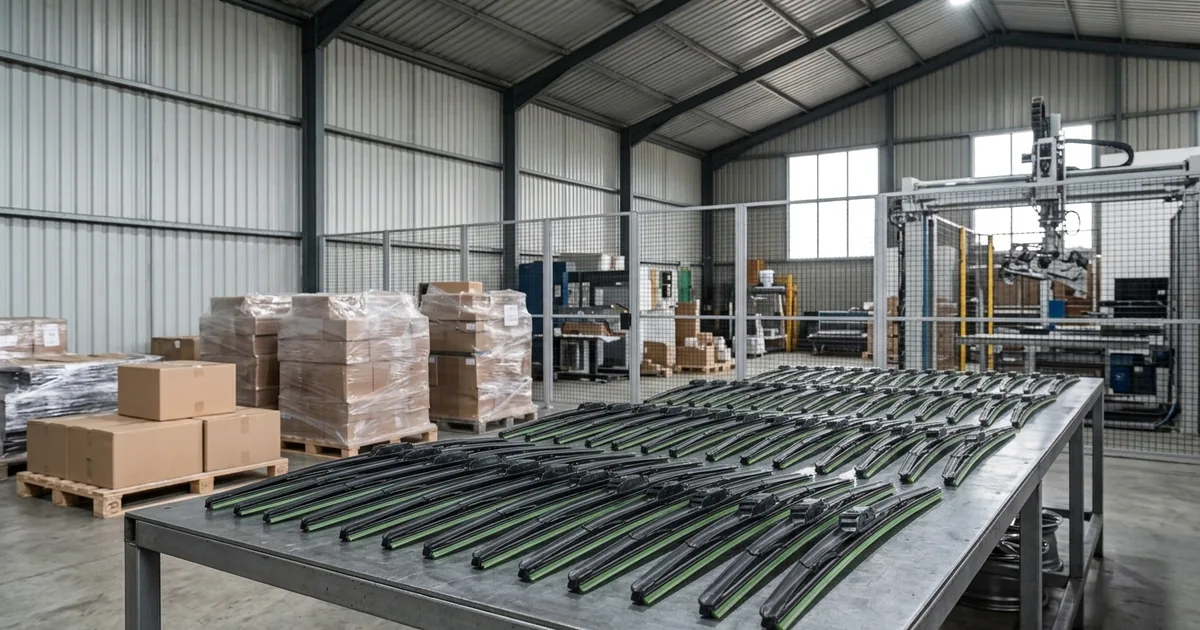
The short answer: a piece is one single item. A set is a group of items sold together as one unit, and the supplier decides what is in it. The unit is part of the MOQ: "MOQ 100 sets" can mean far more individual pieces than "MOQ 100 pieces", and a price "per set" cannot be compared with a price "per piece" until you know how many pieces make one set. Always confirm the unit — and what is inside a set — in writing.
You've found a price that looks great, and you're not sure what you're agreeing to buy. That's a fair thing to be unsure about: the supplier chooses the unit, and there is no standard for what a "set" contains. You're not supposed to know that unless you've bought this way before.
The mix-up is easy to miss on a listing and expensive to find after you have paid. This guide shows how to read the unit, how to compare quotes correctly, and what to confirm before you order. It is part of our series on minimum order quantities when importing from China.
What Is a "Piece" and What Is a "Set" on Alibaba?
On a listing, the unit shown next to the MOQ and the price is chosen by the supplier: it might be pieces, sets, pairs, boxes or cartons. A piece is one item. A set is whatever the supplier defines as one sellable group — it may be two items, four, ten or more. There is no standard for it, so the number of pieces in a "set" can differ from one supplier to the next, even for the same type of product.
Why Does the Unit Change Your MOQ and Your Price?
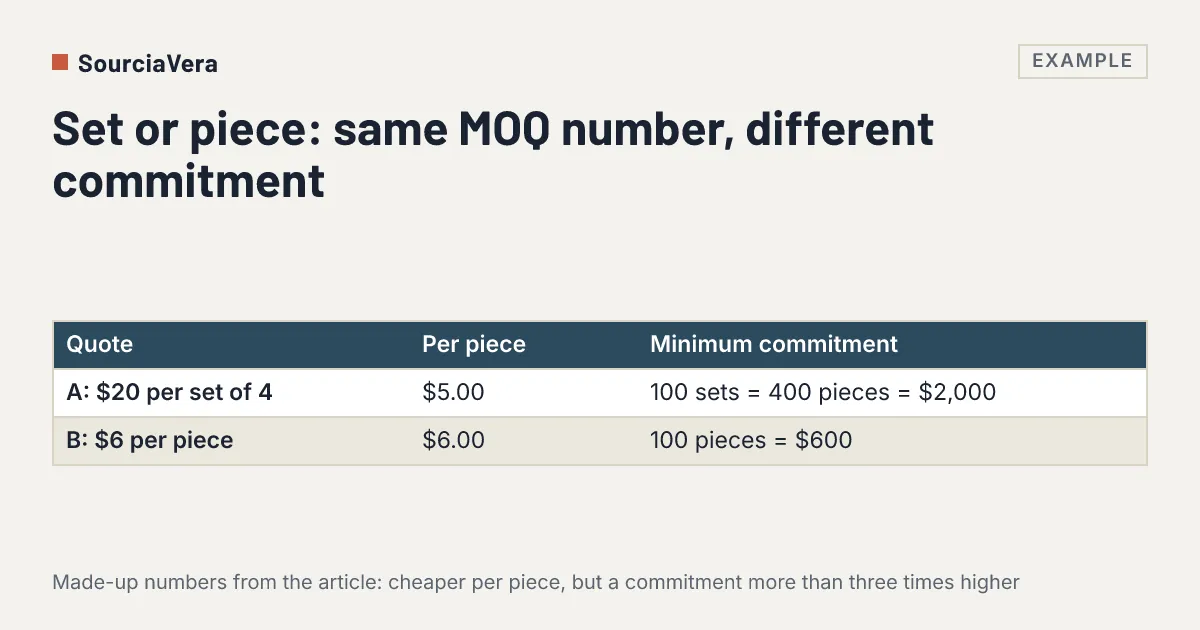
Because the same number means different quantities. "MOQ 100 sets" of four pieces each is 400 pieces; "MOQ 100 pieces" is 100 pieces. The price follows the same logic: "$20 per set" and "$6 per piece" look like a cheap set and an expensive piece, but they only compare after you convert them to the same unit. Here is an example with made-up numbers:
| Quote | Unit | Pieces per unit | Price per piece | Minimum commitment |
|---|---|---|---|---|
| Supplier A: $20 | per set | 4 | $5.00 | MOQ 100 sets = 400 pieces = $2,000 |
| Supplier B: $6 | per piece | 1 | $6.00 | MOQ 100 pieces = $600 |
These numbers are illustrative, not real quotes. Supplier A is cheaper per piece, but its minimum commitment is more than three times higher. Neither number tells you that until you convert the unit.
What Does a Set Look Like in Auto Parts?
These are common patterns, not rules — always ask the supplier what is in their set:
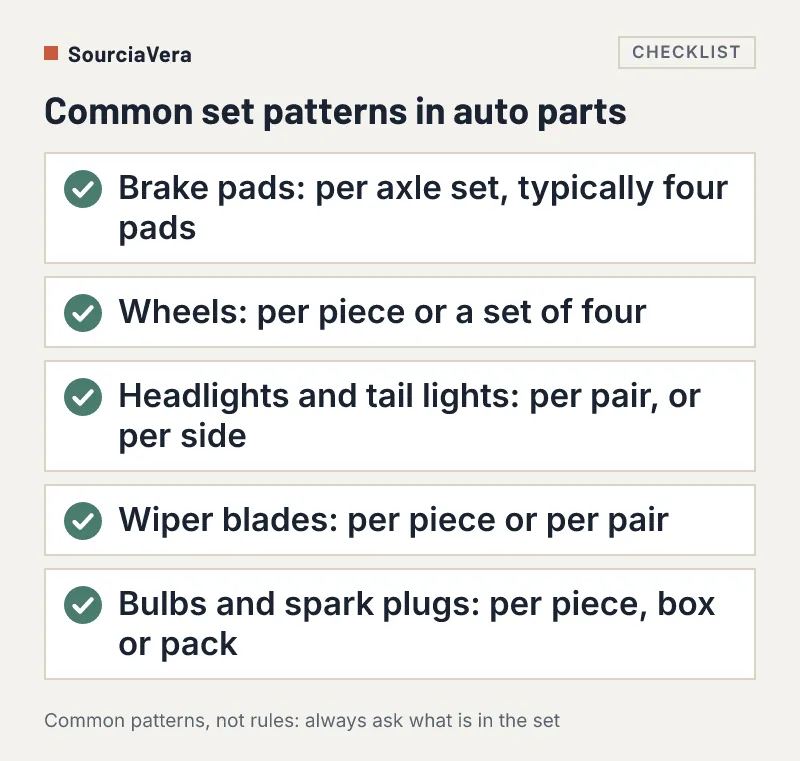
- Brake pads: often sold per axle set, typically four pads (two per wheel). In Mexican Spanish this is usually a juego de balatas.
- Wheels: sold per piece or as a set of four.
- Headlights and tail lights: often per pair (left and right), or per piece for each side.
- Wiper blades: per piece or per pair.
- Bulbs and spark plugs: per piece, per box or per pack of a fixed quantity.
Terms like juego and balatas are explained in Mexican Auto Parts Terminology: A Complete Guide for International Buyers.
How Do You Convert a Quote to a Price Per Piece?
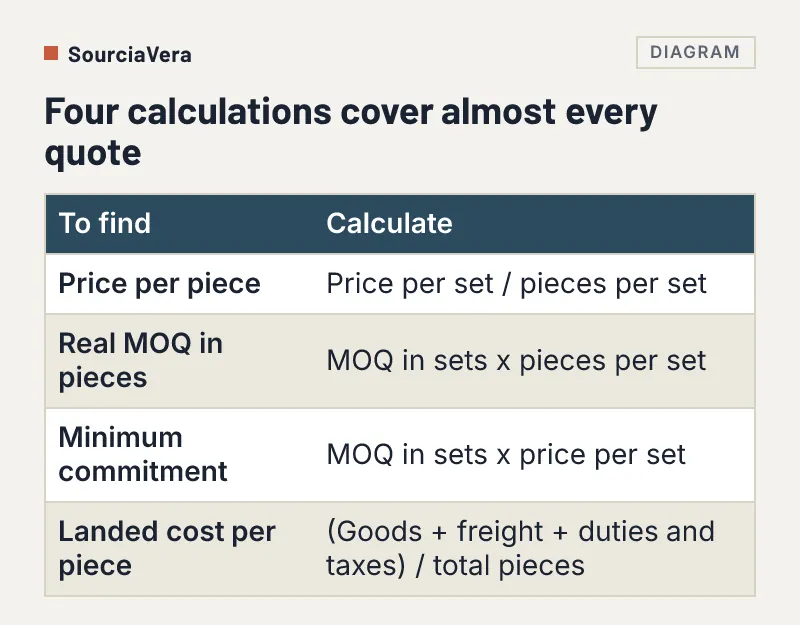
Four calculations cover almost every quote:
- Price per piece = price per set ÷ pieces per set
- Real MOQ in pieces = MOQ in sets × pieces per set
- Minimum commitment = MOQ in sets × price per set
- Landed cost per piece = (goods + freight + duties and taxes) ÷ total pieces
A second example with made-up numbers shows how cartons add another layer. A supplier quotes a set of four brake pads at $18 and says "MOQ 5 cartons, 24 sets per carton". That is 5 × 24 = 120 sets, or 480 pads, and 120 × $18 = $2,160. The price per pad is $18 ÷ 4 = $4.50. If you only needed 100 pads, the MOQ is almost five times what you wanted. Ask whether the supplier will sell by the set instead of by the carton.
How Do You Read a Quote Without Getting Caught?
- Ask: "How many pieces are in one set, and what exactly is included?" and get the answer in writing.
- Check that the MOQ and the price use the same unit.
- Convert every quote to price per piece before you compare suppliers.
- Check the carton and packing-list quantities against your order.
- Confirm whether accessories (clips, shims, hardware, sensors) are included in the set or sold separately.
- Confirm the part number or specification of each piece in the set.
Can You Buy Fewer Than One Full Set?
Sometimes. Some suppliers will split a set and sell single pieces, usually at a higher price per piece or with a different MOQ; others will not. Ask before you assume, and compare the total cost rather than the unit price.
What Are the Most Common Mistakes?
- Comparing a per-set price with a per-piece price
- Assuming a set includes accessories
- Ordering sets when you need individual pieces, or the reverse, and ending up with the wrong stock
- Reading "MOQ 1 set" as "one piece"
- Not checking whether the carton quantity matches the order
Why Should Every Number Have Its Unit in Writing?
Units are not the only thing that gets mixed up. On an order for a client in Latin America, the supplier's first spec sheet for a spare wheel kit mixed up the offset (ET 30) with the center bore (54.1 mm) — two different measurements that, confused, would have meant a wheel that doesn't sit right without a spacer. We required a re-issued, stamped spec sheet before approving the sample, and confirmed the real fitment with an installation video on the vehicle. The full case is in this EV wheel verification case. The lesson applies to sets and pieces too: if a number matters, get it in writing with its unit, for every piece in the set.
What Should You Ask the Supplier?
Send the same message to every supplier, so the answers can be compared:
Please confirm in writing: (1) the unit used for the MOQ and for the price (pieces, sets, pairs or cartons); (2) how many pieces are in one unit, what each piece is, and its part number; (3) whether accessories such as clips, shims or hardware are included; (4) whether you sell single pieces, and at what price; (5) how many units are packed in one carton.
What Should You Do Next?
- Find the two units on the listing: the one next to the MOQ and the one next to the price. If they differ, stop and ask.
- Send the message above and keep the supplier's answer.
- Put every quote in a simple table with the four calculations: price per piece, real MOQ in pieces, minimum commitment and landed cost per piece.
- Compare suppliers on landed cost per piece, not on the number in the headline.
- Write the unit and the part number of each piece into the order or proforma invoice, and check the packing list against it before the goods ship.
- Before you pay a deposit, go through 10 Things to Check Before Paying a Chinese Supplier Deposit.
Frequently Asked Questions
What is the difference between a set and a piece in MOQ?
A piece is one item. A set is a group of items sold together as one unit, and the supplier decides what is in it. The unit is part of the MOQ, so 100 sets can mean many more pieces than 100 pieces.
How many pieces are in a set?
It depends on the product and the supplier. There is no standard, so ask in writing how many pieces make one set and what each piece is.
Is MOQ 100 sets more than MOQ 100 pieces?
Usually yes, unless a set contains only one piece. Multiply the MOQ by the pieces per set to see the real quantity, and by the price to see the real commitment.
Can I buy fewer than one full set?
Sometimes. Some suppliers split sets and sell single pieces, often at a higher price per piece or with a different MOQ. Ask before you assume.
How do I convert a price per set to a price per piece?
Divide the price per set by the number of pieces in one set. For example, $20 for a set of 4 pieces is $5.00 per piece. Then multiply the MOQ in sets by the pieces per set to see the real minimum quantity.
Summary and Next Step
The unit is part of the MOQ and part of the price. Before you compare suppliers or commit money, convert every quote to the same unit, get the contents of a set in writing, and look at the total commitment, not just the unit price. A clear answer to "what exactly is in one set?" is also a good sign about the supplier.
For buyers importing from China, understanding the supplier before investing money can reduce unnecessary risks. SourciaVera helps international buyers verify Chinese suppliers, understand manufacturing capabilities, and make safer sourcing decisions. If you're not sure where to start, the $49 Remote Check looks at the basics — company registration, manufacturer vs. trader, address, and whether the payment account matches the company name — before you place an order. And before you pay a deposit, run through 10 Things to Check Before Paying a Chinese Supplier Deposit.
In short, convert every quote to the same unit and get the contents of a set in writing. If you compare a price per set with a price per piece without converting, the realistic outcome is committing to a far larger quantity or total than you meant to. A $49 remote check covers the supplier basics before you commit to a quantity.
I provide supplier verification services, so you should treat my recommendation accordingly.