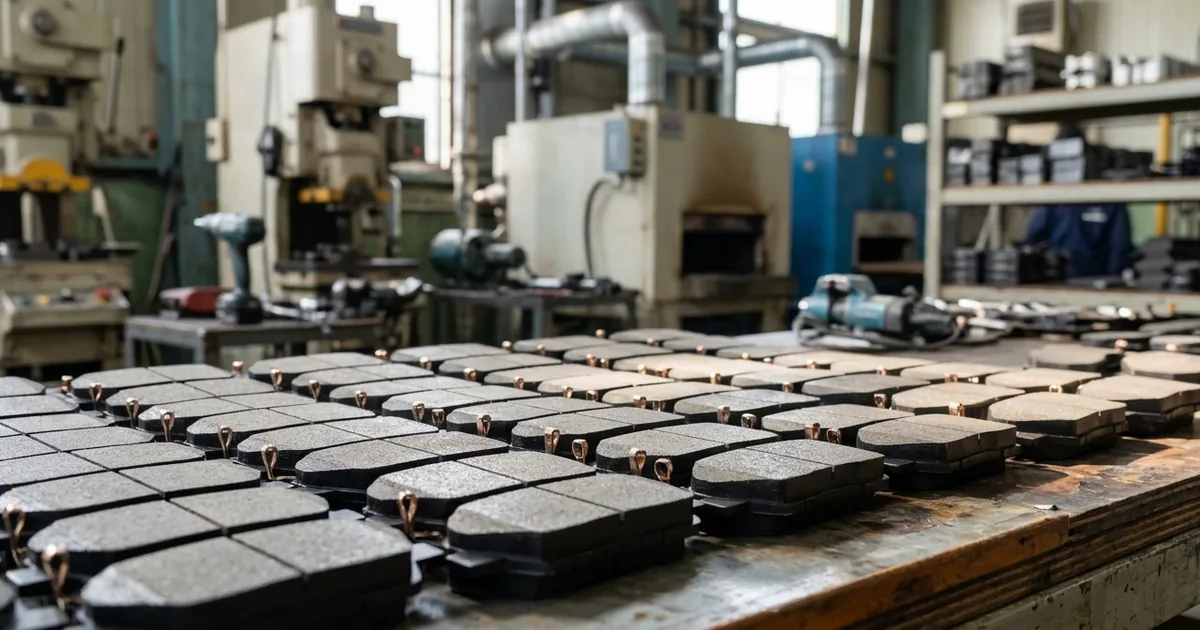
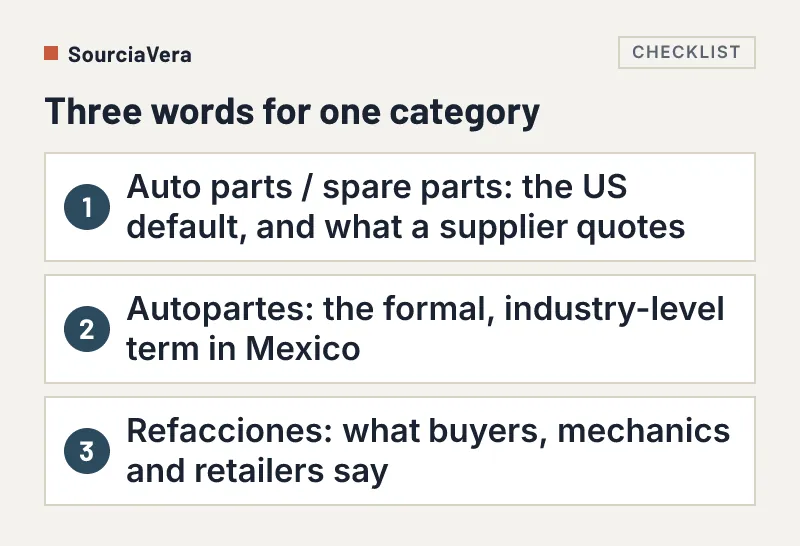
I'm convinced that most sourcing conversations that go wrong don't fail on price or spec. They fail on the word before the price. From our side of the table in Guangzhou, our team and I see it all the time: a buyer emails a Chinese supplier asking about "auto parts," the supplier quotes a catalog of "spare parts," and three messages later nobody has confirmed they're even talking about the same category. Meanwhile the buyer's actual customer back home doesn't use either of those words. They say refacciones.
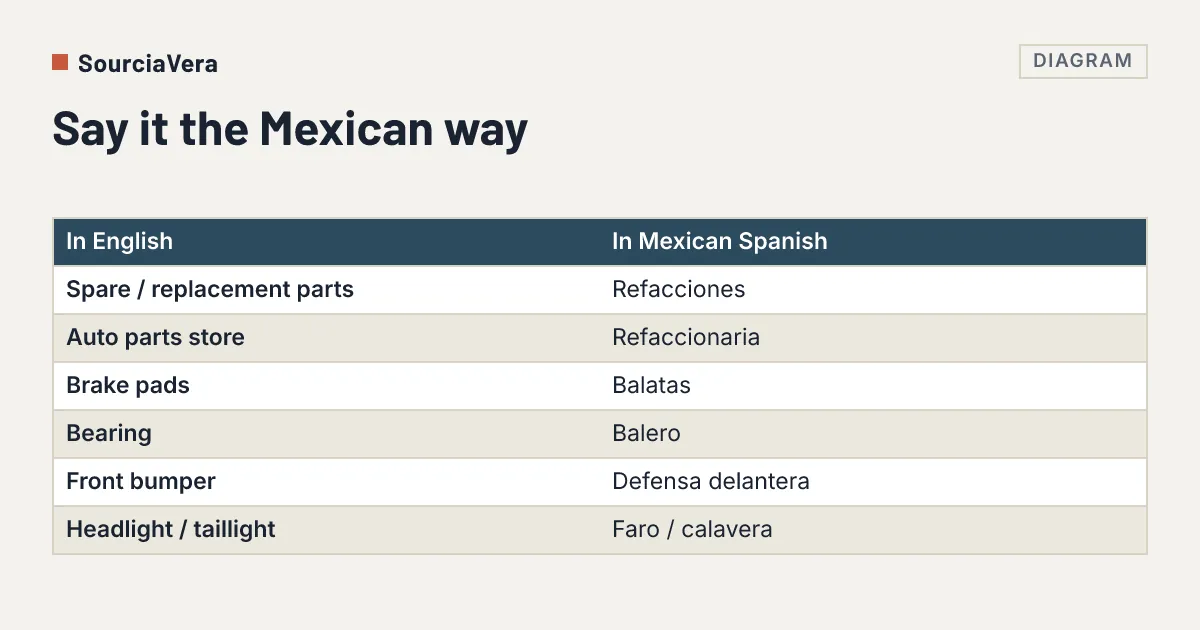
The short answer: in Mexico, replacement auto parts are called refacciones and the shop that sells them is a refaccionaria; autopartes is the formal, industry-level term. “OEM” and “aftermarket” are used untranslated, and several everyday part names differ from textbook Spanish: balatas for brake pads, balero for bearing, defensa for bumper, calavera for taillight. The tables below map each English term to the word a Mexican buyer actually uses.
In the United States, the industry defaults to auto parts or spare parts. In Mexico, buyers, mechanics, and retailers overwhelmingly say refacciones, and the shop that sells them is a refaccionaria — not a "tienda de autopartes," which is technically correct and rarely what anyone actually says. That gap seems small until it's the reason a supplier misquotes a category, a customs document uses the wrong term, or a Mexican retailer's website doesn't match the keywords its own customers are searching.
Our team in Guangzhou works in English and Spanish every day, and I put this guide together as a working reference for exactly that situation: a Mexican importer, a Chinese factory and an English-language spec sheet all trying to describe the same part. Keep it open next to your RFQ.
- Refacciones, not "partes de auto," is the term the Mexican aftermarket actually uses — and refaccionaria is what a parts shop is called.
- OEM and aftermarket are used directly in Spanish (no translation), but "¿Es original o aftermarket?" is the question you'll actually be asked.
- Category vocabulary (defensa, balatas, balero) varies enough from textbook Spanish that a literal translation can confuse a buyer more than it helps.
- Search behavior splits by language: Mexican buyers researching suppliers mix English industry terms with Spanish business terms — neither language alone captures how the search actually happens.
- Getting the vocabulary right doesn't replace verifying the supplier — it just means the RFQ, the fitment data, and the inspection report are describing the same part everyone thinks they're describing.
Why Does Vocabulary Matter in Sourcing?
Three reasons:
- A small gap causes real errors. A supplier misquotes a category, or a customs document uses the wrong term.
- Your customer uses different words. Mexican buyers say refacciones, while a Chinese catalog says spare parts, so three messages in nobody has confirmed they mean the same category.
- Search keywords follow the words. A retailer's website can end up not matching the keywords its own customers search.
1. What Do Mexicans Call Auto Parts? Autopartes, Refacciones, Refaccionaria
These are the words that come up in every conversation I have with Mexican buyers, whatever the category:
| English | Mexican Spanish | Meaning / Notes |
|---|---|---|
| Auto parts | Autopartes | General term, used in industry/B2B contexts |
| Spare parts / replacement parts | Refacciones | The word buyers, mechanics, and retailers actually use day to day |
| Auto parts store | Refaccionaria | Retail or wholesale parts shop — not "tienda de autopartes" |
| Automotive supplier | Proveedor automotriz / Proveedor | Supplier |
| Manufacturer | Fabricante | Factory or producer |
| Distributor | Distribuidor | Distributor |
| Repair shop | Taller mecánico | Where the parts get installed |
Autopartes is the correct industry-level term and works fine in a company name or a formal document. Refacciones is what the actual buyer says on a phone call. If your supplier-facing materials only use one of the two, they're missing the register the end customer speaks in.
2. How Do You Say OEM, Genuine and Aftermarket in Mexico? (Where Miscommunication Gets Expensive)
Before anyone quotes from China, the type of part has to be unambiguous. The price difference between these categories can be 3–5x, so this is the table I'd check first.
| English | Mexican Spanish |
|---|---|
| Genuine parts | Refacciones originales |
| OEM parts | Refacciones OEM |
| Aftermarket parts | Refacciones aftermarket |
| Replacement parts | Piezas de reemplazo |
| Universal fit parts | Piezas universales |
Both "OEM" and "aftermarket" are used directly in Spanish — they don't get translated. What changes is the question a buyer or their customer will actually ask: ¿Es original o aftermarket? ("Is this original or aftermarket?"). If your quote, your product listing, or your inspection report doesn't answer that question in exactly those terms, expect a follow-up message asking it again.
3. Exterior Parts in Mexican Spanish: Defensa, Cofre, Calavera
| English | Mexican Spanish |
|---|---|
| Front bumper | Defensa delantera |
| Rear bumper | Defensa trasera |
| Hood | Cofre |
| Fender | Salpicadera |
| Trunk | Cajuela |
| Headlight | Faro |
| Taillight | Calavera |
| Grille | Parrilla |
| Windshield wiper | Limpiaparabrisas |
In my experience, this is the category where a dictionary translation is most likely to mislead. A bumper is not usually called "parachoques" in Mexican day-to-day use — it's defensa. A supplier deck built around textbook Spanish will still be understood, but it reads like it wasn't written for the market it's targeting.
4. Engine Components in Mexican Spanish
| English | Mexican Spanish |
|---|---|
| Engine | Motor |
| Spark plug | Bujía |
| Air filter | Filtro de aire |
| Oil filter | Filtro de aceite |
| Fuel injector | Inyector |
| Water pump | Bomba de agua |
| Alternator | Alternador |
| Battery | Batería |
5. Suspension, Brakes and Wheels: Why Balatas and Balero Matter
This is also the category where a fitment mistake costs the most. Our team saw that firsthand on the offset case linked below, so getting the term right matters more here than in almost any other section.
| English | Mexican Spanish |
|---|---|
| Shock absorber | Amortiguador |
| Brake pads | Balatas |
| Brake disc | Disco de freno |
| Bearing | Balero |
| Ball joint | Rótula |
| Control arm | Brazo de suspensión |
| Tie rod | Terminal / bieleta |
| Coil spring | Resorte |
| Wheel rim | Rin |
Two of these are worth calling out by name, because they don't just diverge from English — they diverge from generic or Spain-Spanish too. Balatas is what a Mexican buyer, mechanic, or retailer says; "pastillas de freno" is the version you'll see in Spain-Spanish documentation or a generic auto-translated catalog. The same split applies to balero, which shows up as "rodamiento" in more formal or non-Mexican Spanish. Same part, same spec — but if your supplier's translated materials use the generic term, it's not the word your Mexican customer will use when they call to order it.
Sourcing wheels or brake components?
These are the two categories where a single spec, whether offset, bore or gauge, decides if a part fits or gets returned. I wrote up how that plays out in a real order for a BYD Seagull.
6. Electronics and Wiring Terms
| English | Mexican Spanish |
|---|---|
| Sensor | Sensor |
| Rear/backup camera | Cámara de reversa |
| Infotainment screen | Pantalla multimedia |
| Wiring harness | Arnés eléctrico |
| ECU | Computadora del motor |
7. Which Search Terms Do Mexican Auto Parts Buyers Actually Use?
If you're building supplier-facing content, a listing or a landing page aimed at this market, "car parts buyer Mexico" is not the phrase your audience is typing. Buyers search in a mix of English industry terms and Spanish business terms, depending on whether they're looking for a factory or a customer:
English: China auto parts manufacturer · China aftermarket parts supplier · automotive parts factory China · OEM replacement parts China
Spanish: fabricante de autopartes en China · proveedor de refacciones de China · importador de autopartes México · distribuidor de refacciones automotrices · mayorista de refacciones
Notice that Mexican buyers searching for a factory relationship are far more likely to type fabricante, proveedor, or fábrica than any English equivalent — even when the rest of their search mixes in English industry terms.
Summary: Vocabulary Writes the RFQ, Verification Confirms the Part
Knowing that "refacciones" beats "partes de auto" solves a communication problem. It doesn't solve the harder one: whether the supplier quoting you refacciones OEM actually manufactures them, or is a trading company relaying a factory catalog it doesn't control.
The two categories where this matters most — wheels and brake components — are also the categories with the least room for error. A wheel with the wrong offset doesn't just look wrong, it changes suspension geometry and wears tires unevenly on one side. A brake pad quoted as "OEM equivalent" without material certification is a liability question, not a pricing question. Vocabulary gets the RFQ written correctly; a factory audit confirms the part behind it actually matches.
What I've taken from these three-way conversations is that the language problem and the verification problem usually show up together. When a supplier's answers get vague, it's worth asking whether they misunderstood the part or simply don't make it. Getting the words right is how you find out which one it is.
To sum up, getting the words right solves the communication problem but not the verification one. If you stop at vocabulary, the realistic outcome is a correctly written quote from a trading company relaying a catalog it does not control, and a wheel or brake part that does not match. A $49 remote check covers whether the supplier is a manufacturer, and our team can check the part itself at the factory.
I provide supplier verification services, so you should treat my recommendation accordingly.