Most buyers treat a factory's spec sheet as paperwork to file, not to check. I think that's backwards. A spare wheel is not the place to guess: the offset (ET), the center bore (CB), and the bolt pattern (PCD) all have to match the vehicle exactly — and on this order, the supplier's own first spec sheet had two of those numbers mixed up with each other.
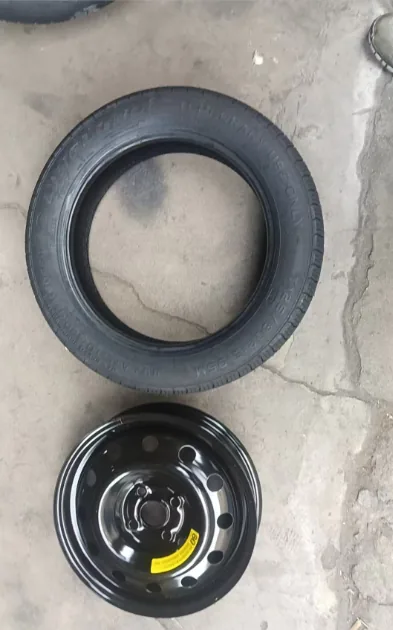
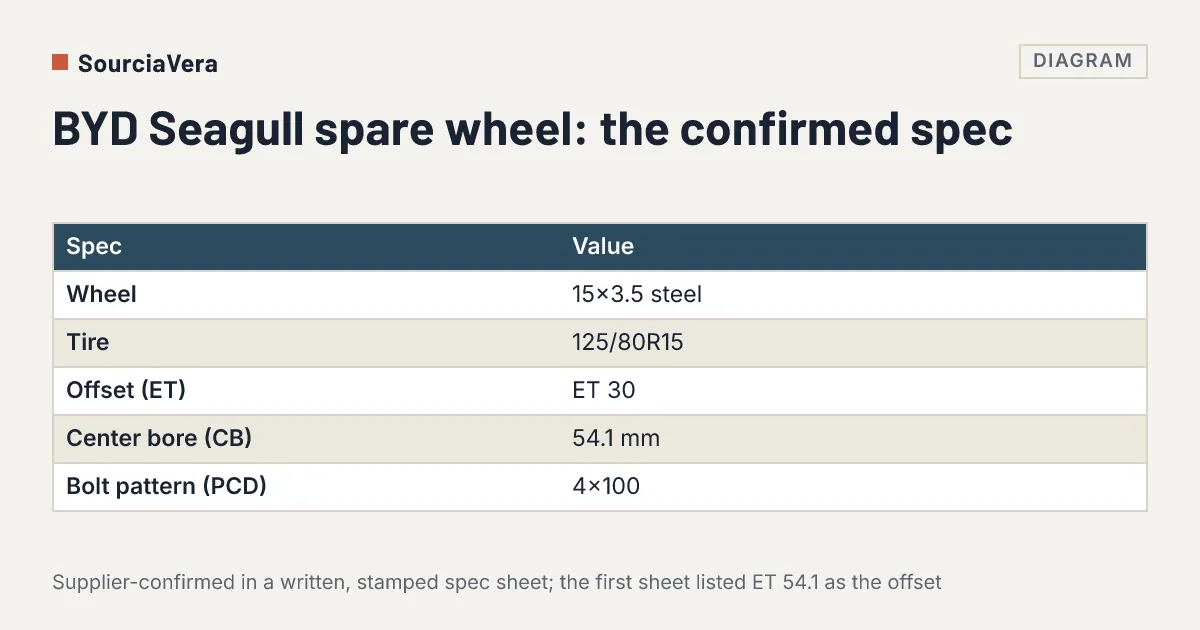
The short answer: the BYD Dolphin Mini — known in other markets as the BYD Seagull — spare wheel kit we sourced is a steel wheel, 15×3.5, with a 125/80R15 tire, an offset of ET 30, a 54.1 mm center bore (CB), and PCD 4×100 — not an ET 54.1 offset, which is what the supplier's first spec sheet claimed. The supplier had put its own center bore figure into the offset field. We caught it by insisting on a written, supplier-stamped spec sheet before paying for a sample, not a verbal confirmation.
A wrong offset isn’t something a spacer quietly fixes. It changes how the wheel sits under the fender, and on a spare wheel meant to go straight on in an emergency, that’s not something you want to discover on the side of a road. Here is how our team caught the supplier’s own mix-up on an order for one of our Latin American clients.
How the Supplier’s Own Spec Sheet Got the Offset Wrong
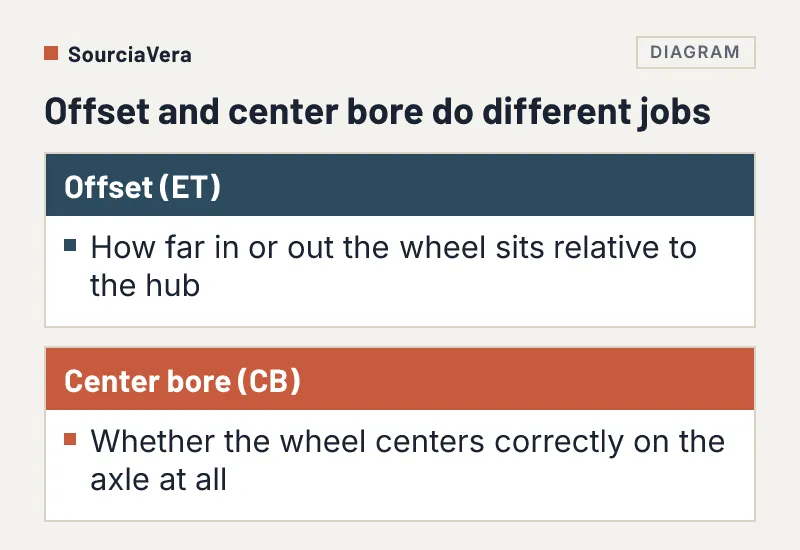
When the supplier sent its first spec sheet for this order, it listed the offset as ET 54.1. That number looked wrong to us for one reason: 54.1 mm is the vehicle’s center bore (CB) — the diameter of the hole that centers the wheel on the hub — not the offset. The two measurements do two different jobs. Offset determines how far in or out the wheel sits relative to the hub; center bore determines whether the wheel centers correctly on the axle at all. Mixing the two up on a spec sheet isn’t just a wrong number on paper — it can mean a wheel that doesn’t sit right or needs a spacer to fit.
We didn’t accept the first spec sheet as final. We asked the supplier to re-check its own numbers and issue a formal, stamped specification document before we would proceed. On review, the supplier corrected itself: the real offset is ET 30, and 54.1 mm was the center bore all along — a 24 mm difference between the two figures, on a part where a few millimeters already matters.
Getting the offset wrong — whether from a typo, a mixed-up spec, or an actual production error — has real consequences on installation. If a spacer is needed to compensate for a wrong offset:
- It changes the suspension and steering geometry.
- It affects how the car handles in corners.
- It can cause uneven tire wear or vibration at highway speed.
A buyer who takes a factory’s first spec sheet at face value, without asking for a written re-check, is betting that a single unverified number is correct. On a wheel, that’s not a safe bet — even the supplier that manufactures the part can get its own paperwork wrong.
We put these same four numbers — size, PCD, offset, and hub bore — into a short video on our Facebook page, with the real fitment test on the car (in Spanish). Watch the video →
How we compared four wheel factories (and why only one qualified)
The problem: every factory quoted, but not every factory could prove its offset. Our team contacted and evaluated four wheel factories before recommending anything. The comparison wasn’t mainly about price — it was about technical accuracy, and whether each factory was willing to prove it:
- Several factories confirmed the offset verbally, with no way to verify it before shipment.
- One supplier’s business license and Alibaba listing both gave an address in Chengdu’s Jinniu District — a district known more for sales offices than production floors. When we asked to see the actual line, the real factory turned out to be in Hongguang, on the other side of the city. That’s not automatically a scam — plenty of legitimate manufacturers run sales from one district and production from another — but it’s exactly the gap between “registered address” and “where your part is actually made” that a buyer can’t catch from a listing page.
- The supplier we finally selected, in Sichuan, was the only one whose registered and actual addresses matched and that was willing to document the real product specification before the client committed to the order.
In my view, a supplier’s willingness to verify — or its refusal — is information in itself. A supplier who can’t prove what they’re selling before shipment won’t be able to fix it after.
What evidence should you ask a wheel factory for before ordering?
Before confirming anything, we coordinated directly with the supplier to get two concrete pieces of evidence:
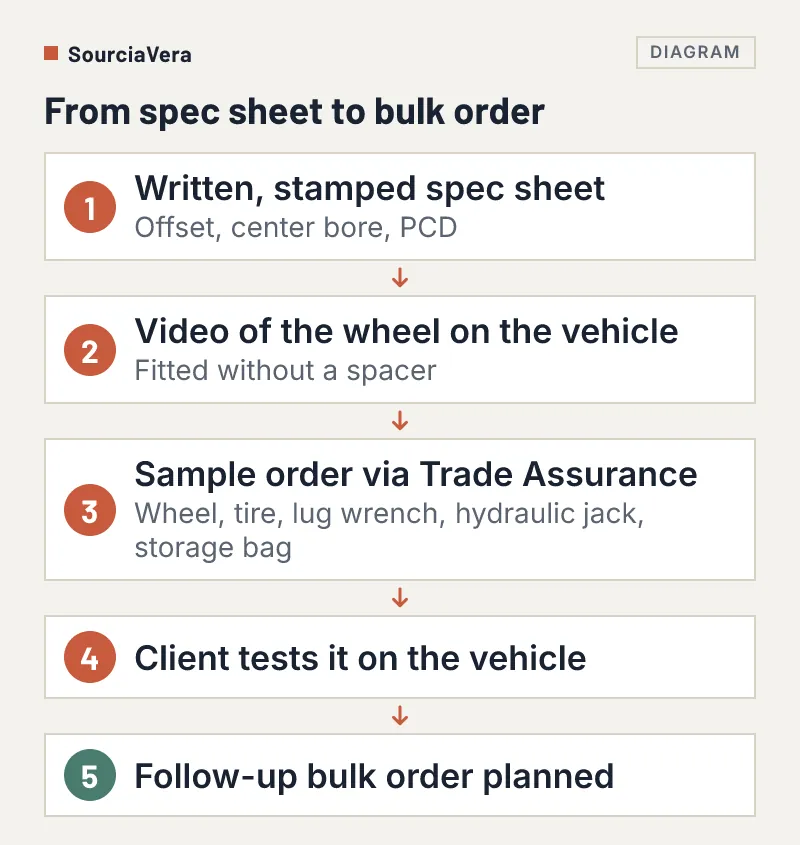
- An actual video of the wheel installed on the vehicle, showing it fit without a spacer.
- A written, supplier-stamped spec sheet with real manufacturing data (offset, center bore, PCD) — not a generic catalog page, and re-issued in writing if the first version doesn’t hold up under a second look.
With the corrected, stamped specification in hand, we placed a full sample order through Alibaba Trade Assurance: wheel + tire + lug wrench + hydraulic jack + storage bag — the complete set exactly as the end user would receive it, not just the isolated part.
The outcome: from sample order to a planned bulk order
The sample shipped and reached the client in September. After testing it against the vehicle, the client confirmed it met the requirement, and the conversation has now moved to a follow-up bulk order.
Summary: Get the Spec in Writing Before the Sample Order
The lesson here isn’t really about this one supplier. It’s that offset, center bore, and PCD all need to be confirmed in writing — because even the supplier that manufactures the part can mix up ET and CB on its own paperwork. A verbal confirmation, or a spec sheet you don’t push back on, isn’t verification. I now ask every wheel factory for a written, stamped specification before any sample order, and I’d tell any buyer sourcing wheels from China to do the same — regardless of how confident the factory sounds on the phone.
What a buyer can take from this case: offset, center bore and PCD all need to be confirmed in writing, because even the factory that makes the part can mix up ET and CB on its own paperwork. If you order on a verbal confirmation, the realistic outcome is a wheel that does not sit right on the vehicle, found only when you test it, with your sample cost and time spent. If you are sourcing parts for a Chinese vehicle, we can ask the factory for the stamped spec sheet and the installation video before you commit, and a $49 remote check covers the company-level questions.
I provide supplier verification services, so you should treat my recommendation accordingly.