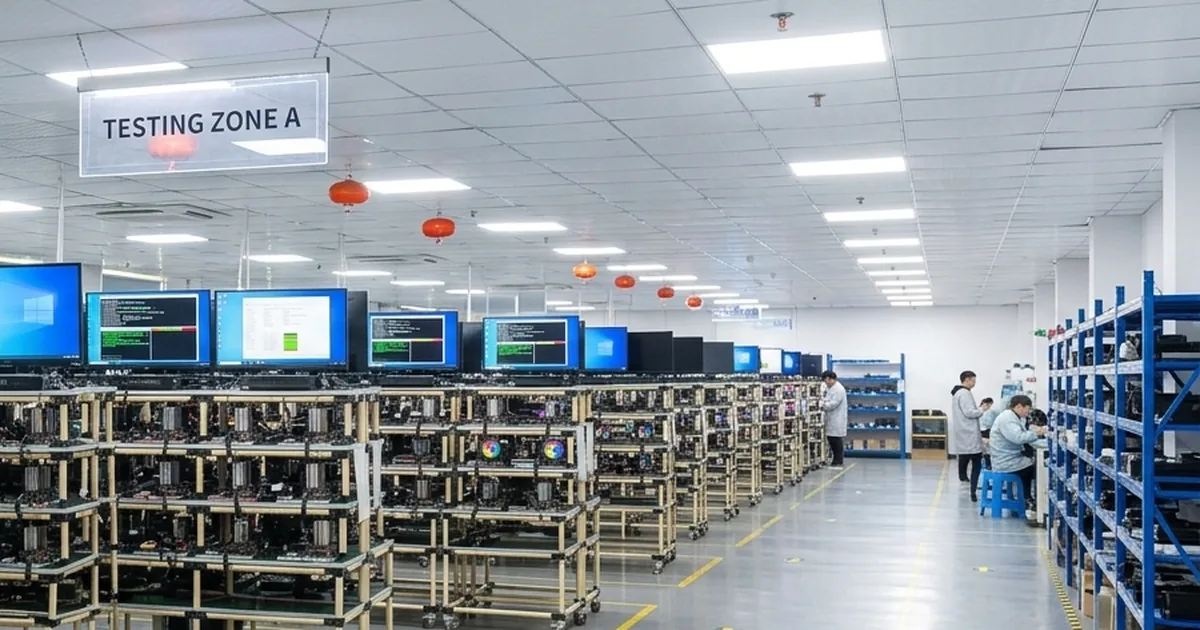
Most buyers who come to Guangzhou for LED auto parts start with one question: who has the lowest price? I think that's the wrong place to start. Price is the one thing this city has in abundance. Within a 50km radius there are thousands of factories making LED headlights, tail lights, light bars, fog lights, underbody kits, off-road spotlights and interior lighting, and factory-gate prices are often well below what distributors in the US and Latin America pay their current suppliers. Finding a cheap quote takes an afternoon. Finding a factory that will build to your spec, container after container, is the actual work.
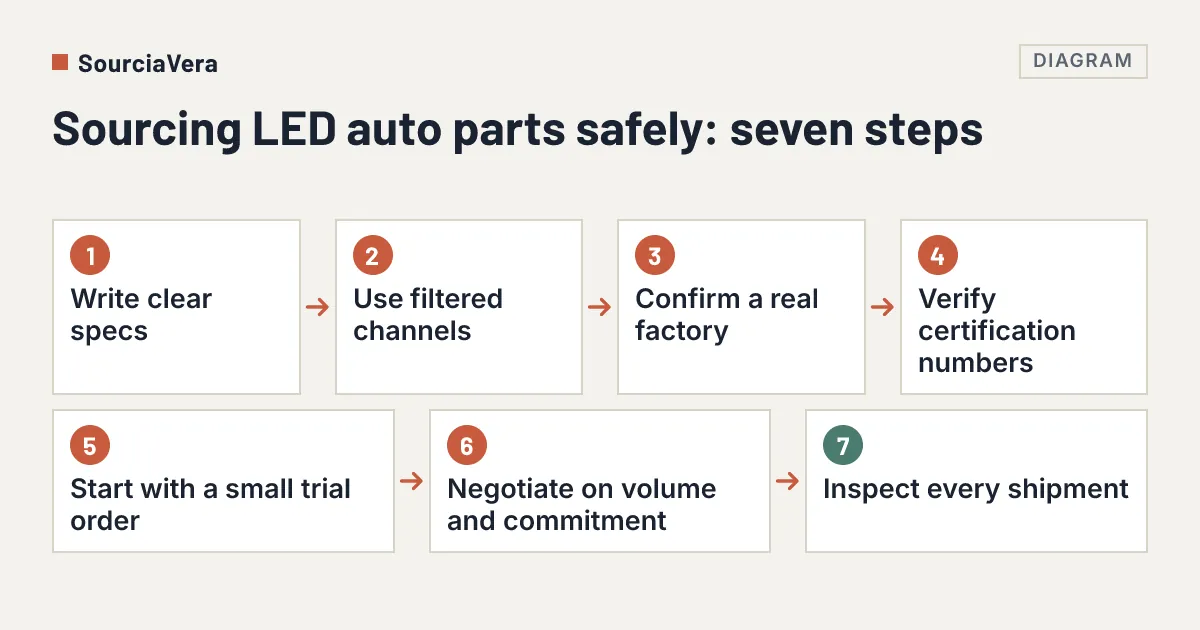
The short answer: to source LED auto parts from China safely, write clear specs first, find suppliers through filtered channels, confirm you're dealing with a real factory, verify certification numbers yourself, start with a small trial order, negotiate on volume and commitment, and inspect every shipment until the factory has proven itself over time. The rest of this guide walks through those seven steps.
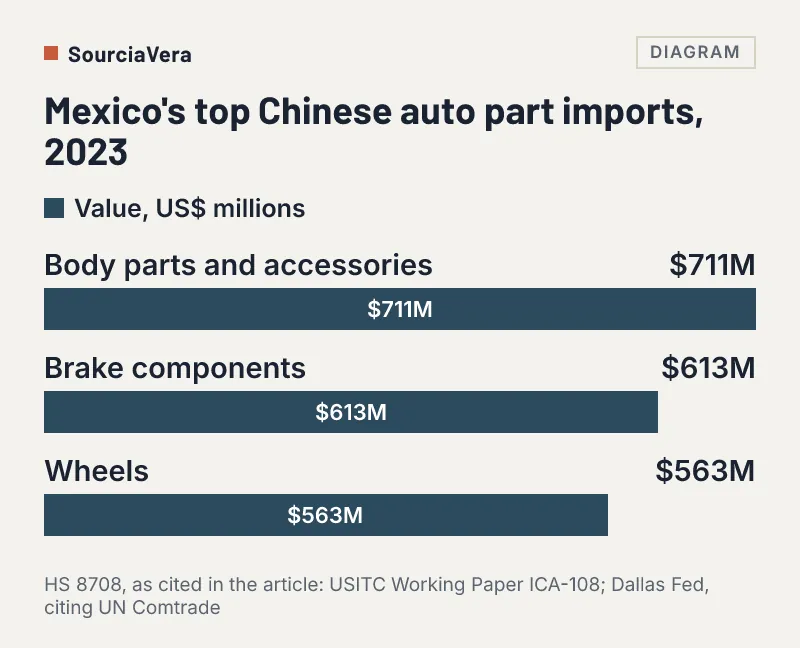
The scale of China's role in this supply chain is well documented. Mexico, one of the largest auto parts markets in Latin America, imported approximately $5.3 billion in Chinese auto parts (HS 8708) in 2023, up from roughly $2 billion a decade earlier. That makes China the second-largest source country for Mexican auto part imports after the United States. The top categories by value: body parts and accessories ($711M), brake components ($613M) and wheels ($563M). Including vehicles, Mexico's total imports from China across HS Chapter 87 reached $13.5 billion in 2024. (Source: USITC Working Paper ICA-108; Dallas Federal Reserve, citing UN Comtrade.)
Our team visits factories in person, and the founder still joins many of the visits. Below is the process I'd walk a first-time buyer through, step by step, the way it usually plays out when a distributor decides to source LED lighting directly instead of through a middleman.
Why Start With Specs Instead of Price?
Three reasons:
- Cheap is easy in Guangzhou. Thousands of factories make LED auto parts within a short radius, and a low quote takes an afternoon to find.
- The work is finding a factory that builds to your spec, container after container. That depends on clear specs, not on the lowest number.
- Consistency only shows over time. The first two orders are how you learn the factory.
Step 1 — What Specs Should You Define Before Contacting a Factory?
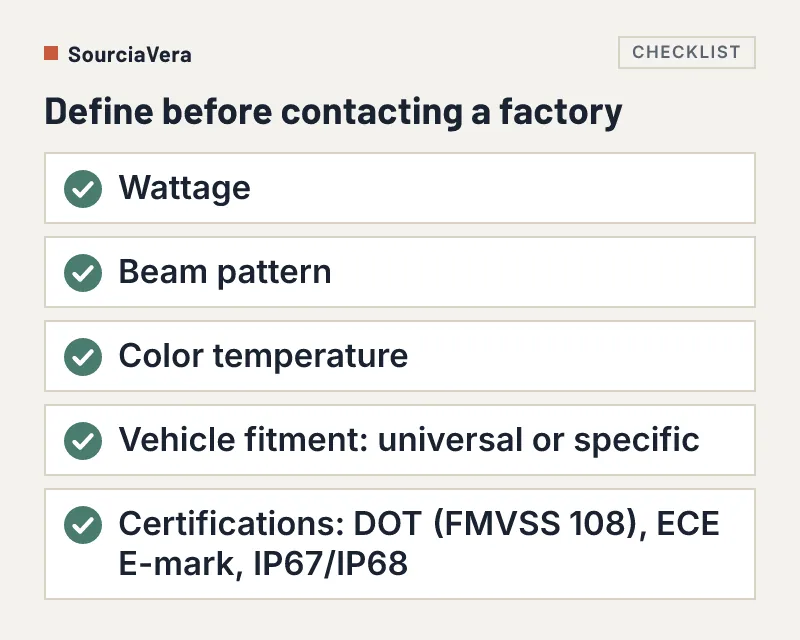
A typical first inquiry says something like "need LED headlights, best price." It gets back a dozen quotes that can't be compared, because every factory filled in the blanks differently. Vague inquiries get vague quotes. Before you contact anyone, define:
- Wattage — output power matters for performance and heat management
- Beam pattern — spot, flood or combo for work lights; low/high beam pattern for headlights
- Color temperature — 5000K for daylight, 6000K for cool white, 3000K for amber fog lights
- Vehicle fitment — universal mount vs. vehicle-specific replacement
- Certifications required — DOT compliance (FMVSS 108) for US road-legal, ECE approval (E-mark) for Europe, IP67/IP68 for water resistance rating
Without specs, you can't compare quotes or reject non-compliant goods. With specs, you have an objective standard to hold the factory to at every stage.
Step 2 — Where Should You Look for LED Auto Parts Suppliers?
There are four main channels, and in my experience each one suits a different kind of buyer:
- Alibaba: The largest selection, but filter hard. Trade Assurance, 3+ years on the platform and a verified supplier badge are the minimums. Read reviews skeptically and verify independently.
- Global Sources: Generally more rigorously verified than Alibaba for electronics and auto parts. The supplier criteria are stricter, and the platform attracts higher-volume buyers.
- Canton Fair (Guangzhou, April and October): You can meet hundreds of LED auto parts manufacturers in person. Phase 1 covers electronics and auto parts. Being able to see and handle the products and have a real conversation with factory representatives is invaluable for a first-time buyer.
- Local sourcing agent: A team based in Guangzhou can pre-qualify factories, negotiate in Chinese, arrange samples without the language barrier and verify suppliers on your behalf before you commit to anything.
Step 3 — Is It a Real Factory or a Trading Company?
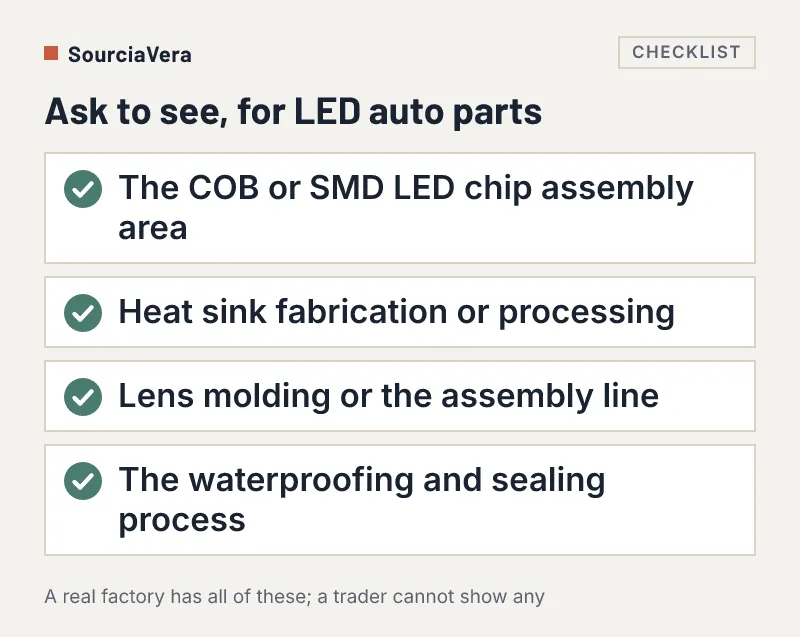
As I cover in the factory verification guide: check the business name, ask for a live video tour showing your specific product, and confirm the registered address is a manufacturing facility. For LED auto parts, our team always asks to see:
- The COB or SMD LED chip assembly area
- Heat sink fabrication or processing
- Lens molding or the assembly line
- The waterproofing and sealing process
A real factory will have all of these. A trading company can't show you any of them, because production happens at a separate facility it doesn't control.
Step 4 — Which Certifications Does Your Market Require?
In regulated markets, certifications aren't optional. For LED auto parts, the requirements depend on the destination:
- United States: lighting sold as road-legal has to meet FMVSS 108, which builds on SAE standards. There is no government approval or SAE certificate to look up: the manufacturer self-certifies and marks the lens “DOT”. Ask for the lab's photometric test report for your exact part number instead of relying on the marking. Selling non-compliant lighting as road-legal can bring serious legal exposure for the importer.
- European Union: ECE/R (UN Economic Commission for Europe) regulations apply: ECE R112 for headlamps, ECE R7 for position lights, and so on.
- Latin America: Requirements vary by country. Mexico follows US standards in many categories; other markets may accept CE.
Plenty of factories will say they have these certifications. Ask for the actual certificate number and verify it yourself on the issuing body's website, because a certificate on a listing doesn't always match the product you're buying. Uncertified LED parts can be seized at customs and returned at your cost, with possible fines on top.
Step 5 — Why Should Your First Order Be Small?
I never recommend placing a first order at full volume. Order a small batch, 50 to 200 units, from your top 2–3 candidate factories. Have them inspected before shipment. Sell the batch. If quality holds and return rates stay low, scale with the winning factory. This adds 6–8 weeks to your timeline, but it removes the single biggest risk in China sourcing: a full container of defective goods.
Most Guangzhou LED factories can accept small orders of 50+ units from new buyers. If a factory insists on a 500-unit MOQ for a first order from a buyer it doesn't know, negotiate, or find a supplier more open to building the relationship gradually.
Step 6 — How Do You Negotiate a Better Price?
Factories in Guangzhou expect negotiation. The first quoted price is not the final price. The levers you have:
- Larger order volumes — the most powerful lever
- Long-term commitment — even an expressed preference for repeat orders shifts pricing
- A simpler SKU lineup — fewer variants reduce setup costs
- Less complex packaging
- FOB pricing vs. DDP — taking responsibility for freight can lower the factory price
Never reveal your target price first. Ask "what is your best price for [X] units?" and "what's your OEM/private label pricing?" Even if you're not ready for OEM, the question signals that you're a serious buyer with plans to grow, and factories give serious buyers better pricing.
Step 7 — How Do You Build a Supplier Relationship That Lasts?
The good China-sourcing relationships I've seen take 2–3 orders to settle. The first order will probably have small problems: a packaging issue, a minor spec deviation, a delay. The second order is where you enforce your quality standards clearly. By the third, both sides understand the system.
Build a QC checklist specific to your product. Keep a golden sample on file. Run a pre-shipment inspection on every order until you have 12+ months of consistent quality from the same factory. At that point you can move to sampling inspection instead of 100% checking, and your sourcing cost drops further.
Summary: Cheap Is Easy, Consistent Is What You Are Shopping For
The buyers who do well with LED parts from Guangzhou aren't the ones who found the cheapest quote. They're the ones who wrote clear specs, started small, and treated the first two orders as a way to learn the factory. Cheap is easy here. Consistent is what you're really shopping for, and it only shows up over time.
To sum up, write clear specs, start small, verify certification numbers yourself and treat the first two orders as a way to learn the factory. If you chase the lowest quote and skip those steps, the realistic outcome is a first container that does not match the sample or the certificates, with cash tied up and a resupply gap. A $49 remote check covers who really makes the part, and our team can look at a shortlist before you commit.
I provide supplier verification services, so you should treat my recommendation accordingly.