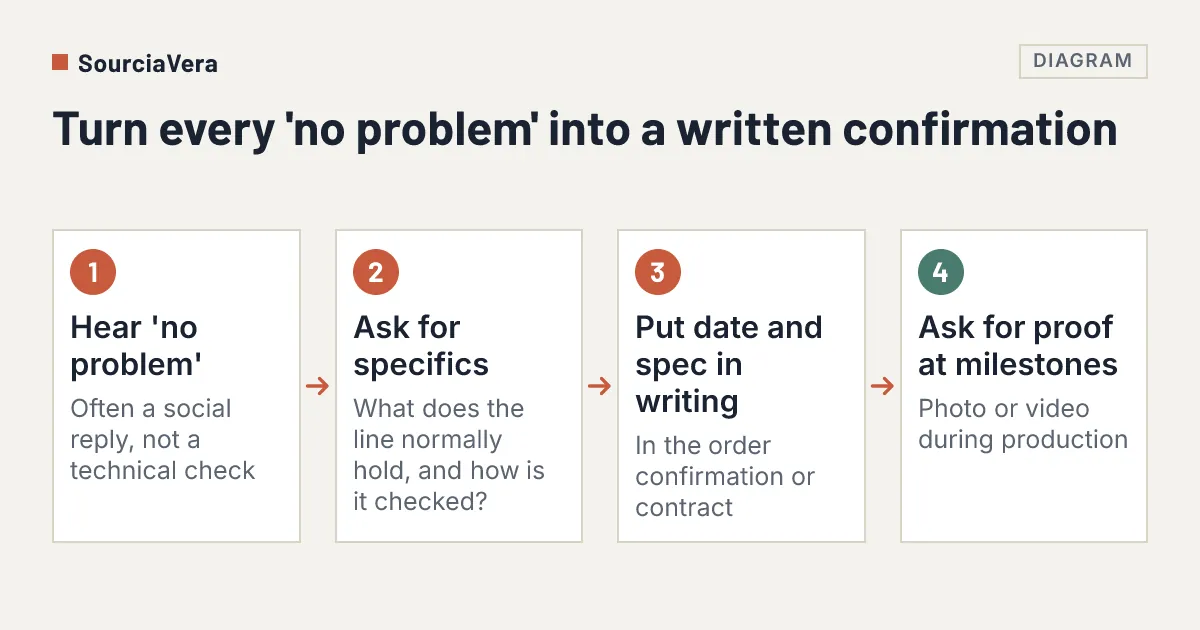
Quick answer: "No problem" is rarely a technical confirmation — most of the time it's a social response that avoids saying "no" directly, or avoids admitting something isn't actually settled yet. It doesn't mean the spec is guaranteed, the deadline is confirmed, or the process already exists. What protects your order isn't tuning that phrase out — it's turning every "no problem" into a specific, written confirmation before any money moves.
I work as a China sourcing agent based in Guangzhou, between Chinese factories and buyers across Latin America, and there's one phrase that causes more misunderstanding than any other, in both directions: méiwèntí (没问题) — "no problem." I hear it from suppliers before they've actually checked whether they can do something. And I watch buyers treat it like a signed contract.
Literally "no problem" or "not an issue." In everyday Chinese business conversation it functions less like a technical yes and more like a social reflex — a way to keep the conversation moving without directly refusing or admitting uncertainty.
Why Does a Chinese Supplier Say "No Problem" Even When There Is One?
From what I've seen working with factories here, méiwèntí often isn't a technical assessment at all — it's a social one. Saying "no, we can't do that" or "no, that's not ready yet" directly can feel like causing the other person to lose face, or like admitting failure in front of a potential client. Avoiding that is a strong instinct in a lot of business conversations here — not a fixed rule, and not something that applies to every person or every factory, but a pattern I run into often enough that I plan around it.
Underneath it is a habit of "say yes first, work out the how afterward." On simple requests that habit actually helps — it keeps things moving. The problem is that it quietly stretches to cover questions it was never built to answer, like whether a tolerance is actually achievable on this production line, or whether a deadline is realistic given everything else already queued up on the factory floor.
How Does Each Side Misread the Other When Working With Chinese Suppliers?
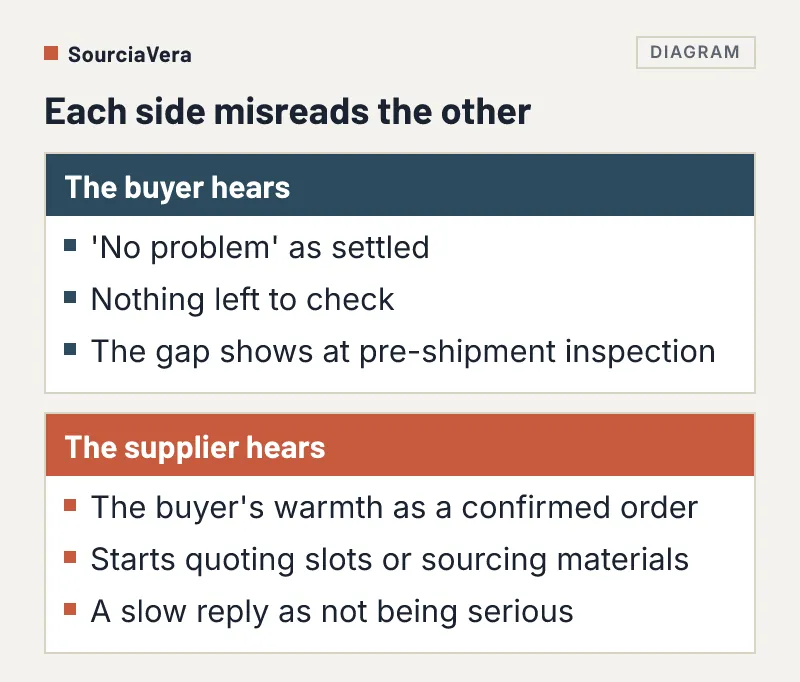
The buyer's side of this is the one people usually talk about: a Latin American buyer hears "no problem" and treats it as settled — nothing left to check, no reason to ask a follow-up question. The gap shows up later, usually at pre-shipment inspection, when the "confirmed" spec wasn't actually met, because nobody ever asked exactly how it was going to be held.
What I see less discussed is the other direction. Buyers from Latin America tend to build the relationship with real warmth before getting into business specifics — enthusiasm, friendliness, genuine interest in the people they're talking to. A Chinese supplier, used to reading friendliness as a signal that a deal is already moving forward, sometimes reads that warmth as a confirmed order, and starts quoting production slots or sourcing materials before the buyer has actually decided anything. When the buyer then takes a few weeks to respond — because they were still comparing options, not because they changed their mind — the supplier reads it as the buyer not being serious, when really the two sides were just at different stages of the same conversation without realizing it.
Neither misreading comes from bad intent on either side. They come from two different communication styles meeting in the middle of a transaction where production slots and money are the thing actually at stake.
What Should You Do Instead of Relying on the Phrase?
| Instead of | Do This |
|---|---|
| Asking "can you hold this tolerance?" | Ask "what tolerance does this line normally hold, and how do you check it?" — a question that requires specifics, not a yes/no |
| Accepting a verbal "no problem" on a deadline | Get the date in the platform order confirmation or a written contract, not just the chat |
| Waiting until the final shipment to check | Ask for photo or video proof at defined production milestones, not only at the end |
| Treating warmth from either side as a closed deal | Remember a closed deal has spec, quantity, price and date — in writing, from both sides |
None of this is about distrust. It's about not asking a social phrase to do the job of a technical confirmation — it's the same kind of factory verification that applies whether you're buying wholesale from China for the first time or already have a recurring supplier relationship. For the full list of what to lock down in writing before a deposit moves, I've laid it out in detail in 10 Things to Check Before Paying a Chinese Supplier Deposit — checks #4 and #9 are the ones that come up most often in exactly this situation.
Frequently Asked Questions
How do I ask a Chinese supplier for a real confirmation without it feeling like an accusation?
Ask about the how instead of asking them to repeat the yes. Questions like "what process do you use to hold that tolerance?" or "how many units have you made to this spec before?" ask for information, not a promise — and a supplier who genuinely has it under control answers with specifics, without hesitating.
Does "méiwèntí" mean they will definitely do it?
Not necessarily. It can mean they can do it, they believe they can, or they don't know yet and don't want to say so in that moment. The phrase on its own doesn't distinguish between those three — only a specific confirmation does.
Does this only happen to buyers, or do Chinese suppliers misread buyers too?
It runs in both directions. Just as a buyer can over-read a "no problem," a supplier can over-read a Latin American buyer's warmth as a decided order. Neither misreading belongs to just one side.
Summary: Turn Every "No Problem" Into a Written Confirmation
Neither of these misunderstandings comes from anyone acting in bad faith. They come from two communication styles colliding quietly in the middle of a transaction where production and money are already moving. What actually changes the outcome isn't trusting the other side less — it's relying less on the tone of a conversation and more on what's written down and what can be verified in person.
In short, "no problem" is rarely a technical confirmation, so turn each one into a specific, written confirmation before money moves. If you take the phrase as a promise, the realistic outcome is a spec, a deadline or a process that was never actually settled, found out after production has started. If a supplier keeps answering in reassurances, our team in Guangzhou can confirm the spec, the capacity or the production stage in person.
I provide supplier verification services, so you should treat my recommendation accordingly.