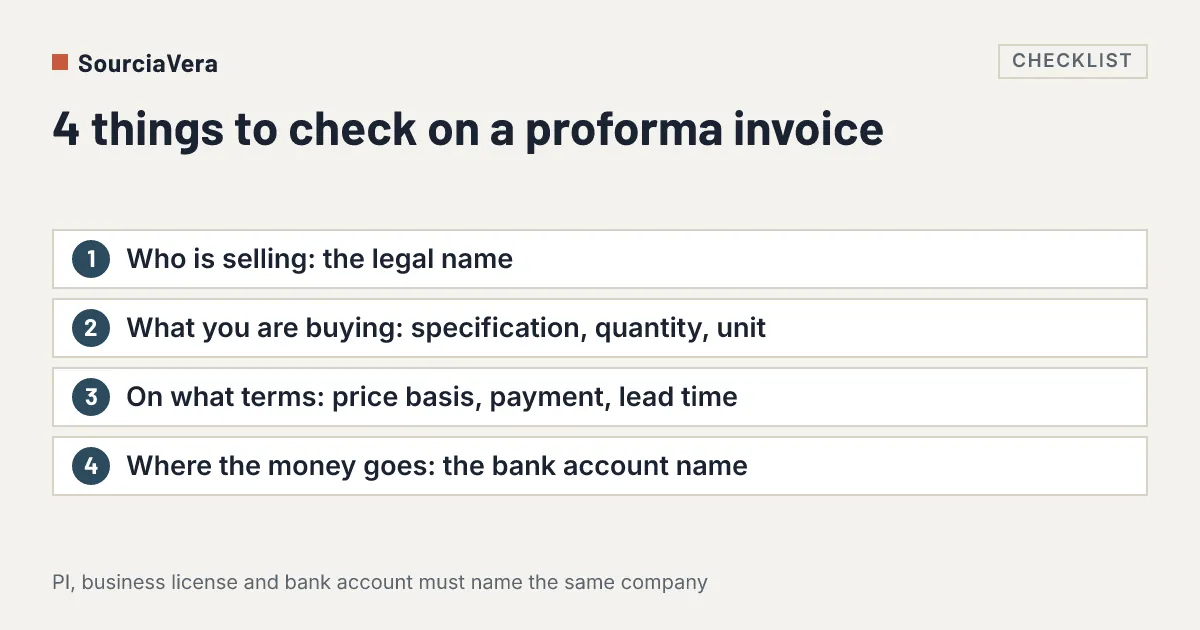
The short answer: a proforma invoice (PI) is the supplier's written statement of what you are buying and on what terms, issued before you pay. Before you pay against one, check four things: who is selling (the legal name), what exactly you are buying (specification, quantity and unit), on what terms (price basis, payment terms and lead time), and where the money goes (the name on the bank account). If the company on the PI, the company on the business license and the company on the bank account are not the same, stop and ask why before you send anything.
You may have agreed a price in chat and now be holding a PI with bank details and a request for the deposit. It is easy to skim, but if the order goes wrong, it is one of the few written records of what was agreed.
What Is a Proforma Invoice, and Is It a Contract?
A proforma invoice is a preliminary invoice: it lists the goods, quantities, prices and terms before the sale is final, and many suppliers send one to confirm an order and ask for the deposit. It is not the commercial invoice that travels with the shipment and is used for customs. Whether a PI is legally binding depends on what the parties agree and on the law that applies; this is general information, not legal advice. In practice, accepting a PI and paying the deposit is how many suppliers start an order, so read it as if it were the contract and fix mistakes before you pay, not after. Recent news shows why the details matter: Mexico's Customs Law reform, which widens the power to seize goods declared below their value (what importers from China should keep in writing); the date from which China's export VAT rebate on new energy vehicles falls (what to put on the PI before then); customs checks on the format of steel mill certificates (what to agree with the supplier); and the new dates of Mexico's electronic value declaration (what invoice, contract and payment must match).
What Should a Proforma Invoice From a Chinese Supplier Say?
Use the table as a checklist against the PI in front of you. The right-hand column shows what should make you stop and ask.
| Field | What to check | Stop and ask if… |
|---|---|---|
| Seller's legal name and address | The full company name in Chinese and English, the same as on the business license (look it up in China's official registry). | Only a brand or sales-account name appears, or it is not the company you have been talking to. |
| Buyer, PI number, date and validity | Your company name and address as they should appear on the import documents; a PI number, an issue date and how long the price holds. | Your details are wrong, or there is no date or validity, so the price can be "updated" after you pay. |
| Product and specification | Model or part number, material, size, color and packaging, worded as in the specification and sample you approved. | It says "as discussed" instead of stating the specification. |
| Quantity, unit and price | The number and the unit, pieces or sets (see "set" versus "piece"); the total equals quantity times unit price; the currency (USD or RMB) is stated. | The unit differs from the quote, the arithmetic is off, or there is no currency. |
| Price basis (Incoterm) | A delivery term such as EXW, FOB, CIF or DDP with a named place, for example "FOB" and the port. ICC says the Incoterms rules "clearly define buyer and seller responsibilities worldwide" (ICC), so the term decides what the price includes. | There is no named place, or quotes use different terms, so prices cannot be compared. |
| Payment terms | The deposit, the balance and what triggers each payment, for example "balance after the inspection report is approved". | The balance is due before you have seen the goods or an inspection report. |
| Lead time | Production time counted from a stated event, such as receipt of the deposit and approval of the sample. | It says "ready soon", or there is no date. |
| Bank details | Beneficiary name, account number, bank name and address, and SWIFT code. The beneficiary should be the seller named at the top. | The beneficiary is a person or another company, with no written explanation. |
| Packaging, quality standard and what happens if goods do not match | Packaging requirements, a stated quality standard, and what the supplier does if the goods do not match. | Nothing is said about quality, or only "good quality". |
Do the Three Names Match?
The most useful check takes a few minutes: compare the seller's name on the PI, the name on the business license and the beneficiary name on the bank account. Stages 1 and 5 of the China Supplier Verification Checklist explain how. If the three are not the same company, you cannot be sure who you are contracting with: ask for a written explanation on the supplier's letterhead and hold the payment until you have it. There can be an ordinary reason, such as a group company that handles the money, but it should be written down before the money moves.
If you buy through Alibaba.com, Alibaba's Trade Assurance buyer page says it protects online orders when payment is made through Alibaba.com, and that your online order and communication records are the basis of refund resolution (Alibaba's page). A payment sent straight to the bank details on a PI is outside that checkout, so there you rely on the supplier and on what the PI says.
What If the Bank Details Change Later?
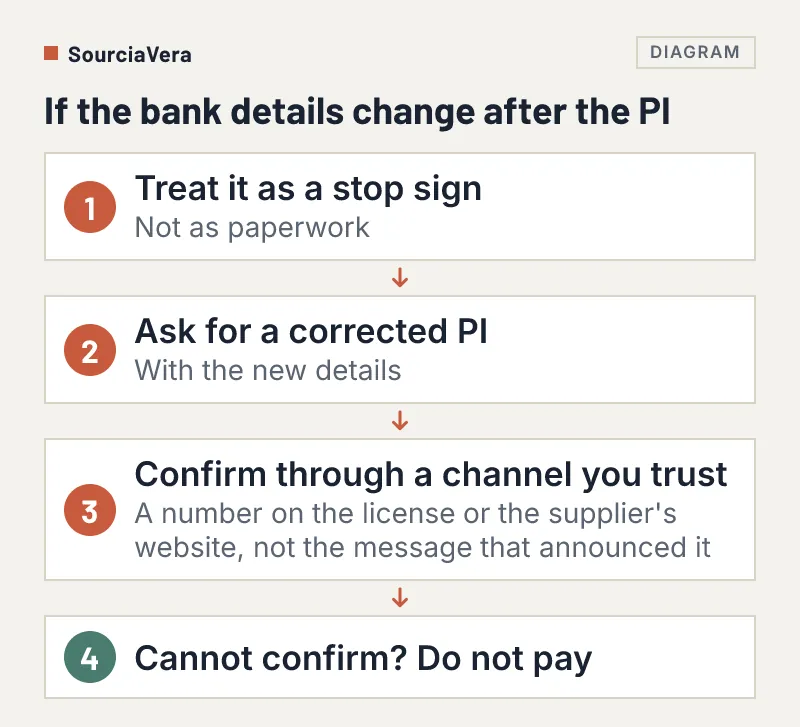
Treat a change of bank details after the PI as a stop sign, not as paperwork. Ask for a corrected PI with the new details, and confirm the change through a channel you already trust, such as a phone number on the business license or on the supplier's own website, not by replying to the message that announced it. If you cannot confirm it, do not pay.
What Does a Clean PI Look Like?
Illustrative numbers, not a real order: 300 pieces at $12.40 each is $3,720, quoted FOB with a named port. A 30% deposit of $1,116 is due when the PI is accepted, and the 70% balance of $2,604 is due after the pre-shipment inspection report is approved. Production takes 25 days from the deposit and the approved sample, and the payee is the registered company named at the top of the PI. That is one way to structure it; our wholesale guide lists 30% / 70% as a common structure for verified factories and 100% up front as high risk, and 10 things to check before paying a deposit covers what should trigger each payment.
What Can Checking a PI Not Tell You?
A PI with matching names does not show that the factory can make your product, that the quality will match the sample, or that the goods will ship on time. It reduces one risk: paying the wrong company, or paying on unclear terms. The sample, a check partway through production and an inspection before the balance handle the rest (see what an inspection costs). No list of checks, including this one, guarantees a clean transaction.
What I would not do is interrogate every supplier on every order. Spend the five minutes on the ones about to receive real money, before the money moves (the 7 questions to ask before you wire money are a start). A PI with bank details is usually where that moment arrives.
What Should You Do Next?
- Ask for the PI on the supplier's letterhead, with the seller's full legal name in Chinese and English and its address.
- Compare three names: the seller on the PI, the company on the business license (look it up in China's official registry) and the beneficiary on the bank account. If they differ, hold the payment and ask for a written explanation.
- Check every field in the table against the specification you approved, and ask the supplier to correct the PI itself rather than explain it in chat. Still comparing suppliers? Start with our guide to how many suppliers to contact and how to compare them.
- Settle the payment split, what triggers each payment and the lead time in the PI. On larger orders, tie the balance to an inspection report.
- If the bank details change after the PI, confirm by phone through a number you already trust, and get a corrected PI before you pay.
Frequently Asked Questions
What is a proforma invoice, and is it legally binding?
A proforma invoice is a preliminary invoice that states the goods, quantities, prices and terms before the sale is final. Whether it is binding depends on what the parties agree and on the law that applies; this is not legal advice. Read it as if it were the contract.
What is the difference between a proforma invoice and a commercial invoice?
A proforma invoice comes before the sale is final, to state the terms and request the deposit. The commercial invoice is the final invoice that goes with the shipment and is one of the documents used for customs entry.
Can I pay a Chinese supplier into a personal account?
Not without a written explanation. A personal or third-party account means the payee is not the company you contracted with, and you cannot check who it is. Ask why, in writing, on the supplier's letterhead.
What does the Incoterm on a PI mean?
It is the delivery term the price is based on, such as EXW, FOB, CIF or DDP. ICC says the Incoterms rules clearly define buyer and seller responsibilities, so the term decides what the price includes. Compare quotes on the same term, with a named place.
Summary and Next Step
A proforma invoice is easy to treat as a formality, but it is where price, specification, terms and the destination of your money meet on one page. You do not need to be an expert in trade documents to read it well; you need to know which fields can hurt you, and to check that the company you verified is the company you are paying.
In short, check which fields can hurt you and that the company you verified is the company you are paying. If you pay against a PI nobody read closely, the realistic outcome is a payment to an account that does not match the supplier, or terms you did not agree to. A $49 remote check looks at whether the payment account matches the company name before you pay.
If you would rather have someone check the basics before the money moves, understanding who is behind each quote before investing money can reduce unnecessary risks. SourciaVera helps international buyers verify Chinese suppliers, understand manufacturing capabilities, and make safer sourcing decisions. I provide supplier verification services, so you should treat my recommendation accordingly. The $49 Remote Check looks at the basics — company registration, manufacturer vs. trader, address, and whether the payment account matches the company name — before you place an order. Send the quote or PI with your request: it is needed to check the payment account.