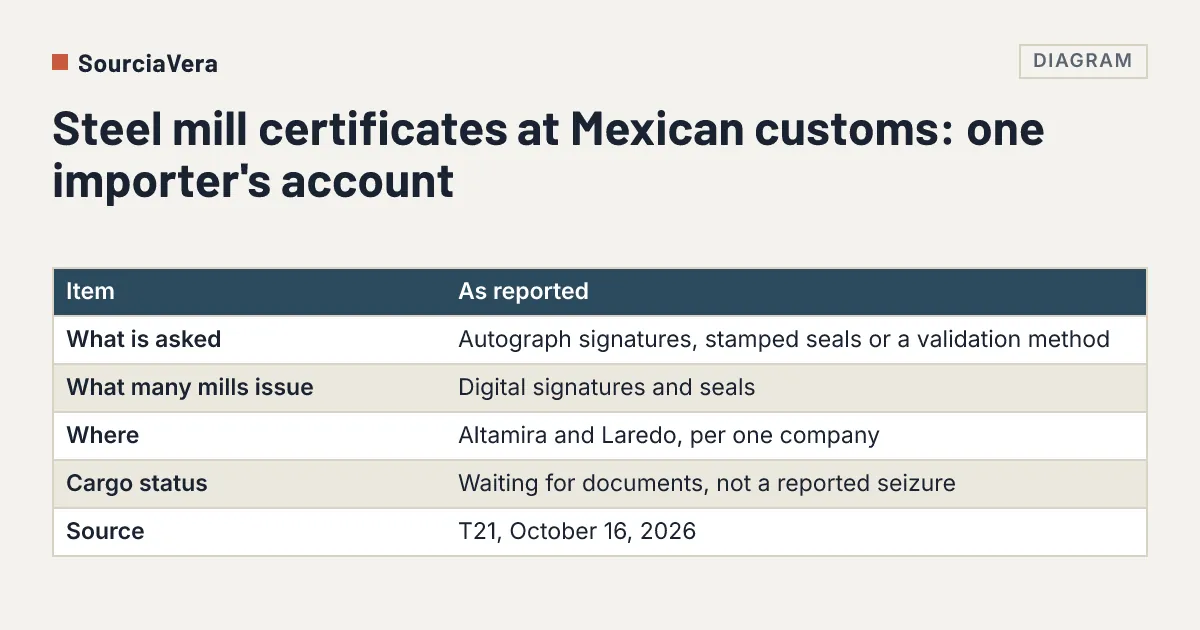
The short answer: a Mexican steel importer told the trade press that customs offices are now checking mill certificates more strictly and asking for autograph signatures, stamped seals or a specific validation method, while many foreign mills issue certificates with digital signatures and seals. If you buy steel or any material that ships with a mill or quality certificate, ask the supplier before shipment what form the certificate will take and whether it matches the goods, and plan for a delay if it does not. This is one company's account, not a customs notice.
This article covers what was reported, what it means for your paperwork and where a third-party check helps. It is based on one trade-press interview and general good practice, not on any first-hand experience of these shipments, and it is not customs advice: ask your customs broker what your port expects.
Why Does It Matter Which Form the Certificate Takes?
- The goods can wait while the paper is fixed. The importer says it keeps the cargo pending presentation to avoid a rejection, so it is a wait for documents and not a reported seizure (T21).
- The fix can take weeks. Some mills no longer have a process to issue the certificate by hand, and others need a person to sign many certificates.
- Waiting costs money and time. The same executive described a plan of deliveries that was already being missed and storage charges that start after the free days.
What Did the Importer Report?
According to T21, Gabriel Sandoval Rodríguez, who runs mobility and logistics at Metal One de México, said at the Amanac shipping-agents congress that reviews of mill certificates are becoming an obstacle for steel supply. Customs demands documents with autograph signatures, stamped seals or specific validation mechanisms, he said, while most mills have digitised the process and use digital seals and signatures that, in his words, the Mexican authority is not recognising. At the time of the interview he estimated about 1,000 tonnes of steel not yet cleared in Altamira and six trucks held in Laredo while the documents were gathered. He said the checks had tightened over about two weeks, that criteria vary between customs offices and that the problems involved certificates from suppliers in Asia and in the United States (T21).
He did not call the customs action wrong: he said these document features were not demanded with the same rigour before and that suppliers need time to adapt. QR codes are another route to validation, but not every mill uses them, and some point to the mill's general site rather than to the original certificate. As an example of the cost, he said that at Manzanillo he has seven days to move cargo, after which storage starts, which he estimated at five to seven dollars per tonne per day. To reduce the exposure he mentioned inventory buffers, more entry ports and alternative suppliers.
We could not find a statement from the customs authority, so treat the report as one company's account of what it is seeing at some ports, not as a rule for every shipment.
What Should a Buyer Ask the Supplier Before Shipment?
This section is general advice, not a rule from the report. It applies to any material that comes with a mill or quality certificate.
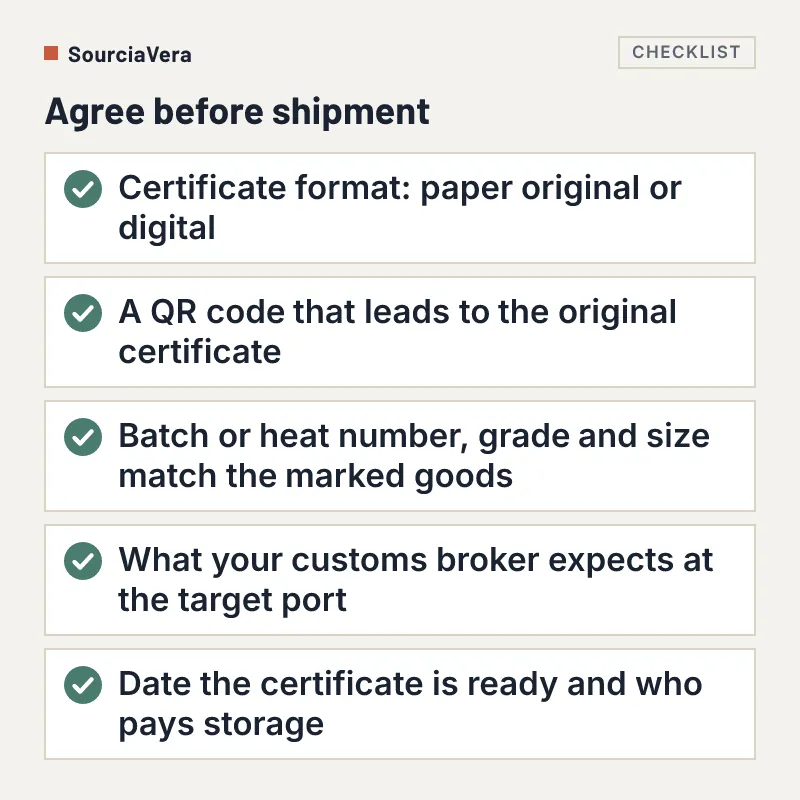
- The format of the certificate. Ask whether it will be a paper original with a handwritten signature and a stamp, or a digital one, and whether a QR code leads to the original document and not to the mill's home page.
- That it matches the goods. The certificate should carry the batch or heat number, the grade and the dimensions that are marked on the material that is shipped.
- What your customs broker expects at the target port. Criteria are said to vary between offices, so ask before the order is placed.
- Who pays if the paper is late. Write the certificate format, the date it will be ready and who bears storage charges on the proforma invoice (the documents to request from a Chinese manufacturer is a good list to start from).
Where Does a Third-Party Check Help?
It cannot decide what a customs office accepts. What it can do is check that the certificate and the goods agree before they leave: a person at the factory or the port compares the markings on the material with the certificate and reports what they find. An inspection before the balance is paid (what a pre-shipment inspection costs) covers this, and the $49 Remote Check looks at whether the supplier is a real manufacturer and whether the payment account matches the company. The 10 things to check before paying a deposit cover the rest. A certificate that does not match the material is a problem at customs and a bigger one for you.
What Should You Do Next?
- Ask for the certificate format now, for orders that have not shipped.
- Check the markings against the certificate before the balance is paid.
- Ask your customs broker what the target port accepts today.
- Write the date and the storage responsibility on the proforma invoice.
- Leave a buffer in delivery dates for a possible paper delay. For a different Mexican change that can also hold goods at the border, see Mexico's Customs Law reform on goods declared below their value.
Frequently Asked Questions
What are Mexican customs offices asking for on steel mill certificates?
According to a Metal One de México executive quoted by T21, customs asks for documents with autograph signatures, stamped seals or specific validation mechanisms. It is one company's account and we found no customs statement.
Is the steel being seized?
The importer says the cargo is waiting for the certificates to be presented so that customs does not reject it. It is a wait for documents, not a reported seizure.
Do QR codes on a certificate solve the problem?
Not always. The executive said QR codes are another way to validate, but some mills do not use them and others link to the mill's general page rather than to the original certificate.
Does this apply to goods other than steel?
The report is about steel. The advice to agree the certificate format and check it against the goods is general and can apply to any material shipped with a quality certificate.
Summary and Next Step
One importer reports that Mexican customs offices are asking for mill certificates with autograph signatures, stamps or a validation method that many mills' digital documents do not give, and that cargo waits while the paper is fixed. For a buyer, the practical answer is to agree the certificate format and check it against the goods before shipment.
In short, settle the paperwork before the cargo leaves, not at the port. A third-party check compares the certificate with the goods and looks at who is behind the supplier, and you can tell us about your order if you want help reading the documents.
If you would rather have someone check the basics before you accept a quote or pay a deposit, understanding who is behind each quote before investing money can reduce unnecessary risks. SourciaVera helps international buyers verify Chinese suppliers, understand manufacturing capabilities, and make safer sourcing decisions. I provide supplier verification services, so you should treat my recommendation accordingly. The $49 Remote Check looks at the basics — company registration, manufacturer vs. trader, address, and whether the payment account matches the company name — before you place an order. SourciaVera is not a customs broker, and nothing here is customs or legal advice.