The short answer: from April 1, 2027, China refunds 9% instead of 13% of the VAT on exported new energy vehicles (NEVs). The cut counts by the export date on the customs declaration, so shipments cleared before that date stay on 13%. The notice changes what the exporter gets back, not what a buyer pays; whether quotes go up is the supplier's decision. For a Latin American buyer the practical consequences are about timing and paperwork: a quote that does not say which rebate it assumes can change, and a supplier who rushes you to pay before April is a reason to slow down and check.
This article covers what the reports say, why it matters when you place an order, and what to ask your supplier to write down. It is based on two trade-press reports and general good practice, not on any first-hand experience of these shipments.
Why Does the NEV Export Rebate Cut Matter to a Buyer?
Three reasons, all about money and timing:
- It changes the exporter's cost, so quotes can move. An export VAT rebate returns the tax paid in domestic production so that goods leave China closer to a tax-free price; a lower rate means a smaller refund, all else equal (GlobalChinaEV).
- The date that counts is the export date. The reported notice applies the rate by the export date on the customs declaration, so the shipping date, not the order date, decides which rate applies.
- A deadline invites pressure. A cut that starts on a known date gives suppliers a reason to ask for quick deposits or to promise "last chance" prices. That is where many unnecessary risks begin.
What Did China Announce?
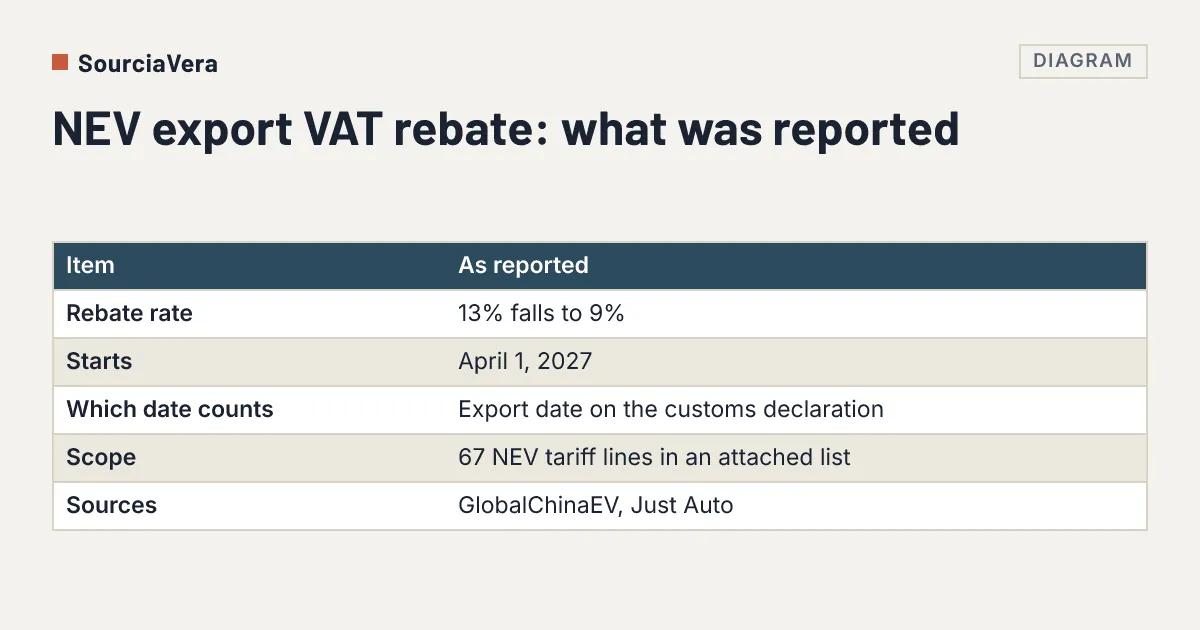
According to GlobalChinaEV, China's Ministry of Finance and the State Taxation Administration cut the VAT export rebate on new energy vehicles from 13% to 9% on October 12, 2026, effective April 1, 2027, in a joint notice it numbers Announcement No. 29 of 2026. The rate follows the export date on the customs declaration, so shipments cleared before April 1, 2027 stay on the old 13% schedule. An attached list covers 67 NEV tariff lines, spanning battery-electric commercial vehicles and plug-in hybrid passenger cars, including range-extended models; secondary reads of the attachment also list electric buses and electric truck tractors (GlobalChinaEV). Just Auto confirms that the government will cut the NEV rebate to 9% from 13% from April 2027, as part of a broader review of export tax rebates (Just Auto).
We could not open the Ministry's notice itself, so the numbers above come from these two reports. Check the attached product list in the original before you assume a product is covered; the reports we read describe vehicles and do not say whether parts or charging equipment are included.
Why Is China Doing This, and How Big Is the Export Trade?
Just Auto describes the move locally as an effort to rein in the spillover of China's domestic NEV price war into overseas markets and to reduce tensions with key trading partners, and notes accusations of dumping as domestic demand falls (Just Auto). The rebate cut follows earlier ones in clean energy: GlobalChinaEV reports that China eliminated VAT export rebates for solar photovoltaic products on April 1, 2026 and cut the battery rebate from 9% to 6% for the rest of 2026, with battery rebates due to end on January 1, 2027.
On scale, GlobalChinaEV cites the China Association of Automobile Manufacturers: September NEV exports of 571,000 units, up 160% year over year, and 4.006 million units from January to September, up 130%, with NEVs more than half of China's vehicle exports for a fourth straight month. It also cites a Deutsche Bank estimate that the change will trim about 5,000 CNY from net profit on each BYD export from the second quarter of 2027. That is an analyst's estimate for one manufacturer, not a forecast of what buyers will pay.
What Should a Buyer Ask the Supplier to Write Down?
This section is general advice, not a rule from the notice. The aim is that a change in the rebate cannot quietly change the deal after you have paid.
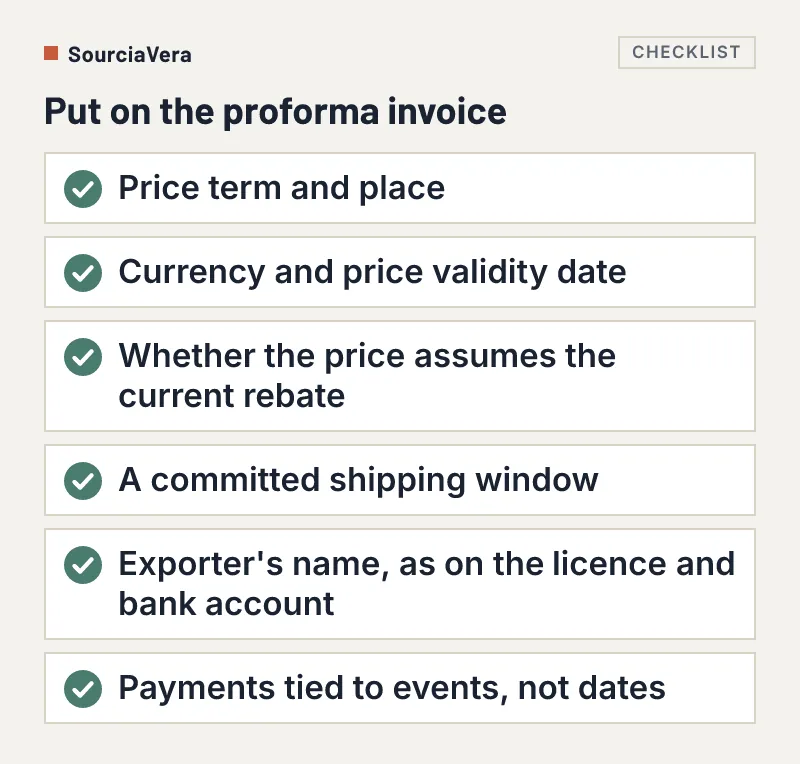
- The price basis and what it assumes. The proforma invoice should state the Incoterm and place (see which price term to ask a Chinese supplier to quote), the currency, and until when the price is valid. Ask whether the price assumes the current 13% rebate.
- The date the goods will be exported. Because the rate follows the export date on the customs declaration, ask for a committed shipping window and what happens to the price if the declaration is dated on or after April 1, 2027. Get the answer in writing, not in a chat message.
- The name of the exporter. Ask who appears as the exporter on the declaration, and check that the company on the PI, the business licence and the bank account are the same (see how to pay a Chinese supplier). A factory and a trading company can both export; you only need to know which one you are paying (factory or trading company).
- Payment triggers, not deadlines. Tie each payment to an event written on the PI, such as an approved inspection report, rather than to a date set by the supplier's tax calendar.
When Is It Worth Having a Third Party Check First?
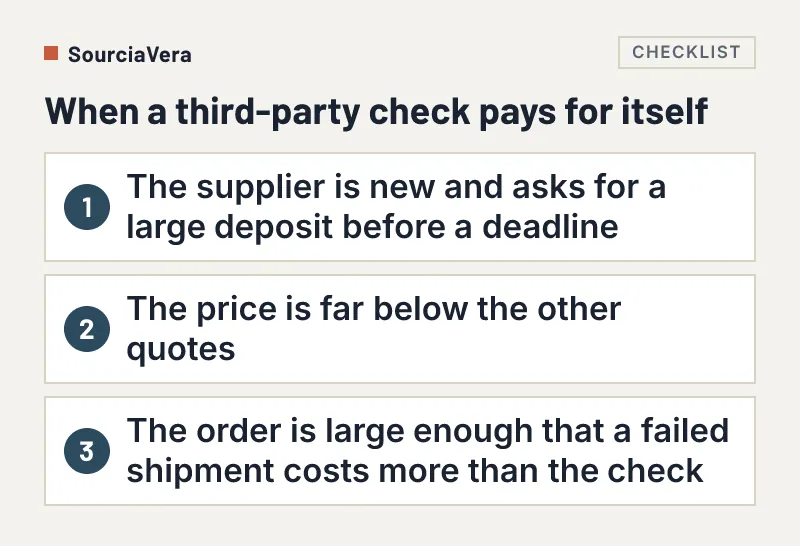
The rebate cut is not a reason to distrust a supplier. It is a reason to check the few things that a rush can hide. A third-party check is worth its cost in three situations: the supplier is new to you and asks for a large deposit before a deadline; the price is far below the other quotes (the 9 Alibaba supplier red flags explain why); or the order is large enough that a failed shipment would cost more than the check. The $49 Remote Check looks at the company registration, whether it is a manufacturer or a trader, the address and whether the payment account matches the company name. An inspection before the balance is paid (what a pre-shipment inspection costs) checks the goods themselves, and the 10 things to check before paying a deposit covers the rest.
What Does the Notice Not Tell You?
It does not say that prices will rise, by how much, or who will absorb the cost: that is decided quote by quote. It does not say what your own country charges on import, which is a separate question for your customs broker. And it does not say anything about a particular supplier. This is general information, not tax or legal advice.
What Should You Do Next?
- List the orders that could ship on or after April 1, 2027 and ask each supplier for a committed shipping window.
- Ask for the price basis and the validity date in writing and whether the price assumes the current rebate.
- Check the exporter, the licence and the bank account name before any deposit.
- Do not accept a rush: a deadline set by a supplier is a reason to ask for the terms in writing, not a reason to pay sooner.
- Plan the inspection before the balance, so a tighter shipping schedule does not skip it.
Frequently Asked Questions
What changed in China's NEV export VAT rebate?
According to GlobalChinaEV and Just Auto, the VAT export rebate on new energy vehicles falls from 13% to 9% from April 1, 2027. The rate follows the export date on the customs declaration, so shipments cleared before that date stay on 13%.
Will Chinese NEV suppliers raise their prices because of the rebate cut?
The notice does not say. A smaller rebate lowers the exporter's refund, but whether and how it is passed on is decided quote by quote, so ask each supplier to state in writing what its price assumes.
Does the rebate cut apply to auto parts or charging equipment?
The reports we read describe vehicles: 67 NEV tariff lines, including battery-electric commercial vehicles and plug-in hybrid passenger cars. They do not say whether parts are included, so check the attached product list in the original notice.
Which date decides whether the 13% or the 9% rate applies?
The export date on the customs declaration, according to GlobalChinaEV. That is why the shipping window matters more than the order date, and why it should be written on the proforma invoice.
What should I ask a supplier who says the price will rise in April?
Ask for the price basis, the validity date and the assumed rebate in writing, and for a committed shipping window. A supplier who only offers a rush deposit and no written terms is a reason to check the company before you pay.
Summary and Next Step
China's rebate on exported NEVs falls from 13% to 9% from April 1, 2027, by export date. The cut hits the exporter's cost; what it does to your quote depends on what the supplier writes down. If the price basis, the shipping window and the payment triggers are on the PI, a change in the rebate is a conversation. If they are not, it can become a dispute after the money has moved.
In short, fix the terms before the deadline pressure starts. A $49 remote check looks at who is behind the supplier and whether the payment account matches the company, and you can tell us about your order if you want help reading a quote.
If you would rather have someone check the basics before you accept a quote or pay a deposit, understanding who is behind each quote before investing money can reduce unnecessary risks. SourciaVera helps international buyers verify Chinese suppliers, understand manufacturing capabilities, and make safer sourcing decisions. I provide supplier verification services, so you should treat my recommendation accordingly. The $49 Remote Check looks at the basics — company registration, manufacturer vs. trader, address, and whether the payment account matches the company name — before you place an order. Send the quote or PI with your request: it is needed to check the payment account.