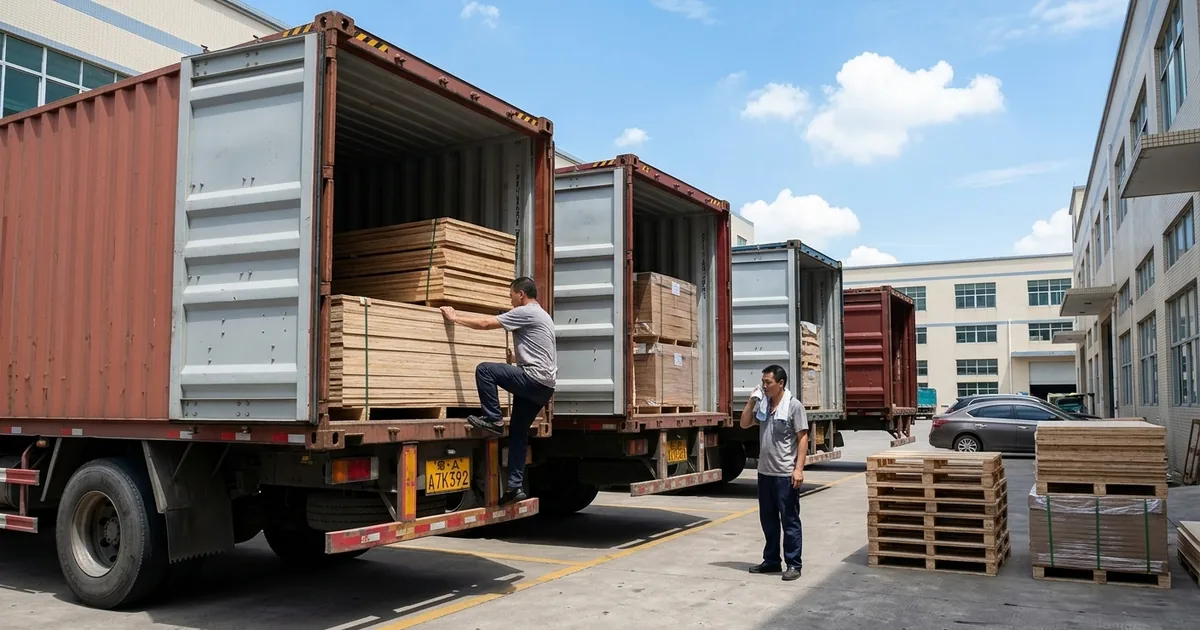
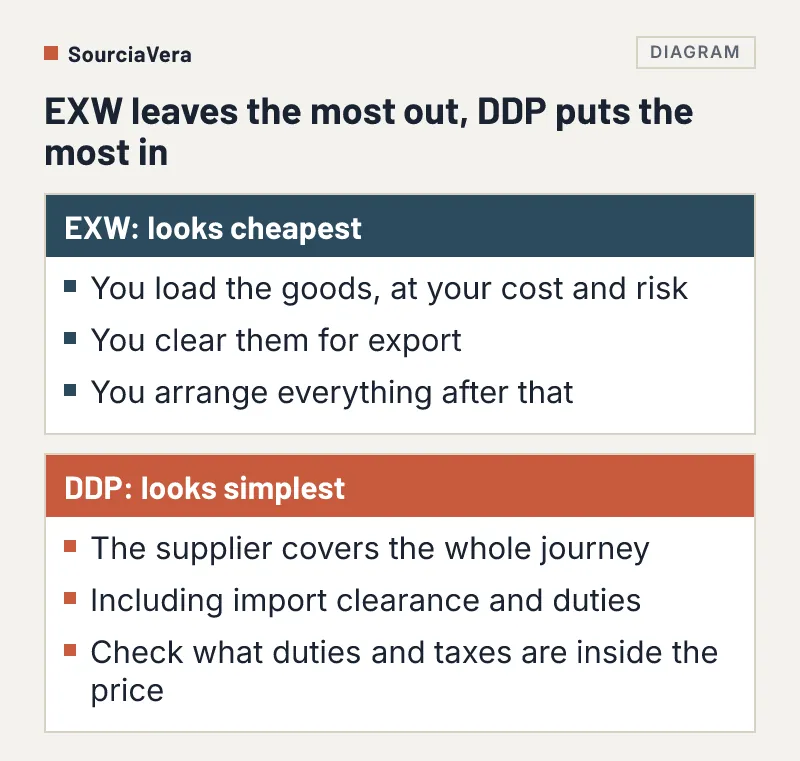
The short answer: ask every supplier to quote on the same Incoterm and to name the place. For most first-time buyers who ship by sea, the usual starting point is FOB with the port named, or FCA with a named place when the goods go to your forwarder in a container. EXW looks cheapest because it leaves the most out (loading, export clearance and freight are yours). DDP looks simplest because it puts the most in, but you still have to check what is inside the price. A quote only means something once you know which Incoterm it is on, and where.
If you are comparing quotes and the prices are far apart, the term is the first thing to check. Two numbers for the same product can describe two different jobs.
What Is an Incoterm, and What Does It Not Do?
Incoterms are standard trade terms published by the International Chamber of Commerce (ICC). The current set, Incoterms 2020, has eleven three-letter terms that, in ICC's words, "clearly define buyer and seller responsibilities worldwide" (ICC). Each one answers the same questions: who loads the goods, who clears them for export, who pays for the main transport, who insures them, who clears them into your country and pays the duties, and at which point the risk of loss or damage passes from the seller to you.
An Incoterm is not a contract. ICC's guidance says the rules become part of a sale only when they are written into the contract, and that they do not deal with when, where or how the price is paid, with who owns the goods, or with what happens if one side breaks the deal (ICC Q&A). So "FOB" on a quote says nothing about the deposit, the balance or when the goods are yours. Those belong in the proforma invoice and the contract.
Who Does What Under EXW, FCA, FOB, CIF and DDP?
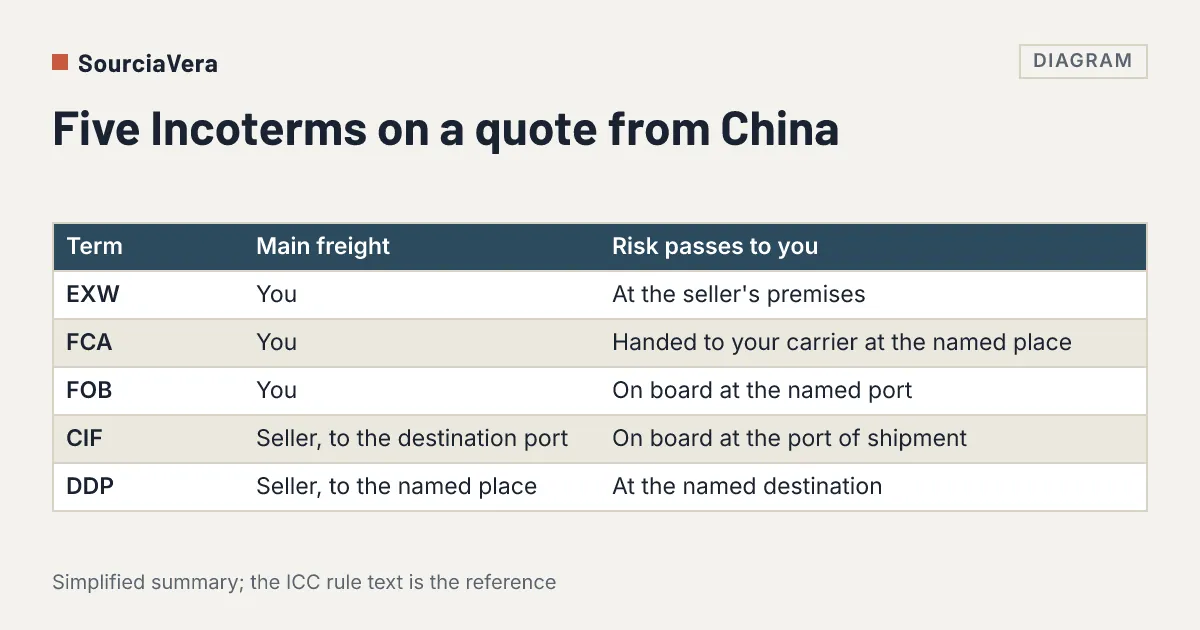
This is a simplified summary of five of the eleven rules, the ones you will meet most often on quotes from China. The full rule text is the reference, and the named place and the version decide the details.
| Term | EXW | FCA | FOB | CIF | DDP |
|---|---|---|---|---|---|
| Loading at the seller's premises | You, at your cost and risk | Seller, if the named place is its premises | Seller, onto the vessel | Seller, onto the vessel | Seller |
| Export clearance | You | Seller | Seller | Seller | Seller |
| Main freight | You | You | You | Seller, to the named destination port | Seller, to the named place |
| Insurance | Nobody is obliged | Nobody is obliged | Nobody is obliged | Seller, minimum cover | Not required (the seller may insure for itself) |
| Import clearance, duties and taxes | You | You | You | You | Seller |
| Risk passes to you | At the seller's premises, when the goods are at your disposal | When the goods are handed to your carrier at the named place | When the goods are on board at the named port | On board at the port of shipment, even though the seller pays the freight | At the named destination |
| Transport modes | Any | Any | Sea and inland waterway only | Sea and inland waterway only | Any |
Why Is EXW Cheap on Paper, and Why Do Many Buyers Avoid It?
Under EXW the supplier's price covers the goods and nothing else: you load them at your own cost and risk, you clear them for export, and you arrange everything after that. Export clearance is the sticking point for a buyer outside China. ICC Academy notes that EXW can cause export complications for both sides, that the seller may end up as the exporter of record when the buyer is not established in the seller's country, and it strongly encourages traders to consider FCA instead of EXW when goods cross a border (ICC Academy). If a supplier quotes EXW, ask for FCA or FOB on the same product, or have your forwarder price the missing pieces before you compare.
FOB or FCA: Which One Fits a Container?
FOB is a port-to-port rule. According to ICC Academy it is for sea and inland waterway transport only, the risk passes when the goods are on board the vessel at the named port, and the seller clears the export (ICC Academy). FCA suits any mode of transport, including multimodal container shipments, which ICC Academy calls well suited to it, and the risk passes when the goods are handed to your carrier. A container is usually handed over to a forwarder or a terminal before it is loaded on a ship, which is why FCA often describes that handover more accurately than FOB. Quotes often say FOB even for container cargo. What matters is that the place is named, so that both sides know where the supplier's job ends and yours begins. Whichever you choose, ask what the price includes up to the handover (trucking to the port or terminal, terminal charges, export clearance), because that is where quotes differ.
What Should You Check on a CIF Quote?
CIF means the supplier pays the freight to the named destination port and arranges insurance, but the risk passes to you when the goods are loaded at the port of shipment, so a loss at sea is your loss even though the supplier booked the ship. ICC says CIF is reserved for maritime trade and that the default insurance is the Institute Cargo Clauses (C), the minimum cover, which the parties can agree to raise (ICC). Ask what cover the quote includes, who the beneficiary is and which destination charges are included. Trucking to your door is yours, because the price ends at the port. For what the minimum cover does and does not give you, see cargo insurance on a shipment from China.
Should You Accept a DDP Quote?
DDP puts the whole journey on the supplier, including import clearance and duties, so the price is the closest thing to a final price. Check three things: which duties and taxes are included and how they were calculated, who is the importer of record, and whether your country lets a foreign seller handle import formalities at all. ICC Academy warns that some countries prohibit foreign entities from carrying out import customs and tax formalities, and suggests DAP in that case (ICC Academy). Ask your customs broker before you accept DDP, and remember that the seller carries the risk until the goods reach the named destination.
How Do You Compare Quotes on Different Terms?
Convert every quote to the same basis, for example landed cost per piece at your door. Illustrative numbers, not real quotes: three suppliers quote the same part.
| Supplier | Quote on paper | What is missing | Landed cost per piece |
|---|---|---|---|
| A | $11.60, EXW | Loading, export clearance and trucking to the port $0.90; freight and insurance $1.10; duties and local charges $1.20 | $14.80 |
| B | $12.40, FOB (named port) | Freight and insurance $1.10; duties and local charges $1.20 | $14.70 |
| C | $13.30, CIF (named port) | Duties and local charges $1.20 (freight and minimum insurance are included) | $14.50 |
On paper A is the cheapest and C the dearest; at your door the order reverses. The numbers are made up, but the pattern is the point: a lower price on a term that includes less is not a lower price. Ask your forwarder for the missing items (see our guide to FCL, LCL and air freight), use the same per-piece formula for every supplier (the MOQ guide shows it with an example), and read how many suppliers to contact and how to compare them to keep the comparison fair.
What Should You Write on the Quote and the PI?
Write the rule, the named place and the version together, for example "FOB Shenzhen, Incoterms 2020". ICC's guidance is to name all three and to be as geographically specific as possible, because an unclear port leaves both sides unsure where the supplier's job ends and where the risk passes (ICC Q&A). The same line belongs in the price-basis row of the proforma invoice. Keep the payment split and the inspection trigger on separate lines, because the Incoterm does not cover them (see 10 things to check before paying a deposit and what an inspection costs).
What Can an Incoterm Not Tell You?
It does not tell you that the supplier is who it says it is, that the goods match the specification, or that the shipment will leave on time. It decides who pays for which leg and who carries the risk where. The other questions are answered by the checks in the China Supplier Verification Checklist and by an inspection before the balance is paid. This is general information, not legal or customs advice: your forwarder and your customs broker know the rules of your port and your country.
What Should You Do Next?
- Pick one reference term for all quotes: FOB with a named port, or FCA with a named place if the goods go to your forwarder first. Ask every supplier to quote it, and to add their EXW or CIF price if they prefer another term.
- Write the term as rule, place and version (for example "FOB Shenzhen, Incoterms 2020") on the quote and on the PI.
- Ask what the price includes up to the handover: trucking, terminal charges and export clearance. Get the answer in writing.
- Have your forwarder price the missing legs, then compare suppliers on landed cost per piece, not on the headline price.
- If someone quotes DDP, ask who is the importer of record and which duties and taxes are included, and check with your customs broker first.
Frequently Asked Questions
What does FOB mean on a Chinese supplier's quote?
FOB (Free On Board) means the supplier delivers the goods on board the vessel at the named port of shipment and clears them for export. From that point the risk and the main freight are yours. It applies to sea and inland waterway transport only, so check that a port is named.
Is FOB or EXW better when buying from China?
For most overseas buyers FOB or FCA is easier, because the supplier loads the goods and clears them for export. Under EXW you handle loading and export clearance yourself, and ICC Academy strongly encourages FCA instead of EXW when goods cross a border.
What does CIF include, and is it safe?
CIF includes the freight to the named destination port and a minimum level of insurance, the Institute Cargo Clauses (C) by default. The risk still passes to you when the goods are loaded at the port of shipment, so check the cover and the destination charges.
Should I accept a DDP quote from a Chinese supplier?
Only after checking which duties and taxes are included and who is the importer of record. ICC Academy warns that some countries do not allow foreign sellers to carry out import customs and tax formalities, so ask your customs broker first.
Does the Incoterm say when I have to pay or who owns the goods?
No. ICC says Incoterms rules do not deal with the time, place or method of payment, with the transfer of ownership, or with remedies for breach. Put those in the PI and the contract.
Summary and Next Step
A quote is only as comparable as the term behind it. Fix the term and the place first, then compare the numbers, and the cheapest line on the page may turn out to be the one with the most left out. You do not need to memorize the eleven rules; you need to know which one the quote is on and what that leaves for you to pay.
In short, fix the term and the place first, then compare the numbers. If you compare quotes on different terms, the cheapest line may be the one with the most left for you to pay. A $49 remote check looks at who is behind each quote, and you can tell us about your order if you want help comparing them.
If you would rather have someone check the basics before you accept a quote, understanding who is behind each quote before investing money can reduce unnecessary risks. SourciaVera helps international buyers verify Chinese suppliers, understand manufacturing capabilities, and make safer sourcing decisions. I provide supplier verification services, so you should treat my recommendation accordingly. The $49 Remote Check looks at the basics — company registration, manufacturer vs. trader, address, and whether the payment account matches the company name — before you place an order. Send the quote or PI with your request: it is needed to check the payment account.