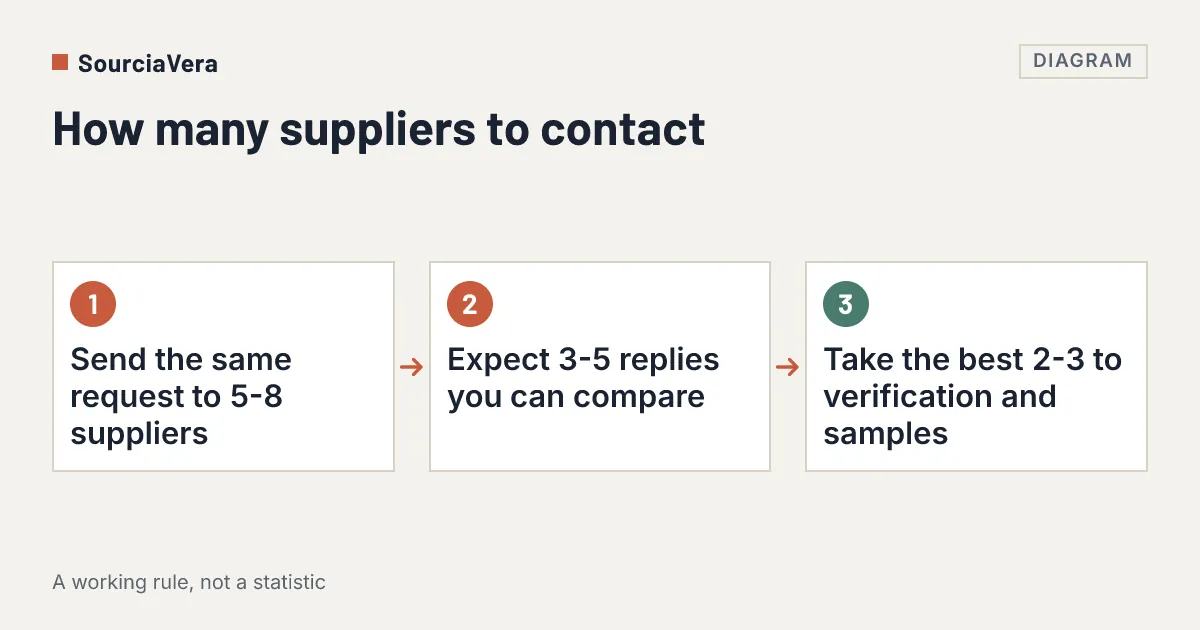
The short answer: as a working rule, send the same request to 5–8 suppliers, expect 3–5 replies you can actually compare, and take the best two or three on to verification and samples. Fewer than that and you have nothing to judge a price against; many more and the replies blur together. What makes a comparison fair is not the number, but that every supplier gets the same specification, the same quantities and the same questions.
You may be looking at a screen of fifty listings and wondering where to stop. There is no official number, and nobody can promise that the cheapest or the fastest reply is the right one. What helps is a method you can repeat: one message, one sheet, and a few checks that decide who stays on it.
Why Not Just Ask One Supplier, or Fifty?
With one supplier you get a price and nothing to judge it against: you cannot tell a fair quote from a high one, or an honest answer from a convenient one. With fifty, every reply costs time to read and answer, many of them are generic, and you end up choosing the supplier who answered fastest instead of the one who fits your product.
The 5–8 / 3–5 / 2–3 range is a working rule, not a statistic. Our guide to building a hardware product in China gives a similar range for components: shortlist three to five candidate factories, not one.
What Should Every Supplier Receive?
The same message, with the same attachments. A short template makes the replies easy to compare. This is a template, not a quote from a real exchange. Copy it and fill in the brackets:
Hello, I am looking for [product]. Specification: [dimensions, material, finish, packaging, labeling, certifications]. Please quote [quantity A], [quantity B] and [quantity C], with the price per unit and what the unit is (one piece or one set), your MOQ, the sample price and time, the lead time, and your payment terms. Please also send your full Chinese company name as printed on your business license, and tell me which factory makes this product and where it is. Thank you.
Three quantities show you how the price moves with volume, and asking what the unit is avoids the trap in "set" versus "piece". Asking for the Chinese company name lets you start stage 1 of the China Supplier Verification Checklist, and asking who makes the product starts stage 2.
How Do You Compare the Replies Fairly?
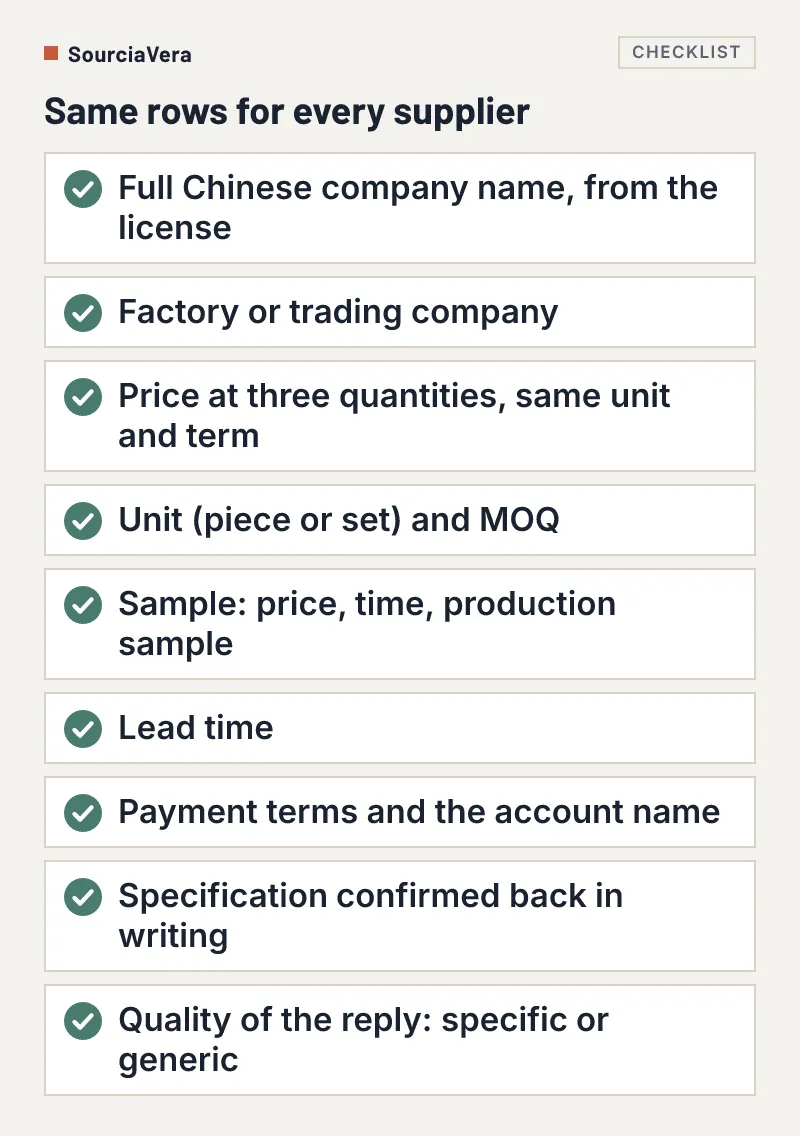
Put every reply on one sheet, with the same rows for every supplier. Here is a layout you can copy into a spreadsheet:
| What to compare | Supplier A | Supplier B | Supplier C |
|---|---|---|---|
| Full Chinese company name (from the license) | |||
| Factory or trading company (stage 2) | |||
| Price at quantity A, B and C (same unit, same delivery term) | |||
| Unit (piece or set) and MOQ | |||
| Sample: price, time, production sample offered? | |||
| Lead time | |||
| Payment terms and the name on the bank account | |||
| Specification confirmed back in writing? | |||
| Quality of the reply (specific or generic) |
- Compare landed cost, not unit price. Add freight, duties, taxes and any broker fees to each quote; how to buy wholesale from a factory shows the arithmetic.
- Use the checks as gates, not as points. A supplier whose license does not match its name, or who will not say who makes the product, is out whatever the price. Do not average a low price against a failed check.
- Keep the terms the same. A quote on a different delivery term, unit or specification is not comparable until you ask for it on yours.
What Can the Replies Tell You?
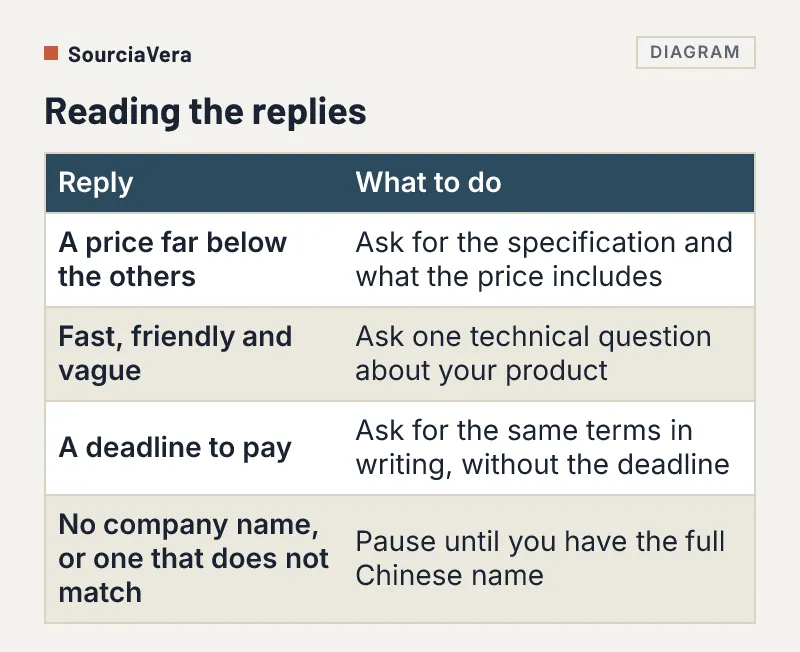
| Reply | What it can mean | What to do |
|---|---|---|
| A price far below the others | A different material, a different unit, or something left out of the quote. | Ask for the specification and what the price includes. The lowest price deserves a direct question before you wire anything (see 9 Alibaba Supplier Red Flags That Should Make You Walk Away). |
| Fast, friendly and vague | A quick reply is not a bad sign, but a vague one gives you nothing to compare. | Ask one technical question about your product. A specific answer is information. |
| A deadline to pay | Pressure to decide before you have checked anything. | Ask for the same terms in writing, without the deadline. |
| Questions about your specification | Someone has read it. | Note which questions they asked; they show what the supplier will build to. |
| No company name, or one that does not match | You cannot run stage 1. | Pause until you have the full Chinese name as printed on the license. |
Should You Contact Factories, Trading Companies or Both?
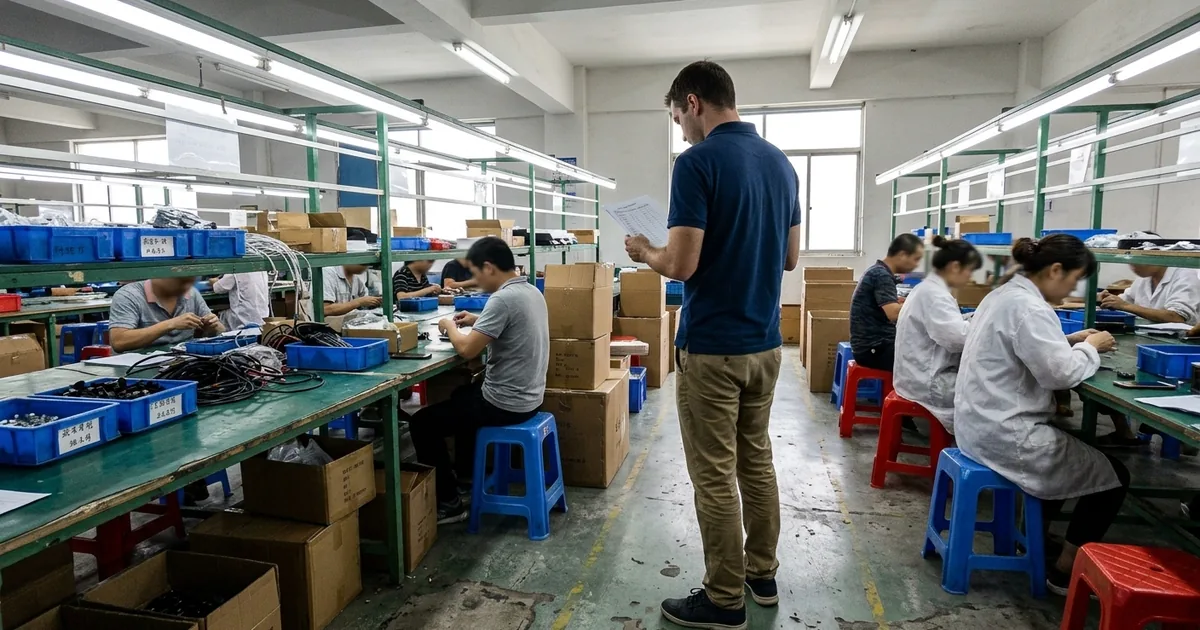
Both can be fine, as long as you know which one you are paying. I don't mind a trader, and I don't automatically trust a factory. What I care about is that the buyer knows which one they're paying, and why (Trading Company vs Factory). Including one trading company in your group can show you what the convenience costs next to the factories' prices.
When Should You Stop Comparing and Start Verifying?
When two or three suppliers have given you quotes you can compare on the same terms. Before you pay a deposit, run those two or three through the checks: the free China Supplier Verification Checklist (a printable PDF) or 10 Things to Check Before Paying a Chinese Supplier Deposit. A sample proves that the factory can make your product once, by hand, when it knows you are watching; Sample Looks Great, Bulk Order Is Garbage covers what to ask beyond it. How much checking each one deserves depends on what a failed order would cost you; how to reduce the risk of buying from China gives a rule of thumb by order size.
What Should You Do Next?
- Write the specification down in one document: dimensions, material, finish, packaging, labeling and certifications.
- Pick 5–8 listings that look like they make your product, from more than one platform if you can.
- Send each of them the same message, with three quantities.
- Fill in the sheet, and drop any supplier that fails a check: the license, who makes it, the bank account name.
- Take the best two or three through the checklist, then to samples.
Frequently Asked Questions
How many suppliers should I contact in China?
As a working rule, send the same request to 5-8 suppliers, expect 3-5 replies you can compare, and take two or three of them on to verification and samples. It is a rule of thumb, not a statistic: the point is to have enough quotes to judge a price against, and few enough to check properly.
How do I compare Chinese suppliers?
Put every reply on one sheet with the same rows: full Chinese company name, factory or trading company, price at the same three quantities and delivery term, unit and MOQ, sample terms, lead time, payment terms and the name on the bank account, and whether they confirmed your specification in writing. Compare landed cost, not unit price, and treat the checks as gates: a supplier that fails one is out whatever the price.
Is the cheapest Chinese supplier the best choice?
Not automatically, but a price far below the others deserves a direct question before you pay. It can come from a different material, a different unit or something left out of the quote, so ask for the specification and what the price includes, and compare on landed cost.
Should I contact factories or trading companies?
Either can work as long as you know which one you are paying. A group that includes both lets you see what the convenience of a trading company costs. Check which one you are dealing with using the business license, the registered address and a live look at the production line.
Do I need a sourcing agent to compare suppliers?
No. You can run this comparison yourself with one message and one sheet. A sourcing agent can do the legwork and the follow-up, but ask the same questions of an agent as of a supplier: who they are legally, how they are paid, and who answers if something goes wrong.
Summary and Next Step
Comparing suppliers is less about finding the right number of them and more about asking everyone the same questions, writing the answers down and letting the evidence decide. You don't have to know everything about Chinese manufacturing to do that. You just need a sheet, a message and the patience to check before you pay.
In short, ask every supplier the same questions, write the answers down and let the evidence decide. If you pick from the replies and pay without checking, the realistic outcome is a deposit with a supplier you could not identify. A $49 remote check covers the basics for a shortlist, and our team can visit the factory of the supplier you prefer.
If you would rather have someone on the ground check the suppliers on your shortlist, understanding who is behind each quote before investing money can reduce unnecessary risks. SourciaVera helps international buyers verify Chinese suppliers, understand manufacturing capabilities, and make safer sourcing decisions. I provide supplier verification services, so you should treat my recommendation accordingly. The $49 Remote Check looks at the basics — company registration, manufacturer vs. trader, address, and whether the payment account matches the company name — before you place an order.