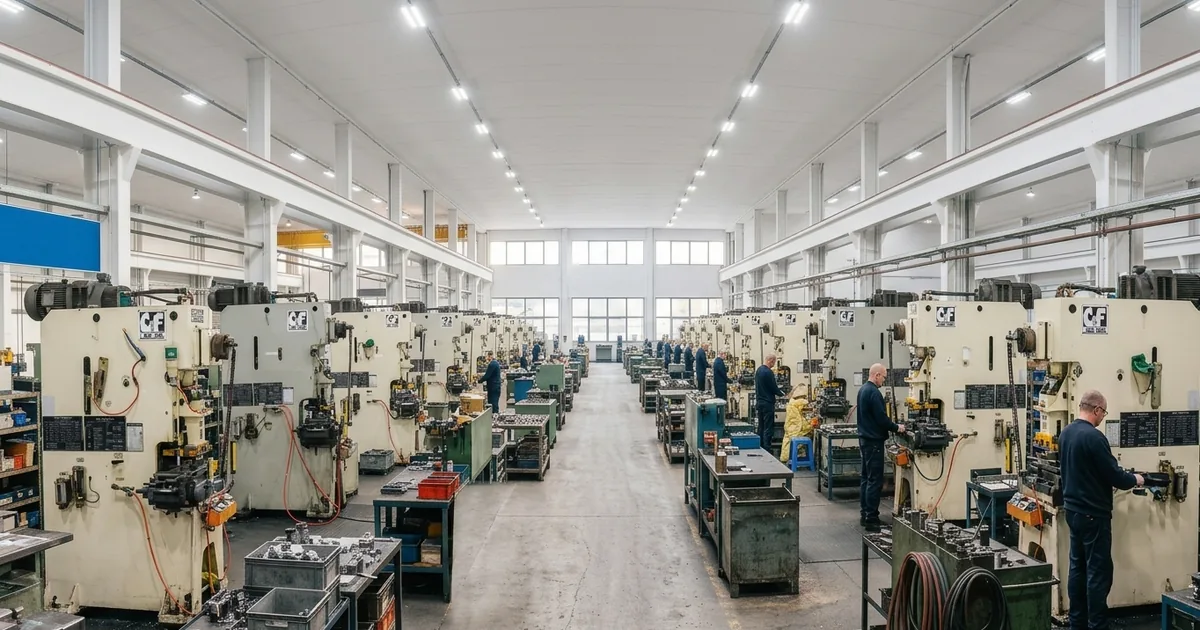
The short answer: there is no single minimum order quantity (MOQ) for importing from China. Each supplier sets its own MOQ for each product, and it can often be negotiated. The number on a listing is the start of a conversation, not a rule: it depends on how the product is made, how much customization you need, and what kind of supplier you are talking to.
If you've just seen "MOQ 500" on a product you like, it's easy to feel that you are too small a buyer, or that you asked the wrong question. You didn't. The supplier sets the MOQ, for its own reasons, and the number on a listing is where the conversation starts.
That is why two quotes for similar products can show very different MOQs. This guide explains who decides the MOQ, why it varies, how to confirm it before you pay, and what you can do when it is higher than you can afford.
Who Decides the Minimum Order Quantity?
The supplier does. MOQ is a commercial term, not a rule from customs or from the platform where you found the supplier. A factory sets it from its own production: setup time, material purchases and packaging runs. A trading company often has two constraints at once: the factory's MOQ and its own margin. That is one more reason to know which one you are dealing with — see Is My Chinese Supplier a Real Factory or a Trading Company?
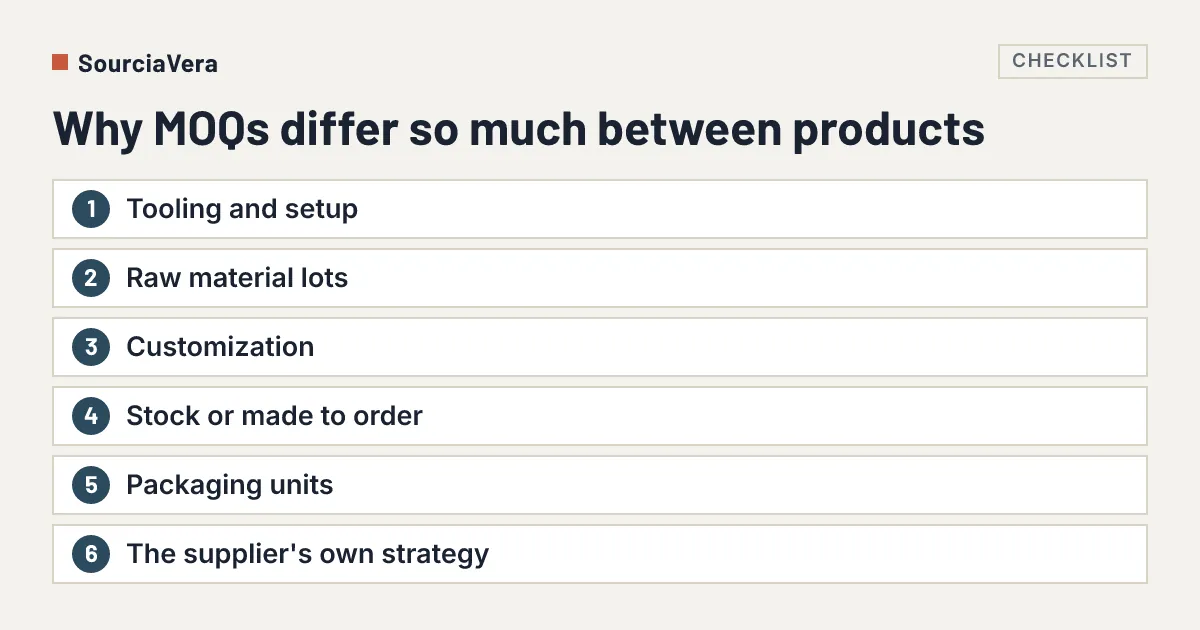
Why Do Minimum Order Quantities Differ So Much Between Products?
- Tooling and setup: products that need a mold, a die or a production-line setup usually carry higher MOQs, because the setup cost has to be spread over enough units.
- Raw material lots: materials, fabrics and components are often bought in lots, and the MOQ can follow those lots.
- Customization: your own logo, color, packaging or specification usually raises the MOQ compared with standard items. We explain the difference in OEM vs ODM for Auto Parts.
- Stock or made to order: items already in stock can sometimes be sold in small quantities, usually at a higher unit price.
- Packaging units: cartons and pallets come in fixed quantities, so MOQs often match them.
- The supplier's own strategy: some suppliers prefer large orders; others accept small ones to win a new customer.
Is the MOQ on the Listing the Real MOQ?
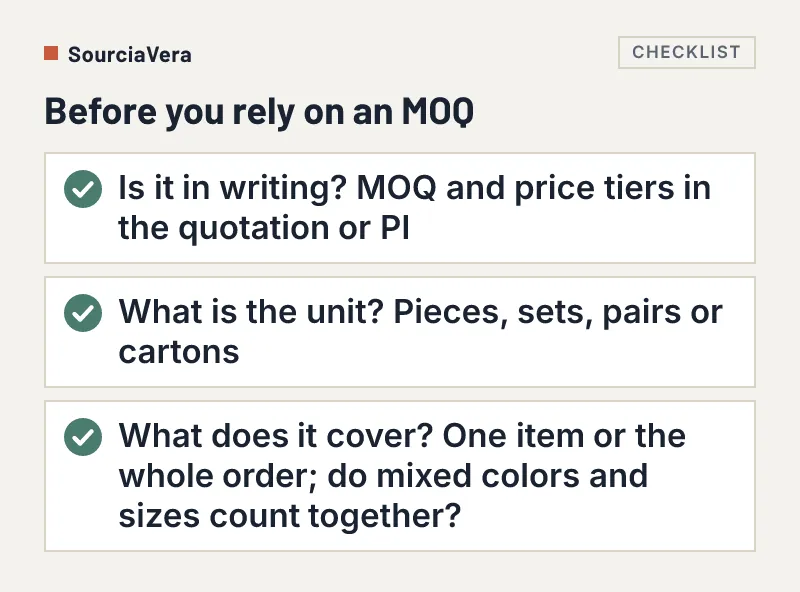
Not always. A listing may show a general MOQ for the product, while the quote for your exact specification, color or packaging is different. Before you rely on a number, check three things:
- Is it in writing? Get the MOQ and the price tiers in the quotation or proforma invoice.
- What is the unit? Pieces, sets, pairs or cartons can mean very different quantities for the same number — see the difference between "set" and "piece".
- What does it cover? One item, or the whole order? Do mixed colors and sizes count together?
How Does the Minimum Order Quantity Affect the Price?
Usually the unit price falls as the quantity rises, which is why suppliers publish price tiers. Ordering below the MOQ, if the supplier agrees, normally means a higher unit price; ordering above it can unlock a lower one. Compare the total cost — price times quantity, plus shipping, duties and taxes — not just the unit price, and don't let a low unit price push you into a quantity you can't sell.
How Much Money Does an MOQ Tie Up?
The MOQ decides how much cash you commit before you sell a single unit. Work it out in four lines before you say yes:
- Goods: MOQ × unit price
- Freight, duties and taxes to your door: ask your customs broker, because rules differ by country
- Months of stock: MOQ ÷ units you expect to sell per month
- Landed cost per unit: (goods + freight + duties and taxes) ÷ units
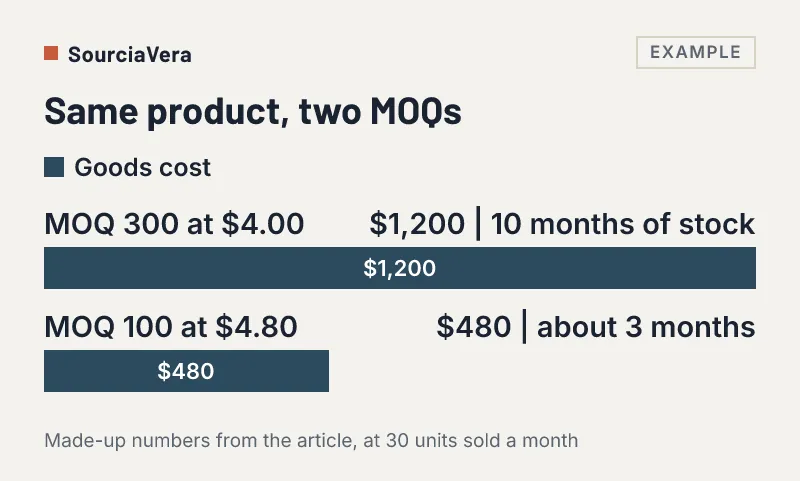
An example with made-up numbers: a supplier quotes $4.00 per unit with an MOQ of 300. The goods cost $1,200. If you expect to sell 30 units a month, 300 units is ten months of stock, and money you will not see back for most of a year. Another supplier will sell 100 units at $4.80, so you pay $480 and hold about three months of stock. The second option costs $0.80 more per unit and ties up $720 less. Which is better depends on your cash, your selling price and how sure you are that the product sells.
Remember to add the waiting time. Our auto parts import guide puts a typical ocean shipment to a Mexican port at 30 to 45 days, on top of production time, so a reorder has to be placed well before your stock runs out.
Can You Negotiate the MOQ With a Chinese Supplier?
Often, but not always. Common ways to get a lower MOQ:
- Start with a smaller trial order at a higher unit price
- Mix SKUs, colors or sizes inside one order
- Choose stock items instead of custom ones
- Accept a longer lead time so the supplier can fit you into a production run
- Pay for the tooling or setup yourself
- Ask a supplier that already makes a similar product
Explain what you plan to build: suppliers are more willing to bend the MOQ for a buyer who looks likely to come back. And treat a very low MOQ on a custom product as a reason to ask more questions, not fewer: who is actually making it, and will quality hold at volume? We cover that in Sample Looks Great, Bulk Order Is Garbage. If your quantity is genuinely small, our small-batch service is built for custom orders from 50 units up.
My advice in our guide to sourcing LED auto parts is that if a factory insists on a 500-unit MOQ for a first order from a buyer it doesn't know, you negotiate, or find a supplier more open to building the relationship gradually. The good China-sourcing relationships I've seen take two or three orders to settle, and the first order will probably have small problems.
What Is a Typical MOQ for Auto Parts From China?
It depends on the part, and typical numbers are only a starting point. In our guide to importing auto parts from China to Mexico, we list typical MOQs such as 50–200 units for alloy and steel wheels and 100–300 units for ODM private label parts (OEM with dedicated tooling usually starts around 500), with others varying by part. Always confirm the MOQ for your exact part in writing.
| Order type | Typical quantity | Where the figure comes from |
|---|---|---|
| Alloy and steel wheels | 50–200 units | Our auto parts import guide |
| ODM private label parts | 100–300 units | Our auto parts import guide |
| Custom small-batch orders (our service) | 50 to 500 units | Our small-batch page |
These are figures from our own pages for the product types we work with, not industry averages. Other products differ, so ask for the MOQ of your exact product in writing.
On this site I've written that a large factory won't give a small order its best attention, and also that Guangzhou LED factories will often take 50 units from a new buyer. Those two don't sit comfortably together, and I'd rather leave them side by side than pick one.
How Do You Check the MOQ Before You Pay?
- Ask for a written quotation or proforma invoice that states the MOQ, the unit and the price tiers.
- Confirm that the MOQ applies to your exact specification, color and packaging.
- Check who you are dealing with: a manufacturer or a trading company.
- Order samples first, and see what changes at bulk quantities.
- Compare the landed cost, not only the factory price.
What Should You Write to the Supplier?
A short message that asks for the same things in the same order makes quotes easy to compare. Copy it and fill in the brackets:
Hello, I am interested in [product, model or part number]. Could you quote 50, 100 and 300 units, with the price per unit and the unit you use (pieces or sets)? What is the MOQ for my exact specification, color and packaging? Can I mix colors or sizes in one order? What is the lead time at each quantity? Do you offer a sample, and what does it cost? Please send the quote as a proforma invoice.
If the answers differ a lot between suppliers, that is information too: it can show who is making the product and who is reselling it.
What Should You Do Next?
- Write down your limits. The most cash you can commit, and how many units you expect to sell per month.
- Send the message above to at least three suppliers and ask for 50, 100 and 300 units.
- Get each answer in writing as a quotation or proforma invoice that states the MOQ, the unit, the price tiers and the lead time.
- Convert every quote to landed cost per unit and months of stock using the four lines above, then compare.
- If every MOQ is above your limit, try the options in the negotiation list: a trial order at a higher unit price, mixed SKUs, a stock item, or a small-batch route.
- Before you pay a deposit, check who you are paying: 10 Things to Check Before Paying a Chinese Supplier Deposit.
Frequently Asked Questions
What does MOQ mean when importing from China?
MOQ stands for minimum order quantity: the smallest quantity a supplier is willing to sell in one order. The supplier sets it for each product, and it can often be negotiated.
Is there a legal minimum order quantity for importing from China?
No. MOQ is a commercial term set by the supplier, not a customs or legal requirement. Import rules, duties and taxes apply to whatever quantity you bring in.
Can I order less than the MOQ?
Sometimes. Some suppliers accept a smaller trial order at a higher unit price, or sell stock items in small quantities. Ask in writing and compare the total cost before you agree.
Why do two suppliers quote different MOQs for the same product?
Factory setup, material lots, customization, packaging and the supplier's own strategy all change the MOQ. A trading company may also quote the factory's MOQ plus its own conditions.
How do I work out what an MOQ will cost me?
Multiply the MOQ by the unit price, add freight, duties and taxes, and divide by the number of units to get the landed cost per unit. Then divide the MOQ by the units you expect to sell per month to see how many months of stock you are buying.
How do I negotiate the MOQ with a Chinese supplier?
Start with a smaller trial order at a higher unit price, mix SKUs, colors or sizes in one order, choose stock items instead of custom ones, accept a longer lead time, offer to pay for the tooling or setup, or ask a supplier that already makes a similar product. Explain what you plan to build: suppliers are more willing to bend for a buyer who looks likely to come back.
Should I order samples before placing a large order?
Yes. Order samples first and see what changes at bulk quantities: a sample shows what a factory can do once, not what the bulk run will look like. Get the MOQ and the price tiers in writing before you pay.
Summary and Next Step
The minimum order quantity is the first negotiation in every China import. Treat the number as a starting point, get it in writing with its unit, and look at the total cost before you commit. The supplier behind the number matters as much as the number itself.
For buyers importing from China, understanding the supplier before investing money can reduce unnecessary risks. SourciaVera helps international buyers verify Chinese suppliers, understand manufacturing capabilities, and make safer sourcing decisions. If you're not sure where to start, the $49 Remote Check looks at the basics — company registration, manufacturer vs. trader, address, and whether the payment account matches the company name — before you place an order.
In short, treat the MOQ as a starting point, get it in writing with its unit and look at the total cost before you commit. If you commit to the number alone, the realistic outcome is a quantity or a total you did not expect, with cash tied up. Tell us about your order, and a $49 remote check covers the supplier behind the number.
I provide supplier verification services, so you should treat my recommendation accordingly.