The short answer: usually because the two prices are not a like-for-like comparison. An Alibaba listing shows a supplier's unit price for a given quantity, specification and unit, before shipping, duties and taxes. An Amazon price is what a seller charges a shopper for one delivered item. When the Amazon price is lower, the seller is paying less per unit than the price you saw, or the product is not quite the same, or the seller is accepting a thin margin or a loss. You can't tell which from the listing alone, but there are six common explanations and a way to check each one.
It is an odd moment when the product you were about to import turns up on Amazon, delivered, for less than the supplier's listed price. It doesn't mean the supplier lied or that you misread the page. It usually means the two prices are answering different questions.
What Does a Lower Amazon Price Tell You?
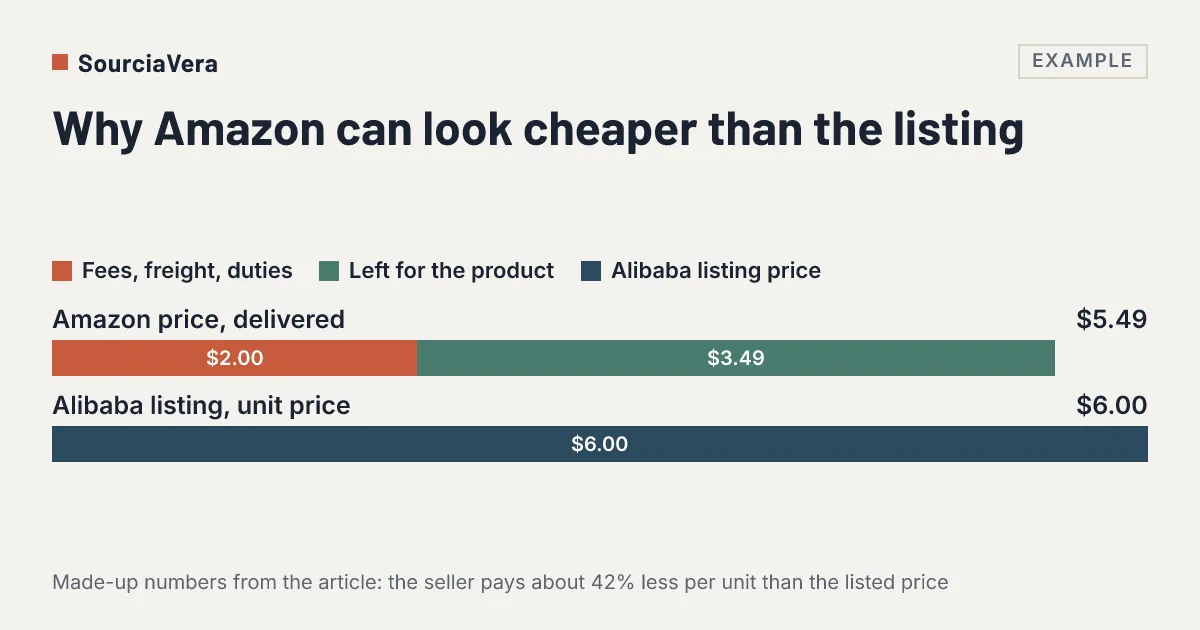
Something about the seller's cost. An Amazon seller who uses Fulfillment by Amazon (FBA) pays for it: Amazon says it picks, packs and ships the orders and handles customer service and returns, and that sellers pay fulfillment costs, monthly storage fees and other charges (Amazon's FBA page, read Oct 8, 2026). So if a product sells on Amazon for less than the unit price on an Alibaba listing, that seller's own cost for the product has to be lower than the listed price, or the seller is selling at a loss or a very thin margin. Here is the arithmetic, with made-up numbers:
| Per unit | Amount (made-up) |
|---|---|
| What the shopper pays on Amazon, delivered | $5.49 |
| Amazon fees, freight and duties paid by the seller | −$2.00 |
| Left to pay for the product itself, before ads and returns | $3.49 |
| The Alibaba listing's unit price you saw | $6.00 |
| Gap between the two | $2.51, about 42% below the listed price |
These numbers are illustrative, not real fees or quotes. The pattern is what matters: to break even, that seller would be paying far less for the product than the price on the listing. The gap has to come from somewhere.
What Are the Common Reasons?
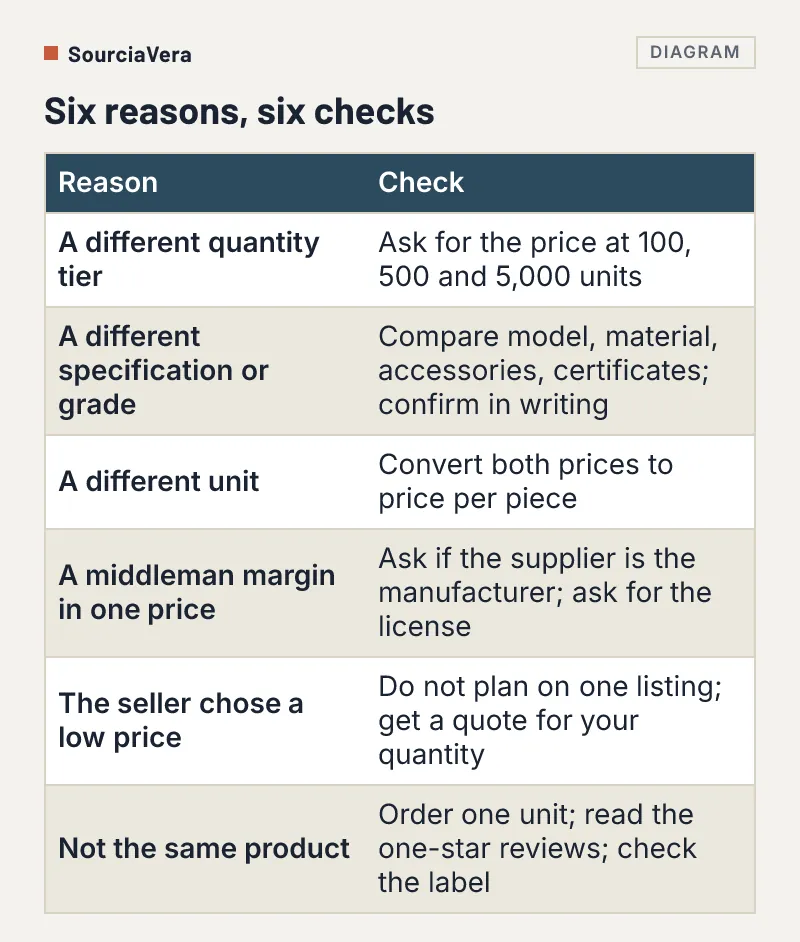
- You saw a different quantity tier. Suppliers publish price tiers because the unit price usually falls as the quantity rises (our MOQ guide), and Alibaba's seller guide says production costs fall with scale (Alibaba seller guide, Nov 19, 2020). A seller buying thousands of units can pay far less per unit than the price shown for your first 100. Check: ask the supplier for the price of your exact product at 100, 500 and 5,000 units.
- The specification, version or quality grade is different. The same photo can sit on products with different materials, finishes, accessories, packaging or certificates. Check: compare model number, material, included accessories and certificates line by line, and ask the supplier to confirm the exact specification in writing.
- The unit is different. A price per set, per pack or per carton is not a price per piece (the difference between "set" and "piece"). Check: convert both prices to price per piece.
- A middleman margin sits in one price and not in the other. Our guide says a trading company buys from factories and resells with a margin; how large that margin is varies by product and supplier, and it is not an Alibaba or Amazon statistic. The Amazon seller may be buying from the factory, or from a different trader. I don't mind a trader, and I don't automatically trust a factory. What I care about is that the buyer knows which one they're paying, and why (Trading Company vs Factory). Check: ask whether the supplier is the manufacturer, and ask for the business license.
- The seller is choosing a low price. A promotion, a clearance, a launch price to collect reviews, or a loss on one product to sell others: the price a shopper pays says little about the seller's cost, and a low price today is not a quote you can rely on tomorrow. Check: don't build your plan on one listing's price; get a quote from the supplier for your quantity.
- It may not be the same product. A lookalike, an older model or a lower grade can share a photo and a name. Check: order one unit and look at it, read the one-star and "not as described" reviews, and check the label for the manufacturer's name.
What Can't Be Known From the Listings?
Two things stay hidden: the seller's real cost per unit, and whether the product is really the same. I can't prove this universally, but from what I've seen, two sellers with similar photos and prices can be reselling from the same handful of factories. In one case we checked, four suppliers with Verified Supplier badges that each presented themselves as producers turned out to be trading or import-export companies (Is Alibaba Trustworthy?).
What Does This Mean for Your Order?
A lower Amazon price is information, not a verdict. It tells you that someone can sell the product at that price; it does not tell you what you can buy it for. Compare total cost, not unit price: the price times the quantity, plus freight, duties and taxes (for the US side, see Can you order from Alibaba in the US?), and decide your walk-away price before you negotiate. If you plan to sell on Amazon yourself, the arithmetic above works in reverse: start from the Amazon price, subtract Amazon's fees (Amazon's FBA fees guide) and your freight and duties, and see what is left for the product.
What Should You Do Next?
- Write down the Amazon listing's exact model, specification and unit.
- Ask the Alibaba supplier for the price of that exact product at three quantities, with the unit and the delivery term, in writing. The message in our MOQ guide does this.
- Convert everything to price per piece and landed cost per unit: goods plus freight plus duties and taxes, divided by the units.
- Ask who makes it. Ask whether the supplier is the manufacturer and ask for the business license. 10 Things to Check Before Paying a Chinese Supplier Deposit shows what to check.
- Consider buying one unit from the Amazon listing, if it costs little, to look at the product and the packaging. It shows what that listing sells, not what a bulk order will be: a sample proves that the factory can make your product once, by hand, when it knows you are watching (Sample Looks Great, Bulk Order Is Garbage).
- Set your walk-away price before you negotiate, and compare it with the landed cost from step 3.
Frequently Asked Questions
Why is a product cheaper on Amazon than on Alibaba?
Often because the two prices are not comparable. An Alibaba listing shows a supplier's unit price for a specific quantity, specification and unit before shipping and duties. An Amazon seller may buy at a higher-quantity tier, from the factory or from a different supplier, may sell a different version, or may accept a thin margin or a loss.
Does Amazon FBA make a product cheaper?
No. FBA is a service the seller pays for: Amazon says it picks, packs and ships orders and handles customer service and returns, and that sellers pay fulfillment, storage and other fees. It does not lower the seller's cost of the product.
Is the Alibaba price the price Amazon sellers pay?
Not necessarily. The listed price applies to a quantity tier and a specification. Sellers who buy larger quantities or buy directly from a factory may pay less.
Can I buy the same product directly from the factory?
Sometimes. Ask the supplier whether it is the manufacturer and ask for its business license. A trading company buys from factories and resells with a margin, so a factory may quote less, but a factory may also have a higher MOQ.
Is a very low Amazon price a red flag?
Not by itself. It can be a promotion, a clearance or a different version. Order one unit, read the reviews and compare the specification before you draw a conclusion.
Should I compare unit price or total cost?
Total cost. Add freight, duties and taxes to the price times the quantity, then divide by the number of units to get the landed cost per unit.
Summary and Next Step
When Amazon shows a lower price than Alibaba, the useful question is not "who is lying?" but "what is different?": the quantity, the specification, the unit, who sits in the middle, or the seller's own choice. Ask for your exact product at your quantity, in writing, and compare landed cost. You don't have to know everything about Chinese manufacturing before you buy from China.
In short, a lower Amazon price means something is different, such as the quantity, the specification, the unit or who sits in the middle. If you compare without asking what differs, the realistic outcome is ordering a product that is not the one you priced. Ask for your exact product at your quantity in writing, and a $49 remote check covers who the supplier really is.
For buyers importing from China, understanding the supplier before investing money can reduce unnecessary risks. SourciaVera helps international buyers verify Chinese suppliers, understand manufacturing capabilities, and make safer sourcing decisions. I provide supplier verification services, so you should treat my recommendation accordingly. If you're not sure where to start, the $49 Remote Check looks at the basics — company registration, manufacturer vs. trader, address, and whether the payment account matches the company name — before you place an order. You don't need to travel to China. We're here, and we handle that part for you.