The short answer: the minimum order quantity (MOQ) decides how much cash and stock a small business has to commit before it sells a single unit. It affects four things: the money you tie up, the months of stock you have to sell through, the unit price you pay, and how many products you can afford to test. It becomes a problem when the MOQ is more than you could afford to lose if the product does not sell.
If the first supplier you like answers "MOQ 500", it is easy to feel that China sourcing was built for someone bigger. That was not a verdict on you: the supplier is protecting its own production costs, and the number can often be discussed. This guide shows how to put numbers on what an MOQ really asks of you, and what to try when it is too high. It builds on our guide to the minimum order quantity when importing from China.
Why Does an MOQ Weigh So Much on a Small Business?
Because one MOQ can be a large share of the cash you have. Alibaba's own guide for sellers explains why suppliers set one: very small runs can lose money. It says a producer might lose money making 10 units and only break even at 30, and that suppliers typically use the break-even point as the baseline for their MOQ (Alibaba seller guide, published Nov 19, 2020). The same guide describes a small retailer who is not sure a new t-shirt line will sell and is asked to commit to a minimum of 200 shirts. The hard part is not the number. It is committing money before you know whether the product sells.
How Much Cash and Stock Does an MOQ Commit You To?
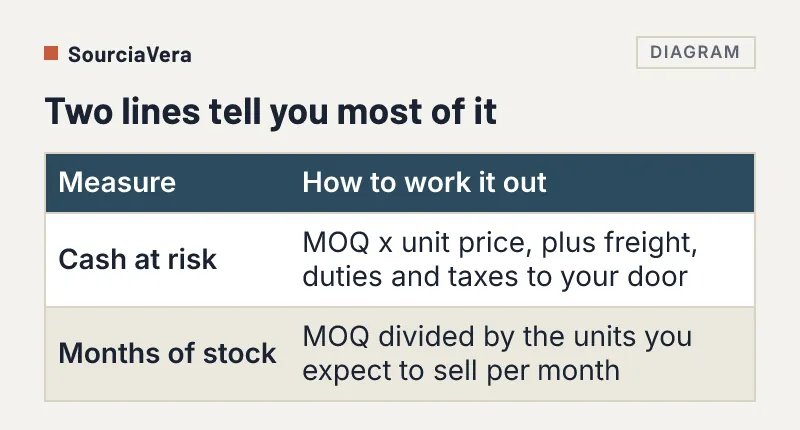
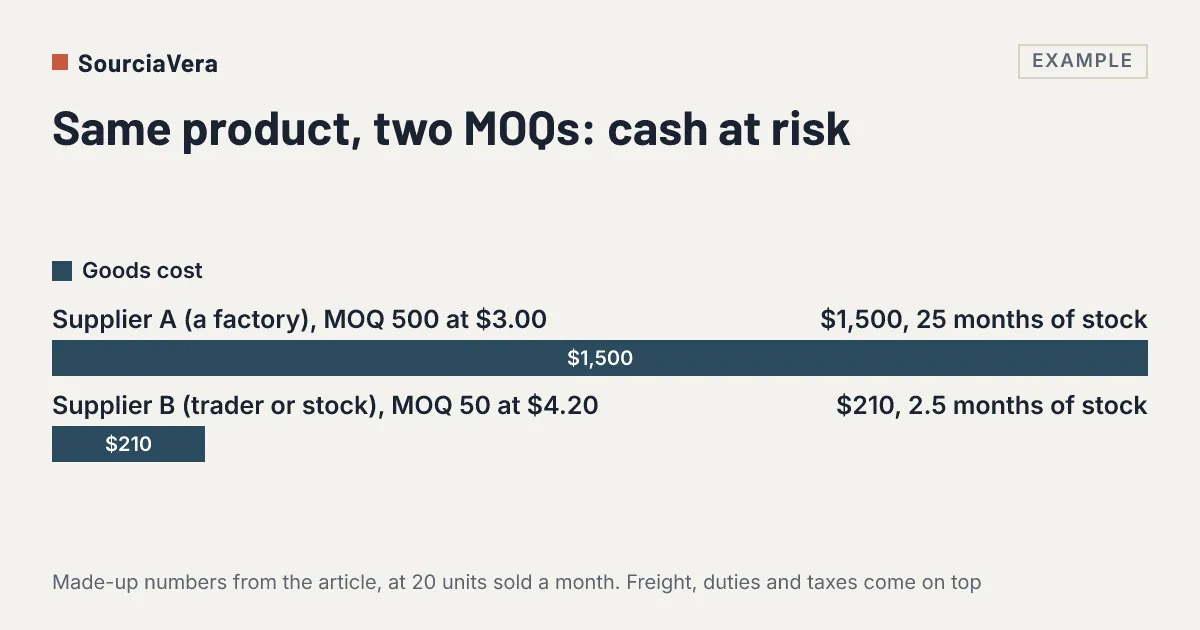
Two lines tell you most of it. Cash at risk is the MOQ times the unit price, plus freight, duties and taxes to your door (ask a customs broker, because the rules differ by country). Months of stock is the MOQ divided by the units you expect to sell per month. Here is a comparison with made-up numbers, for a product you expect to sell 20 units a month:
| Quote | MOQ | Unit price | Goods cost | Months of stock at 20 a month |
|---|---|---|---|---|
| Supplier A (a factory) | 500 | $3.00 | $1,500 | 25 months |
| Supplier B (a trading company or stock supplier) | 50 | $4.20 | $210 | 2.5 months |
These numbers are illustrative, not real quotes. Supplier B charges $1.20 more per unit, which is 40% more and $60 more on a 50-unit order. Supplier A would have you buy 450 extra units: $1,350 of stock that could take almost two years to sell. The table cannot tell you which is better, because that depends on whether the product sells and nobody knows that in advance. It only shows what each choice puts at risk. Freight, duties and taxes come on top of both.
Remember the waiting time too. Our auto parts import guide puts a typical ocean shipment from China to a Mexican port at 30 to 45 days, on top of production time (How to Import Auto Parts from China to Mexico). With a small MOQ you reorder more often, so the next order has to be planned before the first one has sold out.
What Can a Small Business Do When the MOQ Is Too High?
No option works every time, and each one has a price:
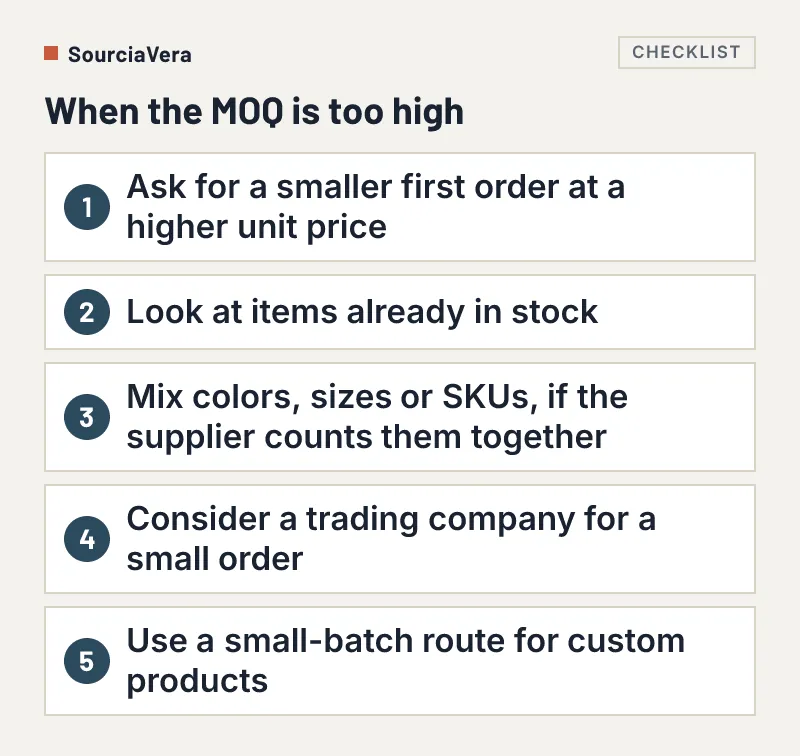
- Ask for a smaller first order at a higher unit price. Alibaba's seller guide suggests asking for a reasonable reduction and buying sample quantities at retail price. Expect to pay more per unit, and expect some suppliers to say no.
- Look at items that are already in stock. The same guide says products in Alibaba's Ready to Ship channel can have MOQs "as low as 5 or 10 units". The trade-off: standard products, little customization, and listings that change.
- Mix colors, sizes or SKUs in one order, if the supplier counts them together. Ask; don't assume.
- Consider a trading company when your order is small. In my experience, a trader is often the better choice when your order quantities are too small for a factory to prioritize. I don't mind a trader, and I don't automatically trust a factory. What I care about is that the buyer knows which one they're paying, and why (Trading Company vs Factory).
- Use a small-batch route for custom products. Our small-batch service covers custom orders from 50 to 500 units. I provide supplier verification services, so you should treat my recommendation accordingly.
Be careful with the opposite case. A very low MOQ on a custom product is a reason to ask more questions, not fewer: who is actually making it, and will quality hold at volume? We cover that in Sample Looks Great, Bulk Order Is Garbage.
How Do You Know Whether an MOQ Is Too High for Your Business?
There is no standard number, so decide yours before you start talking to suppliers. Two questions are enough: what is the most cash you could lose if this product does not sell, and how many months of sales are you willing to hold as stock? An MOQ that fits inside both answers is workable. One that does not is a reason to negotiate or to look elsewhere.
Keep the first order small enough that a mistake is affordable. The good China-sourcing relationships I've seen take 2–3 orders to settle. The first order will probably have small problems: a packaging issue, a minor spec deviation, a delay. And if a factory insists on a 500-unit MOQ for a first order from a buyer it doesn't know, negotiate, or find a supplier more open to building the relationship gradually (Sourcing LED Auto Parts from China).
What Can't Be Known in Advance?
Two things. Nobody can tell you whether the product will sell. And a small buyer's first order often rests on a sample. A sample proves that the factory can make your product once, by hand, when it knows you are watching. It says almost nothing about what 1,000 units off the line will look like.
What Should You Do Next?
- Write down your two limits. The most cash you could lose, and how many units you expect to sell per month.
- Work out both lines for every quote: cash at risk and months of stock.
- Ask each supplier for three quantities, for example 50, 100 and 300 units, with the unit and the price at each. The message in our MOQ guide does exactly that.
- If every MOQ is above your limits, try one option from the list above and write down what the supplier answers.
- Before you pay, find out who you are paying: a factory or a trading company. 10 Things to Check Before Paying a Chinese Supplier Deposit shows how.
- Plan the second order before the first one arrives, so reorder timing is not a guess.
Frequently Asked Questions
How does MOQ affect a small business?
It decides how much cash and stock you commit before you sell anything. A high MOQ ties up money, means many months of stock and leaves little room to test more than one product. A lower MOQ usually comes with a higher unit price.
Can a small business negotiate a lower MOQ?
Often, but not always. Common routes are a smaller first order at a higher unit price, items that are already in stock, mixing colors or sizes in one order, or a supplier that already makes a similar product. Suppliers are more willing to bend for a buyer who looks likely to come back.
How do I know if an MOQ is too high for my business?
Compare it with two limits you set yourself: the most cash you could afford to lose if the product does not sell, and the number of months of sales you are willing to hold as stock. Months of stock is the MOQ divided by the units you expect to sell per month.
Is a lower MOQ always better?
No. A lower MOQ usually means a higher unit price, and a very low MOQ on a custom product is a reason to ask who actually makes it and whether quality will hold at volume.
Are trading companies better for small orders?
Sometimes. In my experience, a trader is often the better choice when your order quantities are too small for a factory to prioritize. It is not automatic: ask who the factory is and what the trader adds to the price.
Summary and Next Step
An MOQ is not only a quantity. It is a cash commitment, a stock level and a bet on a product you have not sold yet. Put numbers on all three before you answer a supplier, and keep the first order small enough that a packaging issue or a delay will not hurt. You don't have to know everything about Chinese manufacturing before you buy from China.
In short, an MOQ is a cash commitment, a stock level and a bet on a product you have not sold yet. If you accept it without putting numbers on all three, the realistic outcome is cash and stock tied up in a product that has not sold, and a delay to your next order. Tell us about your product and the MOQ you were quoted, and a $49 remote check covers the supplier behind it.
For buyers importing from China, understanding the supplier before investing money can reduce unnecessary risks. SourciaVera helps international buyers verify Chinese suppliers, understand manufacturing capabilities, and make safer sourcing decisions. I provide supplier verification services, so you should treat my recommendation accordingly. If you're not sure where to start, the $49 Remote Check looks at the basics — company registration, manufacturer vs. trader, address, and whether the payment account matches the company name — before you place an order. You don't need to travel to China. We're here, and we handle that part for you.