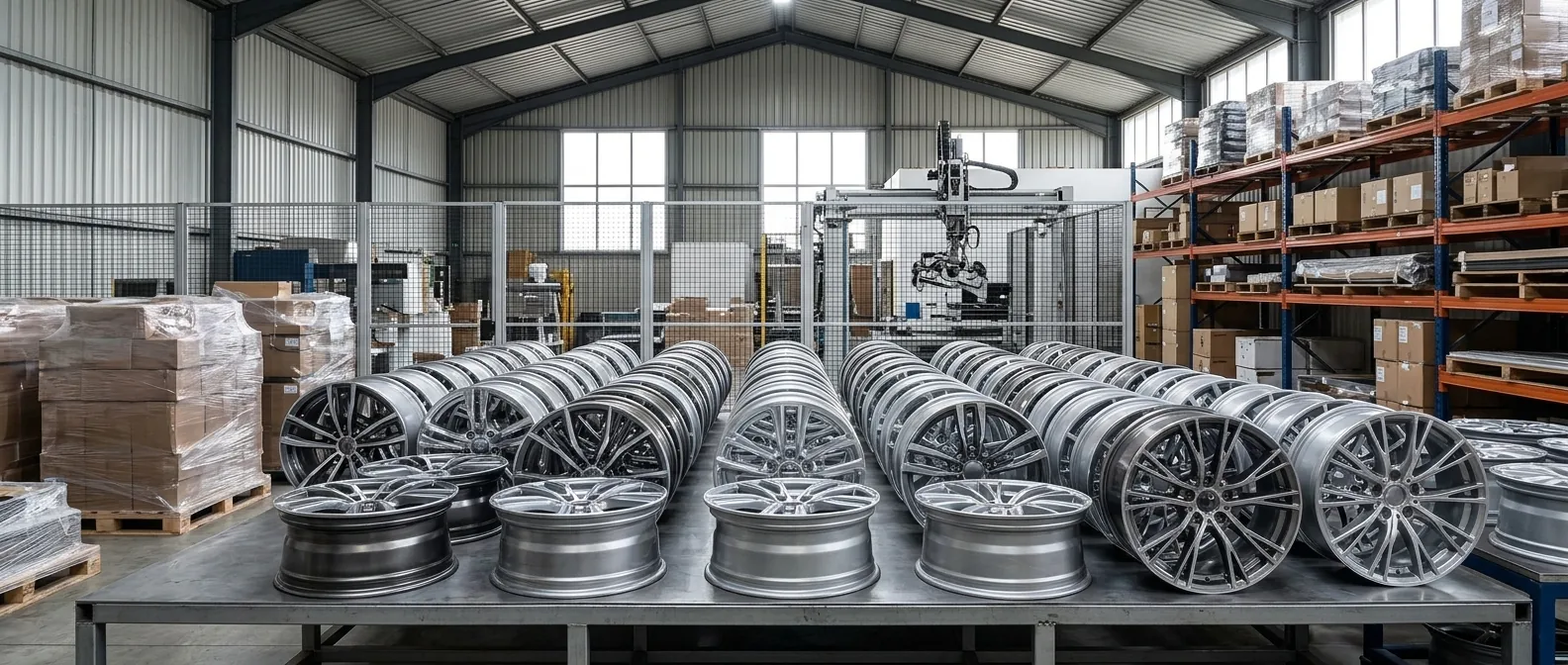
One of our Latin American clients needed to buy a set of OEM wheels for the BYD Seagull. On the surface, a simple part: just find an aluminum wheel manufacturer in China and request a quote. In practice, this type of purchase has one technical detail that, if overlooked, can result in a car that isn’t safe to drive: the offset (ET).
Why ET 54.1 was everything in this order
The BYD Seagull requires a specific offset of ET 54.1. If the wheel that arrives has a different offset — even by a few millimeters — the installer is forced to compensate with a spacer to make the wheel fit. That “fix” isn’t cosmetic: it changes the vehicle’s suspension and steering geometry, affects how it handles in corners, and can cause uneven tire wear or vibration at highway speed.
A buyer who only compares price and wheel diameter, without verifying the exact offset, risks receiving a part that “almost” fits — and “almost” isn’t acceptable when it’s the wheel of a vehicle.
The process: four factories, one that delivered precision
We contacted and evaluated four wheel factories before making a decision. The comparison wasn’t just about price — it was, above all, about technical accuracy and willingness to prove it:
- Several factories confirmed the offset verbally, with no way to verify it before shipment.
- One supplier's business license and Alibaba listing both gave an address in Chengdu's Jinniu District — a district known more for sales offices than production floors. When we asked to see the actual line, the real factory turned out to be in Hongguang, on the other side of the city. That's not automatically a scam — plenty of legitimate manufacturers run sales out of one district and production out of another — but it's exactly the gap between "registered address" and "where your part is actually made" that a buyer has no way to catch from a listing page.
- The factory we ultimately selected, based in Sichuan, was the only one whose registered and actual addresses matched and was willing to document the real product specification before the client committed to the order.
A factory’s willingness to verify — or their refusal — is itself useful information. A supplier who can’t prove what they’re selling before shipment won’t be able to resolve it after.
Verification before buying: installation video + real spec sheet
Before confirming the order, we coordinated directly with the factory to obtain two concrete pieces of evidence:
- An actual video of the wheel installed on the vehicle, showing it fit without needing a spacer.
- A spec sheet with real manufacturing data (offset, width, PCD) — not a generic catalog page.
With that confirmation in hand, we placed a full sample order: wheel + tire + lug wrench + hydraulic jack + storage bag — the complete set as the end user would receive it, not just the isolated part.
The result
Once the client confirmed in person that the product exactly met what was needed, the relationship moved from a sample order to recurring orders. This is exactly the kind of verification we aim to provide in every auto parts category: it’s not enough to find a manufacturer — you have to confirm, with real evidence, that the specific part your client receives matches their vehicle’s exact specification.
Need to verify OEM parts for Chinese vehicles?
SourciaVera verifies auto parts manufacturers in China in person — we confirm technical specifications, review real documentation, and coordinate samples before any deposit. Consult us now.