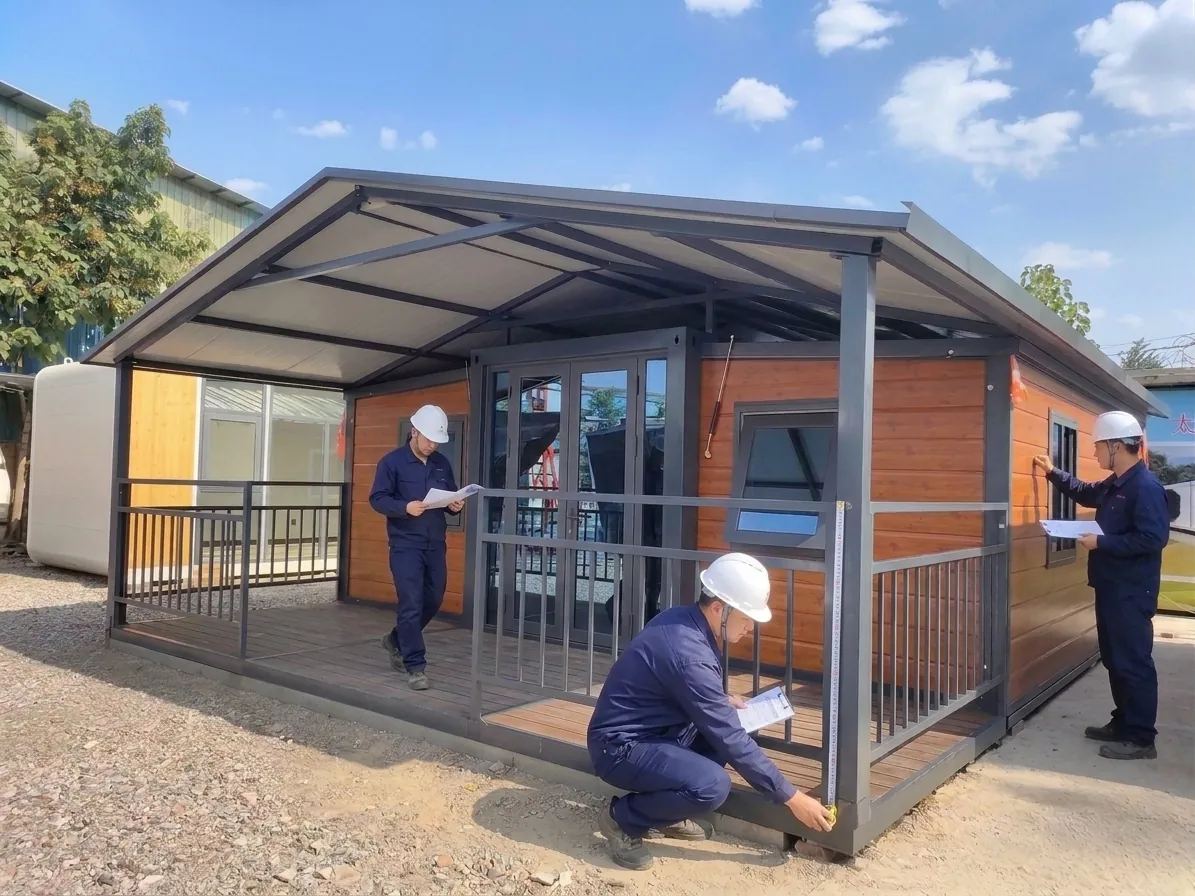
Sellers write "we are a professional manufacturer." Buyers actually want to know: how do I know you're not another Alibaba middleman? The gap between those two sentences is exactly what a factory audit is supposed to close — and after enough of these audits, we've settled on 15 items that catch nearly everything that goes wrong with expandable container house orders. Here's the full checklist, and why each item earns its place.
| Inspection Item | Why It Matters |
|---|---|
| Steel frame thickness | Directly determines structural safety and wind/load rating — the most commonly substituted spec. |
| Welding quality | Poor welds crack under repeated folding and years of thermal expansion, especially at hinge points. |
| Hinge system | The folding mechanism is the product's core function — worn or misaligned hinges bind after a few cycles. |
| Waterproof test (roof & joints) | Roof-to-wall seams can look sealed visually and still leak under real rain — only a water test catches this. |
| Electrical standard compliance | Wiring and outlet standards built for the Chinese domestic market don't always match the destination country's voltage or plug configuration. |
| Insulation core: PU vs. EPS | Both look identical once panels are painted — confirming the actual core material prevents a costly thermal-performance swap. |
| Packing method | Improper crating causes panel and corner damage in transit, especially over a 30–45 day ocean voyage. |
| Factory production capacity | Confirms the delivery timeline quoted is realistic given the factory's actual line throughput, not an optimistic sales estimate. |
| Corner casting & stacking strength | Determines whether units can be safely stacked during storage or transit without structural stress. |
| Floor load rating | Confirms the unit can bear the intended furniture and occupant load without deflection over time. |
| Roof load rating | Matters for regions with heavy rainfall pooling or any expectation of rooftop equipment. |
| Fire rating documentation | Insulation and wall panel materials should carry a real fire-class rating, not just a verbal claim. |
| Business license verification | Confirms the entity you're paying is the entity that actually manufactures the unit. |
| Export/shipping history | A factory with prior exports to humid or coastal markets has already solved problems a first-time exporter hasn't encountered. |
| After-sales & installation support | Determines whether you receive only a shipment or also the technical support needed to assemble it correctly on site. |
How We Use This Checklist in Practice
We don't run these 15 checks as a box-ticking exercise — we run them in an order that front-loads the items most likely to disqualify a factory outright. Business license and export history come first, because there's no point measuring steel gauge at a factory that turns out to be a trading company. Structural items (frame thickness, welding, hinges) come next, since those define whether the unit is safe to ship at all. Waterproofing, electrical compliance, and insulation core come after — these are the items that don't fail the unit outright but determine whether it performs as advertised once it's installed somewhere with real rain, real heat, and a different electrical standard than the one it was built to.
Need Someone to Inspect the Factory in China?
Every item on this list requires being physically present at the factory — measuring plate thickness with a caliper, folding a sample multiple times, pouring water over a roof seam. None of it can be confirmed from a video call or a spec sheet alone.