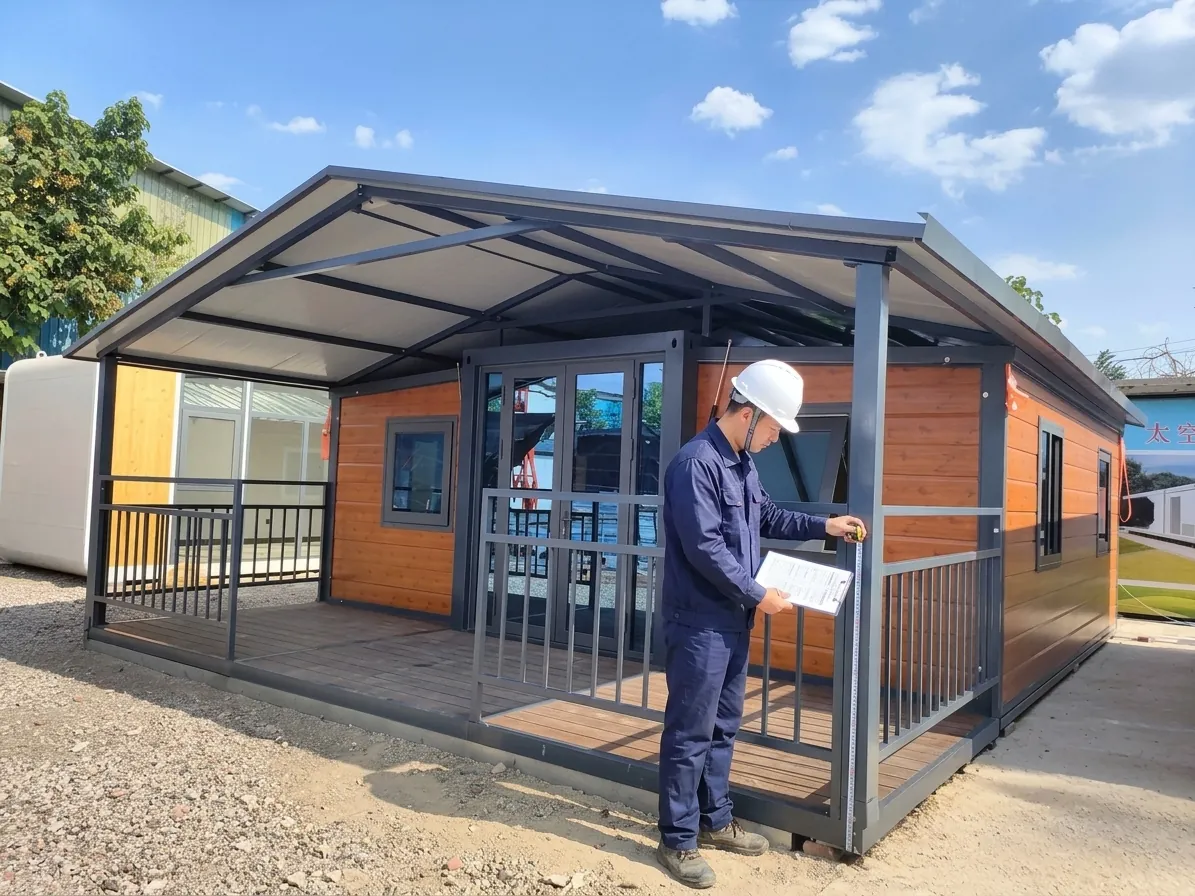
Most guides to importing an expandable container house from China cover the same four topics: shipping, customs, landed cost, and supplier verification. Those four are genuinely the ones that matter — but they read differently once you've actually run an order through them, because the buyer's real experience isn't a checklist, it's a sequence of decisions where the wrong one at step two makes step four more expensive.
Shipping
An expandable container house folds down to roughly a third of its expanded footprint, which is the entire economic case for the product category — two units load into a single 1×40HQ container instead of one. Sea freight is the standard mode; air freight is almost never worth it given the weight of a steel-framed structure relative to its value. Transit time from a Guangdong or Hebei port to a Central American or South American port typically runs 30–45 days door-to-port, depending on transshipment routing.
The detail that catches first-time importers: the factory's quoted "folded dimensions" and the dimensions that actually load into the container are not always the same number. We verify loaded dimensions during a pre-shipment inspection specifically because a unit that folds a few centimeters larger than spec can turn "two units per container" into "one unit plus wasted, paid-for space."
Customs
Classification matters more than most buyers expect. A prefabricated steel structure typically falls under a different HS heading than general steel building materials, and the applicable duty rate and any required import permits vary by destination country — confirm classification with your customs broker before the shipment leaves China, not after it arrives at port. Buyers importing into Mexico, Guatemala, or other Central American markets should also confirm whether the unit requires any local building-code compliance documentation at the point of import, separate from customs clearance itself.
Landed Cost
The EXW or FOB price on a factory's quotation is never the number that determines whether the deal made sense — landed cost is. A realistic landed cost stack includes: unit price (EXW/FOB), ocean freight, marine insurance, destination port handling and customs clearance fees, import duty, inland trucking to final site, and installation labor if the factory doesn't provide it. On a mid-tier unit quoted around $18,000–$19,000 FOB, freight and destination-side costs commonly add 15–25% before the unit ever reaches the buyer's land.
Supplier Verification
This is the step that determines whether the first three go smoothly or become expensive problems. A verified factory gives you a real folded dimension (protecting your freight math), an accurate steel gauge (protecting the unit's actual cost basis), and an honest production timeline (protecting your installation schedule). An unverified supplier can quote a lower number on all four line items above and still cost more once the gaps show up after payment.
A Real Case: What Verification Actually Changes
A buyer in Guatemala came to us wanting a 40 m² expandable unit. The first factory he'd been quoting priced it at $7,900. Once we verified the factory on site, we found the quotation included several spec upgrades the buyer didn't actually need for his use case — a heavier door configuration and a roof upgrade neither required by his climate zone nor requested by him — plus a markup built in for a broker step that wasn't adding any real value. After re-specifying the unit to match his actual requirements and negotiating directly with the verified factory, the same unit landed at $6,700 — a 15% reduction, with a clearer specification than the original quote provided.
The lesson generalizes beyond this one order: the first quotation a buyer receives is rarely the factory's real floor price, and it's even more rarely specified to match what the buyer actually needs. Verification isn't only about catching fraud — a meaningful part of the value is catching over-specification and unnecessary markup on a legitimate factory's own quotation.
What This Means for Your Import Plan
If you're sourcing an expandable container house from China, the sequence that protects your budget is: get quotes from 3–5 factories for the same specification, verify the factory that looks strongest, use that on-site visit to confirm the spec actually matches your climate and use case (not just the factory's default configuration), then build your landed-cost estimate from verified numbers — not the first FOB price you see in a chat window.