The short answer: there is no single best dropshipping platform. The right one depends on where your customers are, how fast you need to deliver, how much margin you need, and how much control you want over quality. Platforms connected to US- or EU-based suppliers are built for fast delivery and an easy start. Tools that import from marketplaces such as AliExpress are built for variety and low prices. Sourcing directly from Chinese factories is built for margin and customization, at the price of more work. Whichever route you take, a platform's own vetting is not a substitute for checking the supplier behind the product.
If you have been comparing platforms for a while, they may have started to look the same. Shopify's own guide says most of them have similar features and differ mainly in cost, product range, policies and ease of use. That isn't you missing something. You are choosing with incomplete information, and the numbers that matter, such as what a sale really leaves you and how long delivery really takes to your customer, take some digging to find.
Shopify's 2026 guide to dropshipping platforms (in Chinese) lists eleven options with their prices, catalog sizes and delivery times, and explains how to choose among them. Lists like that are easy to skim, so this article pulls out the numbers and the points that decide whether a platform works for you — free-plan limits, monthly prices, delivery times and margins — and adds what such lists leave out: what changes when the product comes from China, how to work out whether you will actually make money, and how to check who you are really buying from. It ends with a step-by-step plan, so you know what to do next.
What Is a Dropshipping Platform?
A dropshipping platform is a service or app that connects your online store with suppliers who store and ship products for you. It usually automates the repetitive parts: importing product listings, forwarding customer orders to the supplier, and syncing inventory. You still own the store, the customer relationship and the marketing. The supplier owns the product and the shipping.
What Types of Dropshipping Platforms Are There?
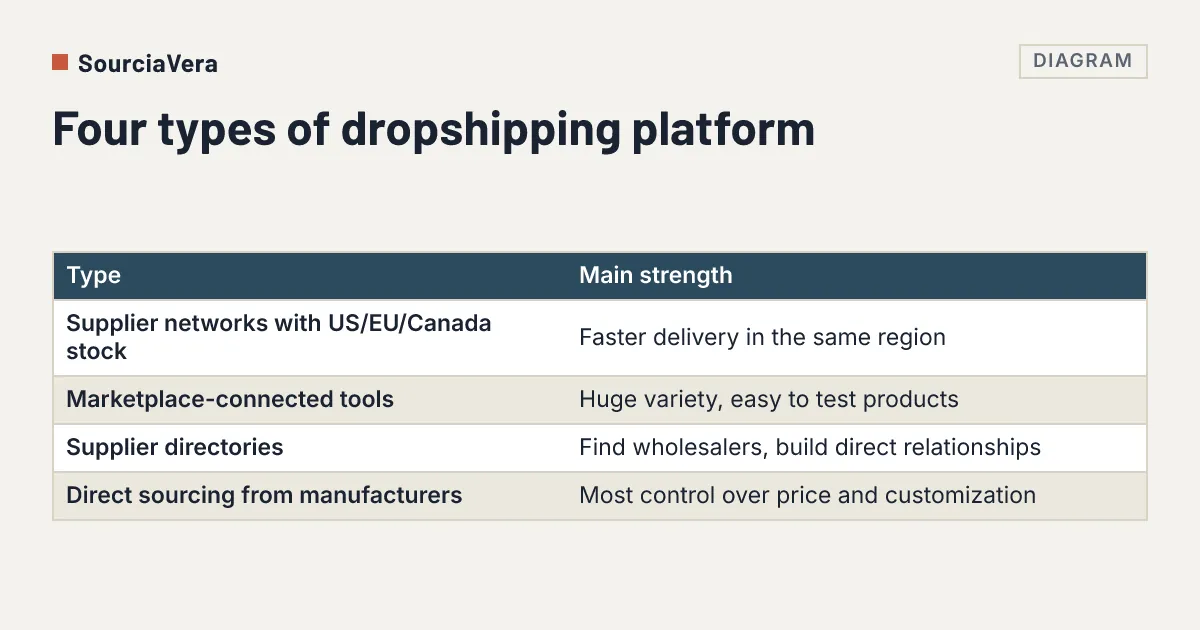
Most platforms fall into one of four models. Each trades speed, price and control differently.
| Type | Examples | Main strength | Watch out for |
|---|---|---|---|
| Supplier networks with US/EU/Canada stock | Spocket, Zendrop, DropCommerce | Faster delivery to customers in the same region | Delivery times apply to specific destinations; check yours |
| Marketplace-connected tools | DSers (AliExpress) | Huge product variety, easy to test products | Crowded niches; delivery times and quality vary |
| Supplier directories | Wholesale Central, Worldwide Brands | A way to find wholesalers and build direct relationships | You do the vetting and negotiating yourself |
| Direct sourcing from manufacturers | Alibaba.com, 1688, sourcing agents | Most control over price, customization and private label | Minimum orders, supplier verification, quality control and shipping are your job |
The examples in the first three rows are platforms named in Shopify's guide; they are not recommendations from us. If you are weighing the last row, we explain how it works in Can You Dropship With Alibaba?
What Do the Platforms in Shopify's Guide Cost, and Where Do They Ship From?
Shopify's guide, published on May 21, 2026, gives each platform's price, catalog size and typical delivery time. The table keeps the figures that matter most when you compare them, ordered roughly from local stock to directories. Prices are as Shopify listed them in that guide (we read it again on Oct 5, 2026); plans change often, so confirm on each platform's own page before you pay. This is a summary of one source, not a ranking or an endorsement.
| Platform | Price listed | Catalog | Stock and delivery | Good to know |
|---|---|---|---|---|
| DropCommerce | Free plan; paid tiers for advanced features | 400+ suppliers in the US and Canada | North America: 3–5 days | Shopify says it offers at least a 30% retailer margin on all products |
| AI Dropship | Free plan: up to 35 products, unlimited orders | US and EU suppliers | 2–7 days | Smaller supplier network than the global platforms |
| Zendrop | $49/month (Pro plan, after a 7-day free trial) | 1M+ products, including US suppliers | US stock: 5–8 days | Works with Shopify stores only |
| Modalyst | Free up to 25 products; $35/month up to 250 | Brand-name and eco-friendly products | US orders: 6–8 days; suppliers ship to 80+ countries | Popular brand items can sell out quickly |
| Trendsi | Free; the cost is built into the wholesale price | 100,000+ fashion products | US: 2–10 days | Women's clothing for sellers in the US |
| Spocket | From $39.99/month | 7M+ products, mostly US and EU suppliers | US, EU and worldwide | Branded invoicing is only on the Pro plan |
| Syncee | Free plan: up to 25 imported products | 12,000+ brands worldwide | Global | Many suppliers also offer wholesale, so you can test through dropshipping and move to wholesale later |
| DSers (AliExpress) | Free up to 3,000 products; paid plans from $19.90/month | 100M+ AliExpress products | Global, shipped through AliExpress | Other retailers may sell the same products |
| Shopify Collective | Free for eligible Shopify merchants | Products from other Shopify brands | Worldwide | Shopify cites typical margins of 20%–50% |
| Wholesale Central | Free directory | 60+ suppliers, mainly in the US | Not applicable: you contact suppliers directly | A directory, not an app: no order or inventory tools |
| Worldwide Brands | One-time $197 | Directory of suppliers that meet its own quality standards | Not applicable: you contact suppliers directly | A directory, not an app: no automation |
The guide also mentions Doba (from $29.99/month; suppliers mainly in the US and China) and Wholesale2b (from $29.99/month; 1M+ products from 100+ wholesale suppliers in the US and Canada).
What Do the Monthly Prices Add Up To?
Our arithmetic from the prices above, before taxes, free trials and any discount for paying yearly, and not counting your own store plan:
- DSers paid plan: $19.90 × 12 = $238.80 a year (the free plan covers up to 3,000 products)
- Modalyst, up to 250 products: $35 × 12 = $420 a year
- Spocket, entry price: $39.99 × 12 = $479.88 a year
- Zendrop Pro: $49 × 12 = $588 a year
- Worldwide Brands directory: $197, paid once
Several platforms have free plans with limits: 25 products on Syncee and Modalyst, 35 on AI Dropship, 3,000 on DSers. That is enough to test an idea without a monthly fee. Consider paying for a plan only once a product has shown that it sells.
How Do You Choose the Right Dropshipping Platform?
Compare platforms on the same few points:
- Total cost: monthly fees, per-order or transaction fees, and charges that only appear later.
- Where the stock sits: the supplier's location decides how long delivery takes for your customers.
- Product range: a broad catalog or a specialist niche, branded or generic items.
- Integration: whether it connects cleanly to your store and keeps inventory and tracking in sync.
- Branding options: custom packaging, invoices or inserts if you want your own brand experience.
- Supplier vetting: what the platform actually checks — and what it does not.
- Returns and support: who handles refunds and replacements, and how fast.
How Much Is Left After Each Sale? A Worked Example
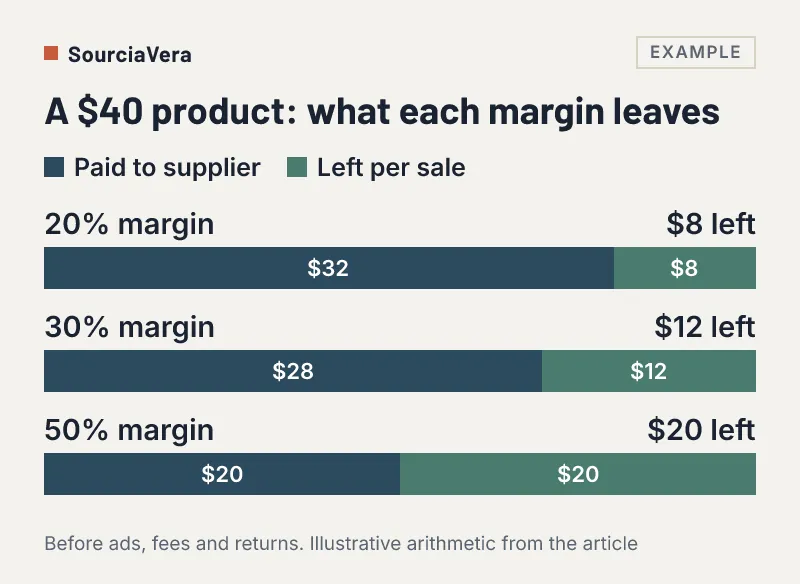
Shopify's guide cites margins of roughly 20% to 50% for Shopify Collective products and says DropCommerce offers at least 30%. We use "margin" here to mean the share of your selling price left after you pay the supplier; the guide doesn't say how each platform defines it, so check that before you rely on the figure. On a $40 product it looks like this (illustrative arithmetic, not a forecast):
| Margin | You pay the supplier | Left per sale, before ads, fees and returns |
|---|---|---|
| 20% | $32.00 | $8.00 |
| 30% | $28.00 | $12.00 |
| 50% | $20.00 | $20.00 |
Now take off what it costs you to win the sale. If advertising costs $12 for each order, a 30% margin leaves nothing before payment fees and refunds, and a 20% margin loses $4 on every order. The rule is simple: advertising cost per sale + payment fees + expected refunds must stay below the margin per sale. Work this out for your own product before you spend on ads, because no platform fixes a margin that is too thin.
What Are the Main Risks of Dropshipping Platforms?
Shopify's guide is open about the downsides, and they are worth taking seriously:
- The same product can be sold by many stores, which makes it hard to stand out.
- Delivery times vary widely depending on where the supplier is.
- Margins depend on the platform and the supplier. The guide cites margins of roughly 20% to 50% for Shopify Collective products and at least 30% for DropCommerce; treat that as a rough guide and work out your own after product cost, shipping, fees and returns.
- Marketplace-based dropshipping, such as AliExpress, is crowded.
- Supplier reliability varies, and inventory-sync problems can lead to overselling.
What Do Dropshipping Platforms Not Check?
Platforms that vet suppliers apply their own criteria. That helps, but it usually doesn't tell you:
- Whether the supplier is the manufacturer or a middleman
- Whether the product you receive will match the sample and the listing every time
- Whether the supplier can keep up if your orders grow
- Whether the business behind the listing is the one you are actually paying
These questions matter more the closer you get to the factory — especially if you move from ready-made products to private label or direct sourcing from China. We cover the first one in Is My Chinese Supplier a Real Factory or a Trading Company?
A badge or a platform's vetting describes how a supplier is presented, not necessarily what it is registered to do. In one case we describe in Is Alibaba Trustworthy?, all four "Verified Supplier" suppliers of 50% hydrogen peroxide that a client was comparing turned out, once we checked their business licenses, to be registered as trading or import-export companies, with no manufacturing scope for that product.
None of this is visible from the outside. It doesn't mean you did something wrong; you simply couldn't see what was happening.
What About Selling in Mexico and Latin America?
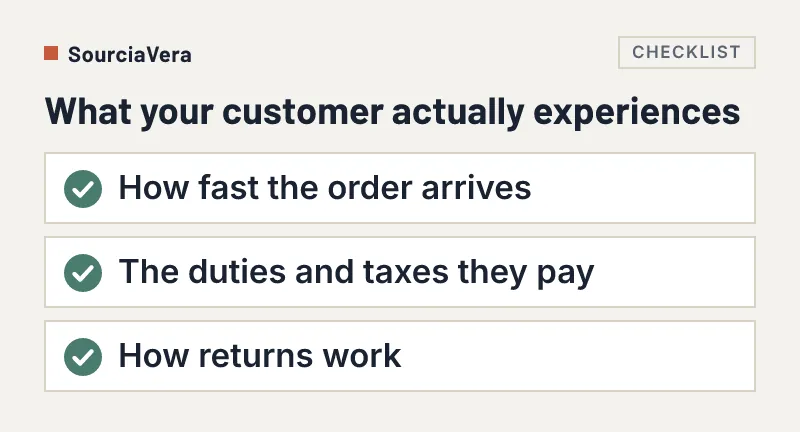
Platform lists are mostly written around customers in the US, Canada and Europe. Several of the platforms in Shopify's guide describe suppliers or warehouses there, so the delivery times they advertise may not apply to a customer in Mexico or elsewhere in Latin America. Before you choose, check where the platform ships, how long it takes, who handles customs duties and taxes, and how returns work. Rules for small parcels differ by country and change often, so confirm with a customs broker or your country's customs authority.
For comparison, our guide to importing auto parts from China to Mexico puts a typical ocean shipment from a Chinese factory to a Mexican port at 30 to 45 days, before any production time and customs clearance. Buying stock in bulk from a factory usually trades delivery speed for margin; platforms with local stock do the opposite.
What Should You Do Next?
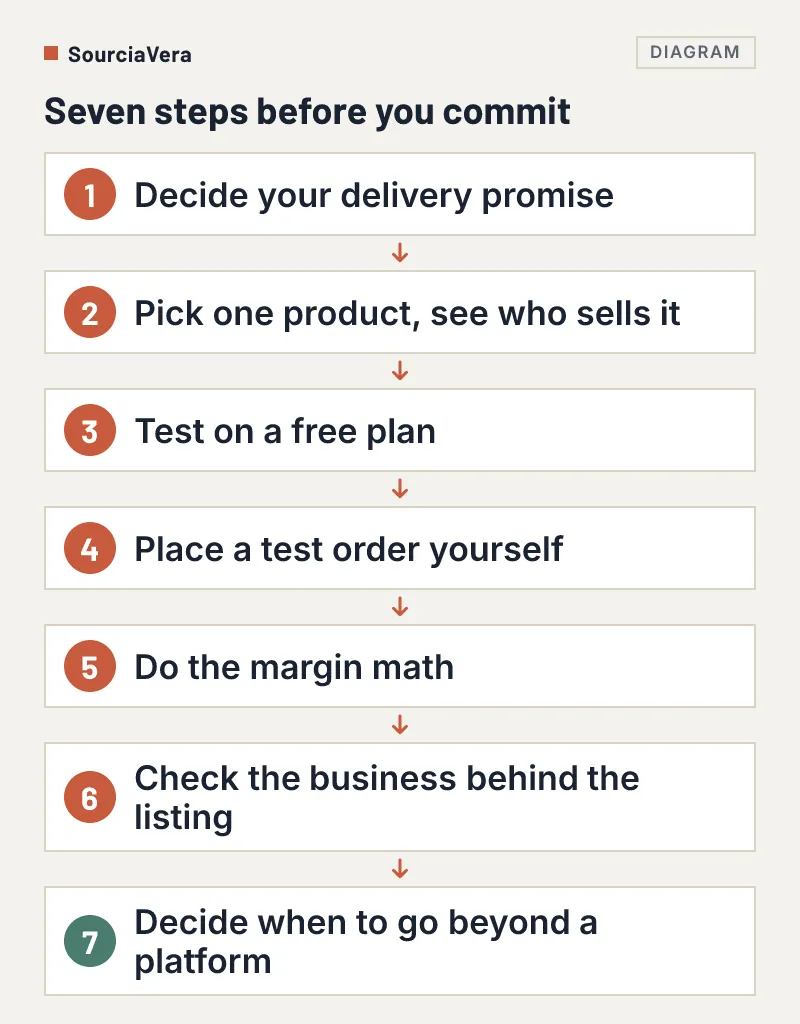
If you are not sure where to begin, work through these steps in order. Each one ends with something you can write down.
- Decide your delivery promise. Where are your customers, and how many days can you honestly promise? For customers in the US and Canada, the platforms above list 2–10 days from local stock (DropCommerce 3–5 days in North America, AI Dropship 2–7, Zendrop 5–8, Modalyst 6–8, Trendsi 2–10). For Mexico or elsewhere in Latin America, ask each platform in writing how long delivery takes to your customers' country.
- Pick one product and look at who already sells it. Note their prices, branding and product pages. Shopify's guide suggests comparing competitors' strategy, target market, branding, key features, price points and site design.
- Test on a free plan. Free limits run from 25 products (Syncee, Modalyst) and 35 (AI Dropship) up to 3,000 (DSers), so you can try an idea before you pay a monthly fee.
- Place a test order yourself. Order through the same route your customers will use. Write down the order date, the delivery date and the days in transit. Compare the product, packaging and paperwork with the listing, and find out who ships, from where, with what tracking, and what happens with returns and replacements. A good sample is a start, not proof: see Sample Looks Great, Bulk Order Is Garbage for what can change once orders get bigger.
- Do the margin math. Selling price × margin, minus the cost of winning a sale, minus payment fees and expected refunds. If the result is below zero, change the product or the price before you change the ad budget.
- Check the business behind the listing. Registered company name, manufacturer or trading company, and whether the payment account is in the same name as the company, plus a live video of the real operation (the production floor or the warehouse). Our guides explain how: real factory or trading company and 10 things to check before paying a deposit.
- Decide when to go beyond a platform. If a product sells steadily and the margin is thin, buying from a manufacturer can raise it, at the cost of minimum orders and more checking. Start with Can You Dropship With Alibaba?
Step 6 is the one that sounds like a sales pitch, and I should say so: I sell that check. If you're testing a product with a handful of orders on a platform that handles the payment, I wouldn't spend $49 on it yet. If you're about to pay a supplier directly, or put your brand on one, I would. You don't need to travel to China. We're here, and we handle that part for you; the $49 Remote Check below is the place to start.
Frequently Asked Questions
What is the best dropshipping platform?
There is no single best one. It depends on where your customers are, how fast you must deliver, your margin target and how much quality control you need. Compare total cost, where the stock sits, product range, integration with your store and how the suppliers are vetted.
Is Shopify a dropshipping platform?
Shopify is an e-commerce platform for building and running an online store. Dropshipping platforms and apps connect your store to suppliers who store and ship the products.
Do dropshipping platforms verify their suppliers?
Some do, and the depth varies. Platform vetting is useful, but it is not the same as checking the factory behind a specific product. If you build a brand around a product, verify the supplier yourself or with a third party.
How much profit can you make with dropshipping?
It varies by product, supplier and competition. Shopify's guide cites margins of roughly 20% to 50% for Shopify Collective products and at least 30% for DropCommerce; treat that as a rough guide and calculate your own after product cost, shipping, fees, returns and advertising.
How much does a dropshipping platform cost?
It ranges from free plans to paid plans of a few dozen dollars a month. In Shopify's May 2026 guide, DSers is free up to 3,000 products and starts at $19.90 a month after that, Modalyst is free up to 25 products and $35 a month up to 250, Spocket starts at $39.99 a month and Zendrop's Pro plan is $49 a month. Prices change, so check each platform's own page.
How long does delivery take with dropshipping platforms?
It depends on where the stock sits. Shopify's guide lists 3–5 days within North America for DropCommerce, 2–7 days for AI Dropship, 5–8 days from US stock for Zendrop, 6–8 days for US orders on Modalyst and 2–10 days for Trendsi. Shipping to other regions usually takes longer, so ask each platform for the delivery time to your customer's country.
Summary and Next Step
Choosing a dropshipping platform is really choosing a supplier model: fast but local, cheap but crowded, or flexible but demanding. Pick the model that fits your customers and your margin, then check the supplier behind it instead of trusting the badge or the list.
If you read Chinese, Shopify's original guide goes through the eleven platforms in detail.
For entrepreneurs sourcing products from China, understanding suppliers before investing money can reduce unnecessary risks. SourciaVera helps international buyers verify Chinese suppliers, understand manufacturing capabilities, and make safer sourcing decisions. We don't run dropshipping fulfillment; we check the supplier before you build on it. If you're not sure where to start, the $49 Remote Check looks at the basics — company registration, manufacturer vs. trader, address, and whether the payment account matches the company name — before you spend money on samples.
In short, a dropshipping platform is a supplier model, and the supplier behind it is still unchecked. If you build a store on a supplier nobody has verified, the realistic cost is parcels that arrive late or wrong, which you are the one to explain to your customer. We do not run fulfillment, but a $49 remote check looks at the supplier before you build on it.
I provide supplier verification services, so you should treat my recommendation accordingly.