
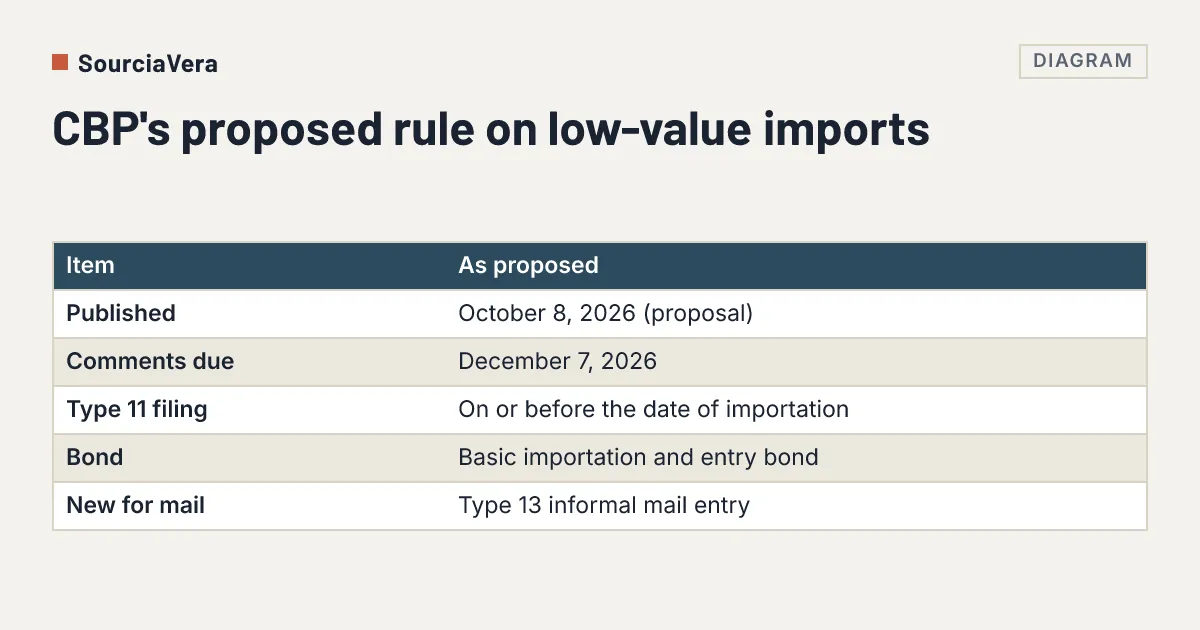
The short answer: on October 8, 2026, U.S. Customs and Border Protection (CBP) published a proposed rule that would change how goods worth $2,500 or less are cleared. Informal entries (Type 11) would have to be filed electronically on or before the date of importation instead of within 15 days after arrival, every Type 11 filer and a new mail entry type (Type 13) would need a basic importation and entry bond, and the final deliver-to party would have to be named. It is a proposal, with comments open until December 7, 2026, not a final rule. If you buy small lots from Chinese suppliers and ship them by courier, air or post, the practical point is that the data must be right before the parcel lands, and your supplier is where much of that data comes from.
This article covers what the notice proposes, what is still open and what to ask your Chinese supplier and your forwarder to provide now. It is based on the notice itself, one trade-press report and general good practice, not on any first-hand experience of these filings. It is not customs or legal advice: your licensed customs broker decides how it applies to you.
Why Does It Matter to a U.S. Buyer?
- Less time to get the paperwork right. Today a Type 11 entry can be filed within 15 days after arrival; the proposal replaces that with "upon or prior to the date of importation" (Federal Register notice).
- A bond becomes part of your cost. The notice says all Type 11 and Type 13 filers would need a basic importation and entry bond, single-transaction or continuous, and sets minimum liquidated damages of $1,000 for each breach of a listed bond condition. It does not say what a bond will cost you.
- Delays are a real risk. The Loadstar reports that CBP's own sampling found more than half of the Type 11 imports sampled between September and November 2025 would have missed the new deadline, and that CBP acknowledged some importers may not receive their shipments (The Loadstar).
What Did CBP Propose?
The notice, published at 91 FR 64532 (Docket USCBP-2026-0298), proposes these changes, as we read it (Federal Register; we read the text through the mirror thefederalregister.org because the official page did not load, and only its first 100,000 characters):
- Type 11 filed at arrival. The 15-day post-arrival window would be replaced by a deadline of "upon or prior to the date of importation", filed electronically. Informal entry stays tied to goods valued at $2,500 or less.
- A new Type 13 for mail. A new "Informal Mail Entry" for mail valued at $2,500 or less that would otherwise qualify for Type 11. The owner or purchaser may self-file or use a licensed broker, the sender's identity and address and the UPU S-10 tracking number would be required, and mail without a timely, proper entry would be treated as voluntarily abandoned after 15 days.
- The final deliver-to party. The filer would have to name the final deliver-to party, with its address, when it differs from the ultimate consignee.
- A bond. A basic importation and entry bond for every Type 11 and Type 13 filer.
Which Dates Are in Play?
- December 7, 2026: the comment deadline for the proposal.
- January 20 (2027, by implication): according to The Loadstar, CBP moved the compliance deadline for mail from October 22 by three months; that article gives no effective date for Type 11.
- July 1, 2027: the date on which, under the law the notice cites, the de minimis exemption ends; the notice says the exemption has been suspended since at least August 29, 2025 and was suspended indefinitely by CBP rules on June 24, 2026.
What Is Still Unknown?
The final text and its effective date, what a bond will cost and who will offer it, how forwarders and brokers will collect the new data, and whether the rule will change before it is final. The Loadstar quotes a freight company as saying the era of lightweight clearance for parcels has closed and advising shippers to check their systems and their exposure to bonding; that is one company's view. Plan with your broker, not with a date from a news report.
What Should a Buyer Ask the Supplier and the Forwarder For?
This section is general advice, not a rule from the notice. Most of what the proposal asks for starts with information your supplier holds.
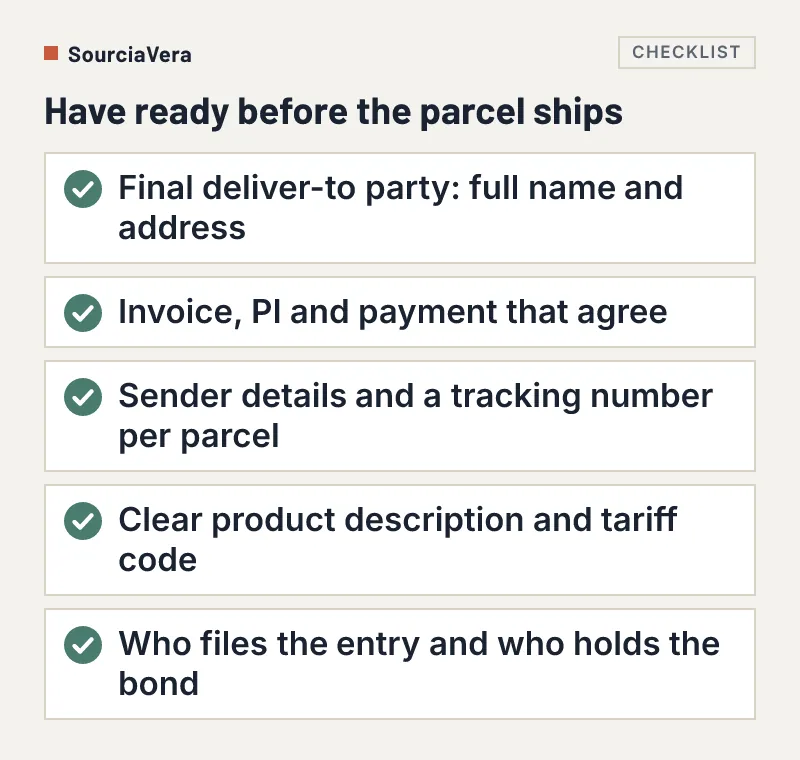
- The final deliver-to party's full name and address, correct and the same on every document. If you ship to a warehouse or a customer, say so before the order is packed.
- An invoice that shows what you paid. The commercial invoice, the proforma invoice and your payment should agree (see how to pay a Chinese supplier).
- The sender's name and address as it will appear on the label, and a tracking number for every parcel, sent as soon as it is known.
- A clear product description and the supplier's tariff code, so your broker can classify the goods without asking twice (the documents to request from a Chinese manufacturer is a good checklist).
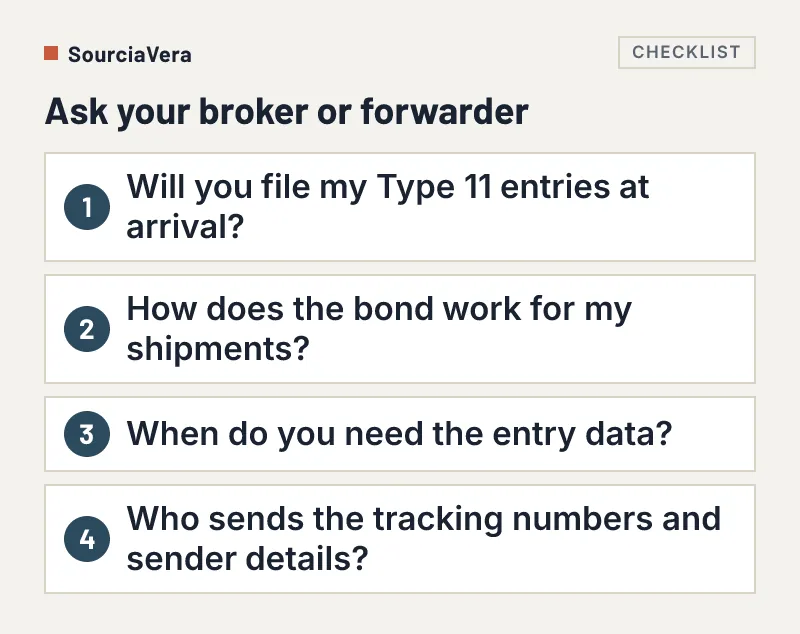
- Shipping data before departure, not after. Ask the forwarder when the entry data is needed and who will transmit it.
- Who files and who holds the bond. Ask your broker or forwarder whether they will file for you and how the bond works for your shipments.
Where Does a Third-Party Check Help?
It cannot file an entry or choose a bond. What it can do is check that the supplier behind the data is real and that the data is true: whether the company named as sender exists and is a manufacturer or a trader, whether the payment account matches the company, and whether the goods in the box match the invoice. The $49 Remote Check looks at the company registration, the address and the payment account name before you place an order. An inspection before the balance is paid (what a pre-shipment inspection costs) compares quantities, labels and descriptions with the documents, and the 10 things to check before paying a deposit cover the rest. A price far below other quotes is both a customs question and a supplier-risk question (see 9 Alibaba supplier red flags).
What Does the Proposal Not Tell You?
It does not tell you what duty you will pay on a given product, how much a bond costs or when the rule will apply. It does not say that your shipments will be held, only that the time to file is shorter. And it says nothing about your supplier. This is general information, not customs or legal advice.
What Should You Do Next?
- Ask your broker or forwarder how they will handle Type 11 filing at arrival and the bond for your shipments.
- List your open orders that ship as parcels and check that each has a full deliver-to name and address.
- Line up invoice, PI and payment with your supplier, with the price term written down (see which price term to ask a Chinese supplier to quote).
- Ask suppliers for tracking numbers and sender details as soon as parcels are packed.
- Check any new supplier before you pay, and consider commenting on the proposal through your trade association if it affects your business.
Frequently Asked Questions
What did CBP propose for low-value imports?
On October 8, 2026 CBP published a proposed rule: Type 11 informal entries for goods worth $2,500 or less would be filed electronically on or before the date of importation, all Type 11 and new Type 13 (mail) filers would need a basic importation and entry bond, and the final deliver-to party would be named. Comments are open until December 7, 2026.
Is this rule final?
No. It is a notice of proposed rulemaking. According to The Loadstar, CBP separately moved the compliance deadline for mail by three months, to January 20, but gave no effective date for Type 11.
When does the de minimis exemption end?
The notice says it ends on July 1, 2027 under the law it cites, and that the exemption has been suspended since at least August 29, 2025.
How much will the bond cost?
The notice requires a basic importation and entry bond, single-transaction or continuous, but the sources we read do not say what it will cost. Ask your broker or a surety.
What should I ask my Chinese supplier to provide?
The final deliver-to party's name and address, an invoice that matches your payment, the sender details and a tracking number for every parcel, and a clear product description with the tariff code. Ask your forwarder when the data is needed.
Summary and Next Step
CBP has proposed that low-value Type 11 entries be filed on or before arrival, with a bond and the final deliver-to party named, and a new Type 13 for mail. It is not final, and the end of the de minimis exemption is set for July 1, 2027. For a buyer from China the preparation is practical: correct deliver-to details, an invoice that matches your payment, tracking numbers and a supplier you have checked.
In short, get the data right before the parcel ships. A $49 remote check looks at who is behind the supplier and whether the payment account matches the company, and you can tell us about your order if you want help preparing the questions for your supplier and forwarder.
If you would rather have someone check the basics before you accept a quote or pay a deposit, understanding who is behind each quote before investing money can reduce unnecessary risks. SourciaVera helps international buyers verify Chinese suppliers, understand manufacturing capabilities, and make safer sourcing decisions. I provide supplier verification services, so you should treat my recommendation accordingly. The $49 Remote Check looks at the basics — company registration, manufacturer vs. trader, address, and whether the payment account matches the company name — before you place an order. SourciaVera is not a customs broker, and nothing here is customs or legal advice.