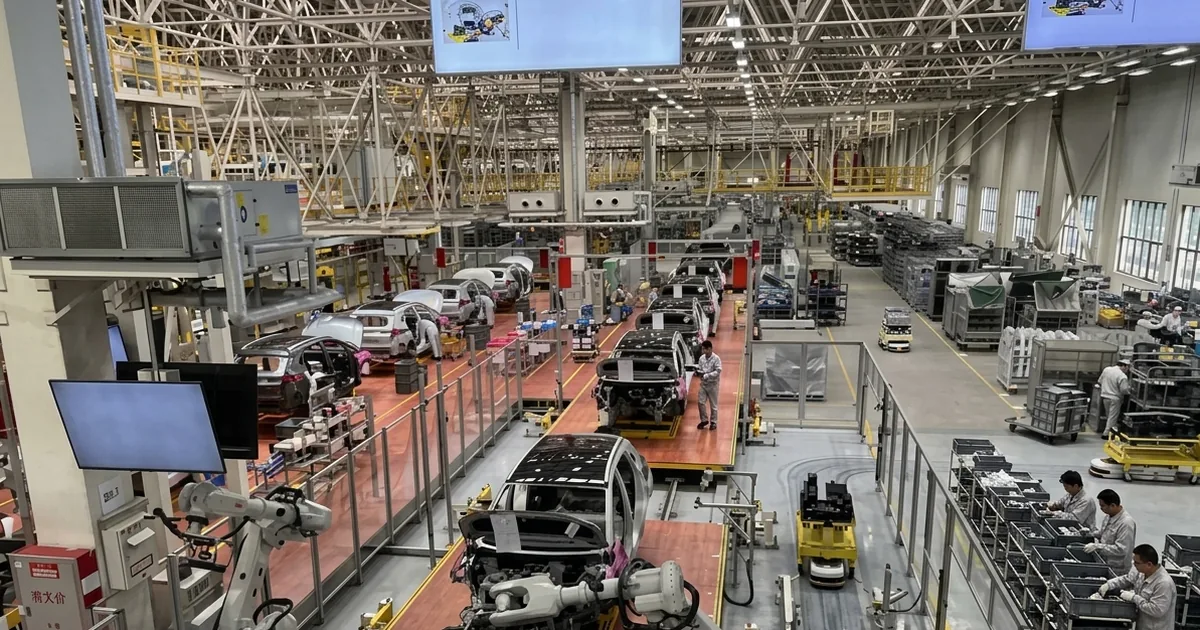
The short answer: the decree Mexico published on 13 October 2026 removes the 10% import duty only on parts and components for vehicle assembly (tariff fraction 9803.00.01), and only for terminal automotive companies that hold a depósito fiscal authorization for vehicle assembly and follow the Secretaría de Economía's guidelines. Reports say it is in force from 14 October for five years. Several headlines read "Mexico eliminates the tariff on auto parts", but on the wording the reports quote, it is not a general cut. An importer or distributor that buys parts to resell them does not appear to be covered.
This article sets out what the decree says, who can use it, who cannot, and what a buyer or a Chinese supplier should do now. It is based on published reports and the legal texts cited below, not on any first-hand experience of this measure.
Update, October 18, 2026: Radio Fórmula reports that the Secretaría de Economía confirmed that only 11 light-vehicle manufacturers can use the exemption, and that it has not published an official list of them. The outlet cites a Reuters analysis of industry data that names Audi, BMW, Ford, General Motors, Honda, Kia, Mazda, Nissan, Stellantis, Toyota and Volkswagen as the likely beneficiaries; that is an analysis, not the government's list. JAC, which assembles vehicles in Ciudad Sahagún, Hidalgo, is not on it, and the report says there is not yet enough official information to say whether JAC can use the mechanism: having a plant does not by itself give access. The report adds that the Secretaría plans controls on imported volumes, prior permits and traceability, plus minimum production requirements and limits on imports relative to the cars made in the country (Radio Fórmula, October 17). The decree text that Expansión cited sets no such requirements, so these controls come from the Secretaría's announced plans, not from a published text we have seen. We have not read the DOF page ourselves. This fits the narrow reading above and is one more reason not to renegotiate prices on the headline. A separate Mexican change that also affects invoices is covered in the Customs Law reform on goods declared below their value.
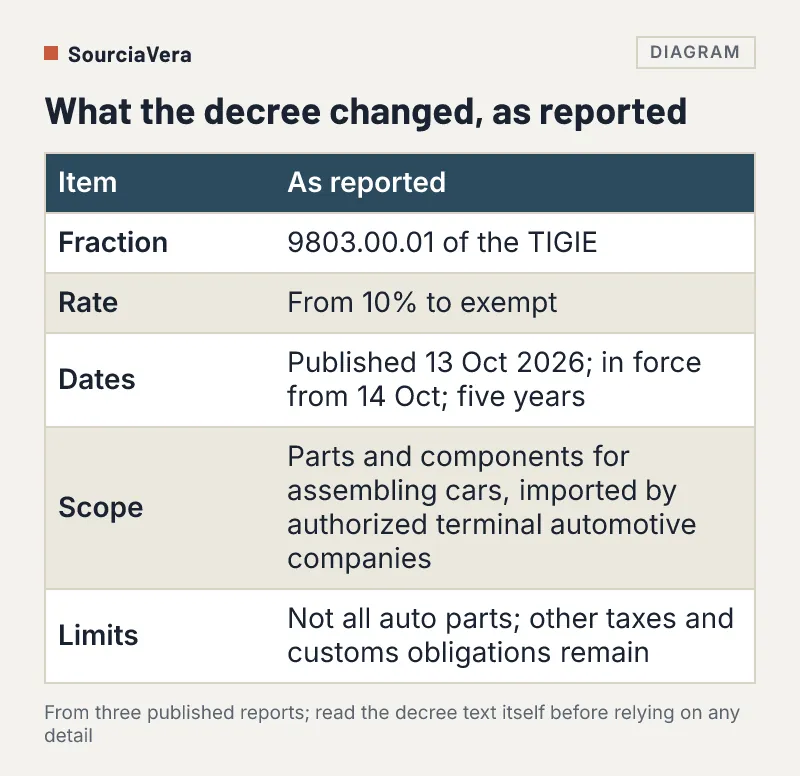
What Did the Decree Change?
- The rate: the decree changes the rate for fraction 9803.00.01 of the Mexican tariff schedule (the TIGIE) from 10% to exempt, according to Cluster Industrial and El Economista.
- The dates: published in the Diario Oficial de la Federación (DOF) on 13 October 2026, in force from 14 October, valid for five years, per the same reports.
- The scope: parts and components for assembling cars, imported by terminal automotive companies that have a depósito fiscal authorization for vehicle assembly and manufacturing under the Ley Aduanera and that follow the Secretaría de Economía's guidelines (El Economista).
- The models: the decree mentions SKD (semi-knocked-down) and CKD (completely knocked-down) assembly as ways to start vehicle production gradually (Cluster Industrial).
- The limits: Cluster Industrial says the exemption does not cover all imported auto parts and does not remove other taxes or customs obligations, and that its application "no es automática". Expansión reports that the text it cites sets no minimum local content and no specific technology-transfer obligation (Expansión).
For context, Cluster Industrial notes that since January 2026 Mexico charges higher tariffs, up to 50% on some vehicles, on imports from countries without a trade agreement, China among them, and that this decree does not lift those. We could not open the DOF page from our network, so everything above comes from these three reports quoting the decree. Read the decree text itself before you rely on any detail.
Who Can Use the Exemption, and Who Cannot?
The table is our reading of the scope as the reports describe it. It is not legal advice.
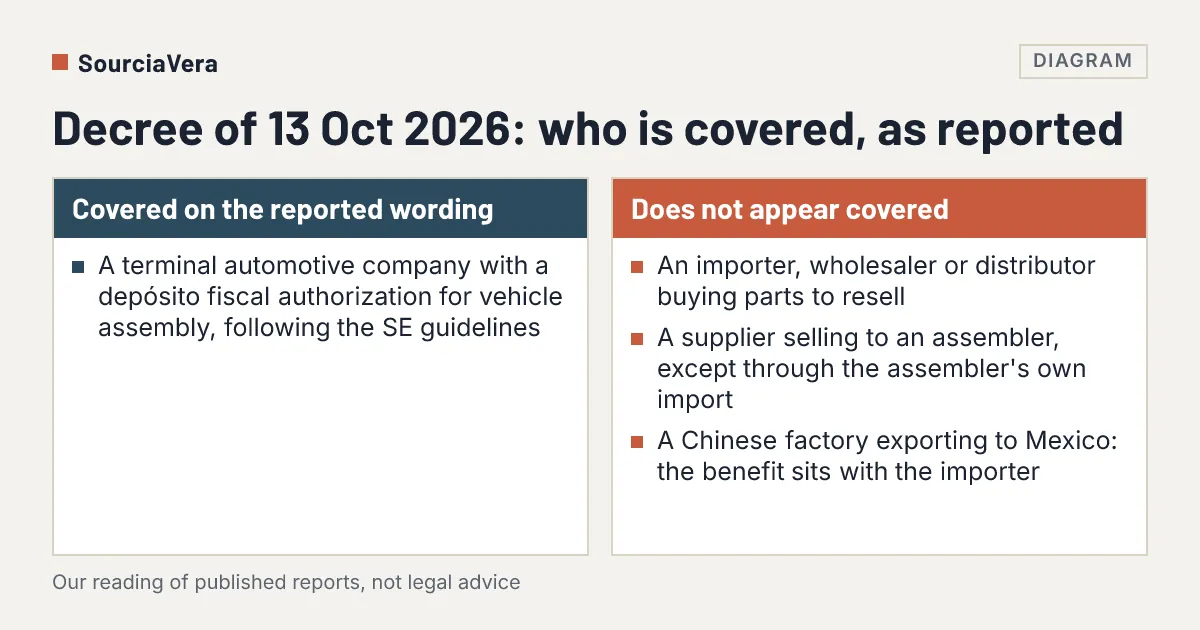
| Who | Covered, on the reported wording? | Why |
|---|---|---|
| A terminal automotive company with a depósito fiscal authorization for vehicle assembly, following the SE guidelines | Yes, this is the group the decree names | It meets every condition the reports list |
| An automotive company without that authorization, or outside the SE guidelines | No | The conditions apply together, not one at a time |
| An importer, wholesaler or distributor that buys parts to resell them | Does not appear to be | The fraction is for parts and components to assemble vehicles, imported by assemblers under that regime |
| A supplier selling parts to an assembler in Mexico | Only through the assembler's own import | The decree names the assembler as the importer, so a supplier is not an importer under it |
| A Chinese factory exporting to Mexico | The decree does not change its own position | It is a Mexican import-duty measure; the benefit, if any, sits with the importer |
The opening line of one report speaks of "autopartes originarias de todo el mundo" (El Economista), which can sound general. The same article, however, limits the exemption to terminal automotive companies with the authorization and the SE guidelines, so read that line and the conditions together.
What Does the Authorization Require?
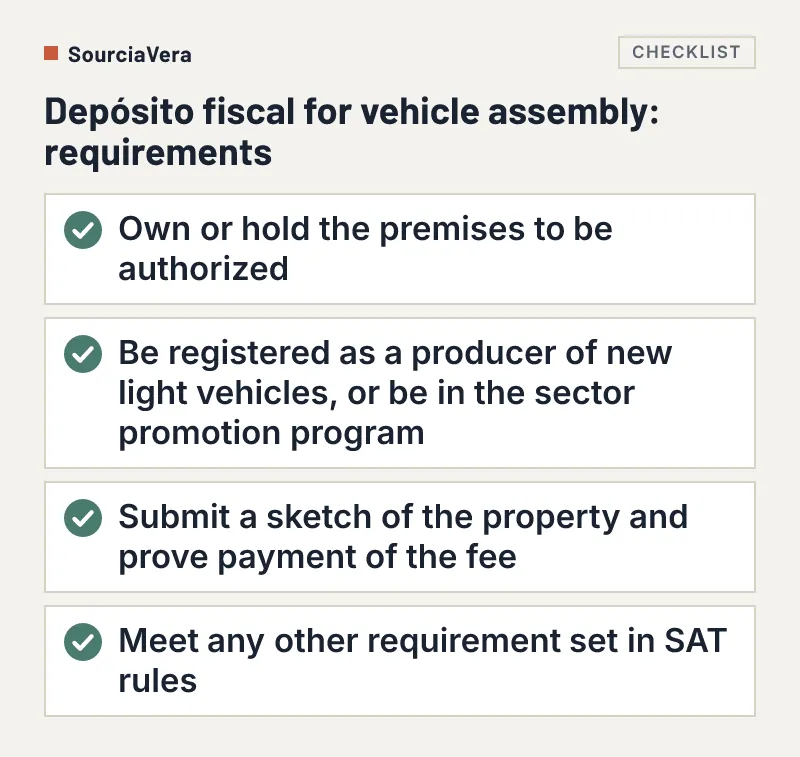
The decree refers to a depósito fiscal authorization under the Ley Aduanera, which is not the same thing as an IMMEX program. Article 182 of the Reglamento de la Ley Aduanera, which implements article 121, fraction IV of the Ley (text of art. 121), lets the customs authority authorize such warehouses for vehicle assembly and manufacturing for terminal automotive companies that are up to date with their tax obligations and meet these requirements, as reproduced on the mLey.mx legal compilation:
- they own or hold the premises to be authorized;
- they are registered as a producer of new light vehicles, or are in the Programa de Promoción Sectorial de la Industria Automotriz y de Autopartes;
- they submit a sketch of the property and prove payment of the fee under the Ley Federal de Derechos;
- they meet any other requirement the SAT sets in its rules.
The same text says the authorization lasts up to ten years and can be renewed. mLey.mx is a compilation, not the official gazette, so check the current wording in the DOF. In plain terms: this is a status an assembler holds, and a distributor of spare parts does not hold it by buying from a supplier.
What Does It Mean for Chinese Factories?
This section is inference, not reported fact. The measure lowers the duty an authorized assembler pays on the parts it imports for assembly, so a factory that supplies parts or kits to such an assembler may see more interest in that channel. Cluster Industrial reports that GAC announced SKD assembly in Mexico for the fourth quarter of 2026 and that JAC already works with SKD and DKD in Hidalgo. Radio Fórmula reports (October 17) that JAC does not appear among the 11 manufacturers able to use the exemption and that official information on whether it can is still missing. Whether any order follows depends on each assembler's project, and the SE guidelines are not yet known to us. For a factory selling to Mexican wholesalers and distributors, nothing in the reported decree changes the duty its buyer pays.
If a buyer says "there is no tariff now", ask three things before changing a quote: who is the importer of record, does that company hold the authorization, and which tariff fraction the parts will be declared under. Keep the price term clear as well (see which price term to ask a Chinese supplier to quote).
What Does It Mean for Importers and Distributors?
On the reported wording, if you import parts to sell them as spare parts, your duty still depends on the tariff classification of each part, set with your customs broker, and the higher rates in force since January 2026 are not lifted by this decree. Do not ask a Chinese supplier for a lower price on the assumption that duty has gone to zero. Expansión quotes an industry analyst who warns that a kit-based assembly model can keep parts coming from China without creating local demand for parts; whether and how that reaches the aftermarket is too early to say, and we have no data on it. The measure is Mexican; it does not change duties in other Latin American countries.
What Should You Do Now?
- Ask your customs broker (agente aduanal) which tariff fraction each of your parts is declared under, and whether 9803.00.01 can apply to you at all. Do not assume it does (see our guide to importing auto parts from China to Mexico for how duty and classification enter your cost, and HS codes and Mexican tariff fractions for how the code is built and what to ask the supplier).
- Do not renegotiate prices on the headline. Keep current quotes until you have confirmed in writing which rate applies to your imports.
- If you supply or work with an assembler, ask whether it holds the depósito fiscal authorization and what the SE guidelines require, and who will be the importer of record.
- Read the decree in the DOF of 13 October 2026 and the SE guidelines when they are published; both decide the details that the reports cannot.
- Keep the usual checks on any new partner: a changed duty does not tell you whether a supplier is real or the goods match the specification (see verify a Chinese supplier before you pay).
Frequently Asked Questions
Did Mexico eliminate the tariff on all auto parts from China?
No. Reports say the decree removes the 10% duty only on fraction 9803.00.01, parts and components for vehicle assembly, for terminal automotive companies with a depósito fiscal authorization that follow the Secretaría de Economía's guidelines. It does not cover all imported auto parts.
Does the decree apply to importers and distributors of spare parts?
On the reported wording it does not appear to. The exemption is tied to assemblers holding the authorization, so a company that imports parts to resell them is not the importer the decree describes. Confirm your own case with your customs broker.
Is depósito fiscal the same as IMMEX?
No. The decree, as reported, refers to a depósito fiscal authorization under the Ley Aduanera. IMMEX is a different program. Ask your customs broker which one a given project would use.
How long does the exemption last?
Reports say five years from 14 October 2026. Check the decree text in the DOF for the exact dates and conditions.
What should a Chinese supplier do when a Mexican buyer mentions the new decree?
Ask who the importer of record is, whether that company holds the authorization and which tariff fraction the parts will be declared under, before changing any quote.
Summary and Next Step
The useful part of this news is the condition, not the headline: the zero rate is tied to an authorization that assemblers hold, so for most importers of spare parts nothing changes today. What is still unknown, and we say so, is how the SE guidelines will work and what the authorized assemblers will actually import.
In short, the zero rate is tied to an authorization that assemblers hold, so for most spare-parts importers nothing changes today. If you plan your costs around the headline, the realistic risk is budgeting for a rate you do not qualify for. Tell us what you import and we will say what to check, and a $49 remote check covers the supplier side of the order.
If you want someone to check the basics of a supplier before you place an order, understanding who is behind each quote before investing money can reduce unnecessary risks. SourciaVera helps international buyers verify Chinese suppliers, understand manufacturing capabilities, and make safer sourcing decisions. I provide supplier verification services, so you should treat my recommendation accordingly. The $49 Remote Check looks at the basics — company registration, manufacturer vs. trader, address, and whether the payment account matches the company name — before you place an order. SourciaVera is not a law firm or a customs broker, and nothing here is legal or customs advice.