The short answer: before a second order from a Chinese supplier, re-check what could have changed since the first: materials, price, production site, capacity and payment details. Compare the new order with a unit from the first batch and put the specification in writing again.
This guide covers why a repeat order carries its own risks, what to re-check and how to start the new order. It is general advice for buyers, based on common practice, not on any single order or any first-hand case.
Why Is a Second Order Not Automatically Safe?
- The first order proved the supplier could do it once. It did not prove that the same materials, the same line and the same care will be used again.
- Things change quietly. Raw material prices, subcontractors, staff and capacity move between orders, and a supplier may adjust to protect its margin.
- Trust lowers your guard. After a good first batch, buyers tend to skip the checks they did the first time, which is when a change goes unnoticed.
What Should You Re-Check Before Paying?
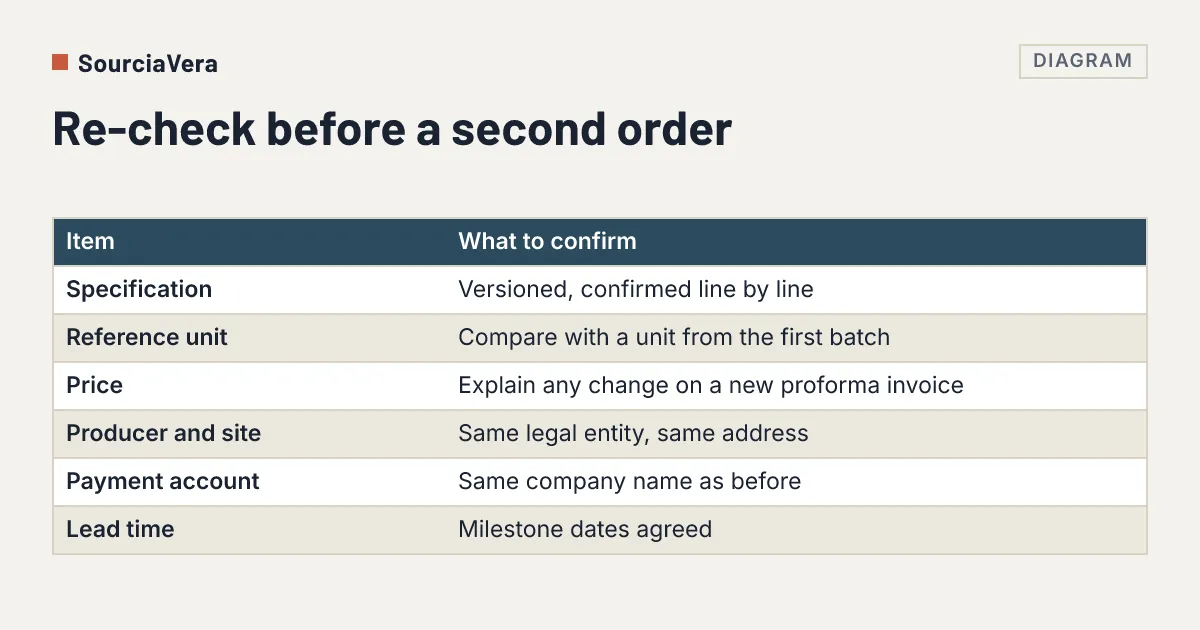
- The specification. Send the written specification again and ask the supplier to confirm it line by line, including materials, dimensions, finish and packaging. Version it, for example "v2, October 2026", so any change is visible.
- A reference unit. Keep one unit from the first batch and, if you can, ask for a unit from the new run to compare (see why bulk orders differ from the approved sample).
- The price and what it includes. A price change is normal; an unexplained one is not. Ask what changed, and confirm the price term and validity on a new proforma invoice.
- The quantity and the unit. Check the minimum order and the unit (pieces or sets) again (see how the minimum order quantity works).
- The producing company and the site. Confirm that the same legal entity, at the same address, makes the goods. A move to a new factory, or to a subcontractor, should be disclosed (see telling a real factory from a trading company).
- The payment account. It should be the same company name as before. A new account or a new name is a reason to stop and ask, by a channel you already trust.
- The lead time and capacity. Ask how the new order fits with the supplier's other work and agree milestone dates.
How Should You Start the New Order?
Treat it as a new order with a head start, not as a renewal. Reuse the documents you collected the first time and refresh the ones that expire (see documents to request from a Chinese manufacturer). If the quantity is much larger than the first, consider agreeing a first shipment of the new quantity before the rest, or checking the goods before the balance is paid (see what a pre-shipment inspection costs).
What Are the Warning Signs on a Repeat Order?
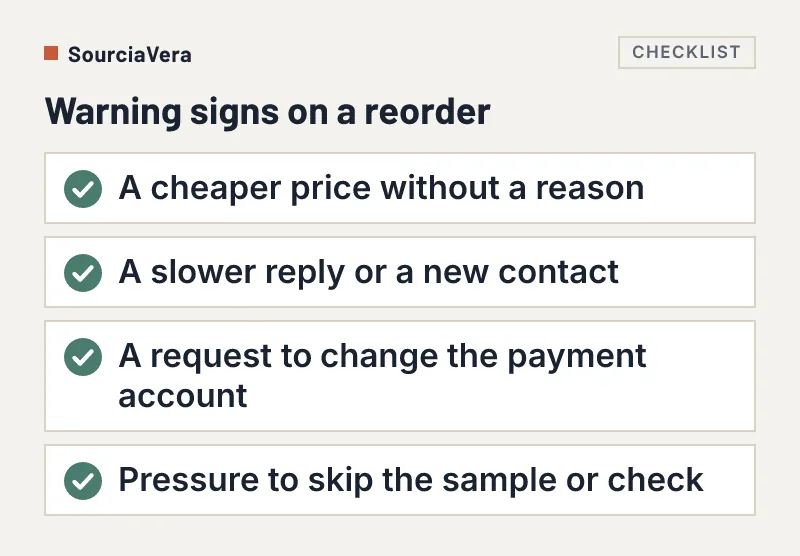
- A cheaper price without a reason, which may mean cheaper materials.
- A slower reply than on the first order, or a different contact person with no introduction.
- A request to change the payment account or to pay in a different way.
- Pressure to skip the sample or the check "because you already know us".
Where Does a Third-Party Check Help?
A second order is when a change is most likely to be missed, because attention drops. An independent check compares the goods and the factory with what you approved the first time, and confirms that the company on the new paperwork is the one that produces the goods. It cannot tell you what the supplier will do in the future; it shows what is there now.
What Should You Do Next?
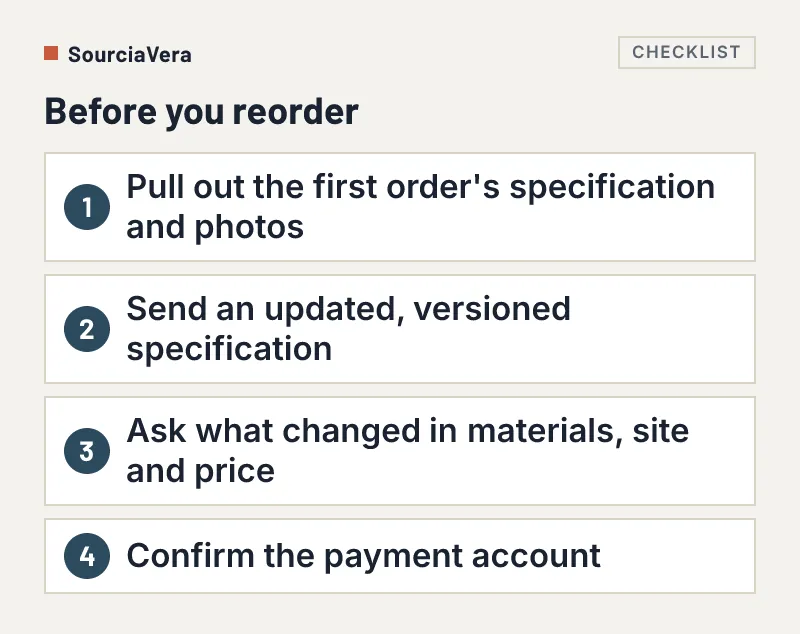
- Pull out the first order's specification, photos and any inspection notes.
- Send an updated, versioned specification and ask for written confirmation.
- Ask what has changed in materials, site, staff, capacity and price.
- Confirm the payment account and the company name before you pay (see ten things to check before paying a deposit).
Frequently Asked Questions
Do I need a new proforma invoice for every order?
Yes. A new proforma invoice records the price, specification, quantity, payment details and dates for that order, so it is the document to compare when something changes.
Should I ask for a new sample on a repeat order?
Not always, but compare the new production with a unit from the first batch. If the supplier changed materials, site or process, a new sample or an inspection of the first units is worth asking for.
What if the price goes up on the second order?
Ask what changed and ask for it in writing. A change in raw material costs can be real; an unexplained rise, or a price drop with no reason, deserves a closer look at the specification.
Can I trust a supplier more after one good order?
A good order is useful evidence, not a guarantee. Keep the same checks, especially on payment details and on who produces the goods.
Summary and Next Step
A repeat order is safer than a first one only if you keep checking. Re-confirm the specification, compare against a unit from the first batch, check the price, the producer, the site and the payment account, and start the new order with milestones.
More on working with a Chinese supplier
In short, repeat the checks that mattered the first time. Tell us about your order if you want help preparing the questions for your supplier.
I provide supplier verification services, so you should treat my recommendation accordingly. This article is general information, not legal advice.