
The short answer: if you paid IEEPA tariffs on goods from China, CBP's CAPE tool lets the importer of record request a refund, with interest. Which entries qualify depends on their status, and the refund goes to the importer of record, who may not be you. Check both before you act.
Verified as of October 25, 2026 against CBP's IEEPA Duty Refunds page and its April 2026 fact sheet. The Phase 3 details come from two law-firm summaries of a CBP court filing, which we did not open.
This article covers what CBP says, which entries are open for claims, what is still unsettled and what to ask your supplier and forwarder. It is based on CBP's own pages, two law-firm notes and general good practice, not on any first-hand experience of these claims. Your customs broker or trade attorney decides how it applies to your entries.
Why Does It Matter to a U.S. Buyer?
- It is money already paid. CBP says CAPE consolidates refunds of IEEPA duties, including interest, instead of processing them entry by entry (CBP).
- The refund does not go to whoever ordered the goods. It goes to the importer of record, or to the party that importer designated on CBP Form 4811, and only that importer or the licensed broker who filed the entries can file the claim (CBP fact sheet). CBP defines the importer of record as the owner or purchaser of the goods or, when designated, a licensed customs broker (CBP Directive 3530-002A). If a broker or forwarder was named on your entries, as we read it, the claim runs through them.
- Scammers are already involved. CBP's page warns that fraudsters use emails, notices and social media to solicit company and personal information from importers and interfere with the refund process.
What Does CBP Say About the Refund Process?
CBP launched CAPE in its ACE system to process valid refund requests for duties imposed under the International Emergency Economic Powers Act (IEEPA), "as authorized by court order or applicable law". To use it, the importer of record or the broker needs an ACE Secure Data Portal account with bank account information for refunds, which is separate from the bank information used for payments, and submits a CAPE Declaration by uploading a CSV file of entry numbers. Refunds are paid by ACH (CBP; fact sheet).
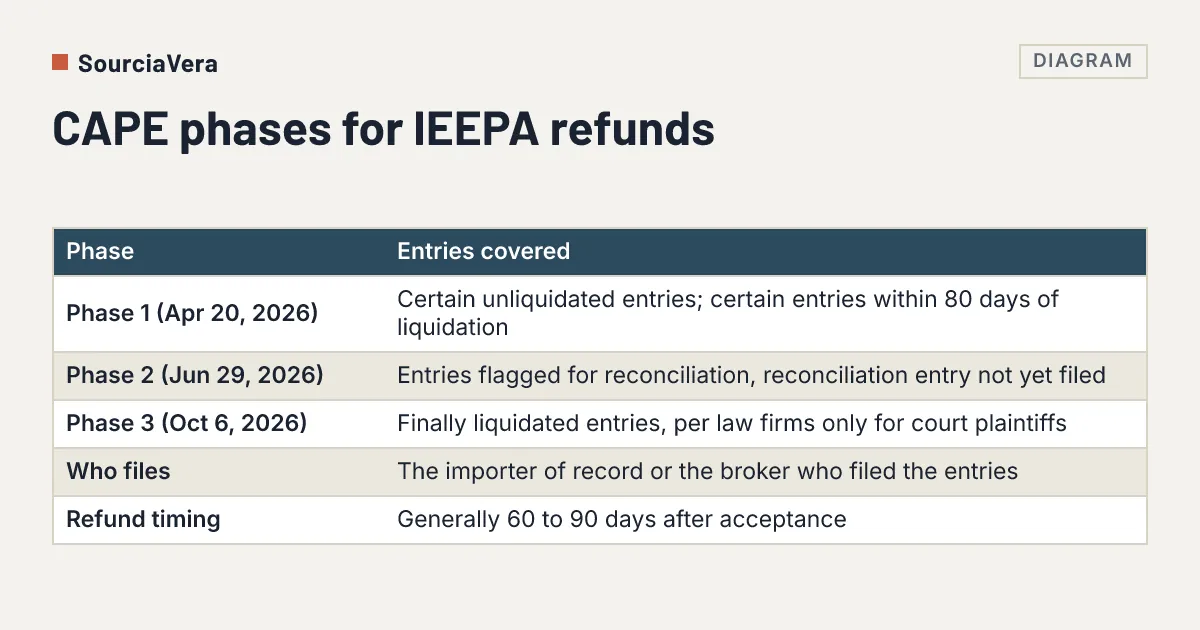
CBP says valid refunds are generally issued within 60 to 90 days after a declaration is accepted, unless a compliance concern needs more review. Refunds are subject to the rules on liquidation and reliquidation (the point at which CBP finalizes the duties on an entry), including netting of overpayments and underpayments across the whole entry, and CBP may divert a refund to offset an importer's undisputed unpaid debts to the United States. Once a declaration is filed, entries cannot be removed from it, and each entry can appear on only one accepted declaration (CBP).
Which Entries Can Be Claimed, and When?
- Phase 1, launched April 20, 2026: certain unliquidated entries and certain entries within 80 days of liquidation (CBP; launch date per Thompson Hine).
- Phase 2, launched June 29, 2026: entries flagged for reconciliation where the reconciliation entry is not yet on file (CBP; launch date per Thompson Hine).
- Phase 3, launched October 6, 2026: finally liquidated entries, but according to two law-firm summaries of a CBP declaration filed with the Court of International Trade on September 15, 2026, only for importers of record that are plaintiffs in a pending case where the court ordered reliquidation, and that gave CBP their importer of record number by July 30, 2026 (Thompson Hine; Warner Norcross & Judd).
CBP's page also says that for Phase 1 you do not need to file a case at the Court of International Trade to receive a refund, and that CBP offers no legal guidance on whether a case is needed for any other entries.
What Is Still Unknown?
Whether importers who are not plaintiffs will get access to Phase 3: Thompson Hine reports that this CBP position is subject to ongoing litigation and that the government appealed the part of the court's order requiring refunds to non-litigating importers on entries liquidated more than 80 days ago. It is also unclear what instructions CBP will give to plaintiffs who sent their importer of record number after July 30. The CBP page we read lists Phases 1 and 2 only, and we did not open the CBP declaration or the court order. Ask your broker or attorney which phase your entries fall into.
What Should a Buyer Ask the Supplier and the Forwarder For?
This section is general advice, not a rule from CBP.
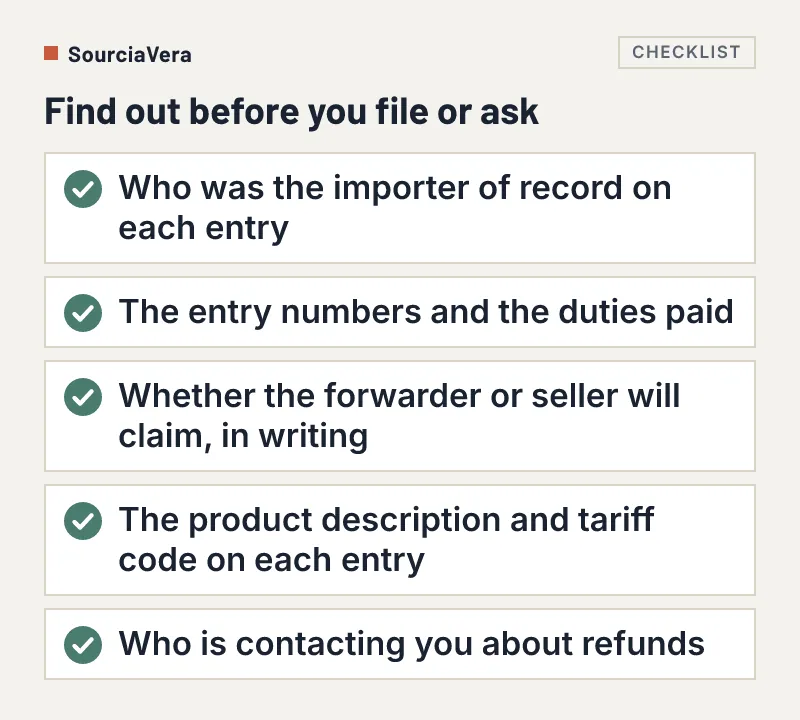
- Who was the importer of record on each entry, and the entry numbers. Under delivered terms such as DDP, or with a forwarder acting as importer, it may not have been you (see FOB, EXW, CIF or DDP price terms).
- The entry summaries and invoices that show the duties paid, matched to the supplier's invoice and your payment (see proforma invoice for a Chinese supplier).
- Who will claim and who will pass the money on. If your forwarder or seller is the importer of record, ask in writing whether it will file and how a refund will reach you.
- The product description and tariff code used on each entry, so your broker can match the entries to the claim (see how HS codes work and documents to request from a Chinese manufacturer).
- Who is contacting you. Use CBP's own pages and your broker, not an unsolicited email.
Where Does a Third-Party Check Help?
It cannot file a refund claim or tell you whether your entries qualify. What it can do is check the supplier side of your records: that the company on your invoices is a real manufacturer or trader, that the payment account matches the company, and that the goods and descriptions match the paperwork your broker will rely on. It can also help you check that a company offering to recover refunds exists before you give it any information.
What Do CBP's Pages Not Tell You?
They do not tell you whether your entries qualify, how much you will receive or how long the litigation will take. They do not name any company that is entitled to a refund.
What Should You Do Next?
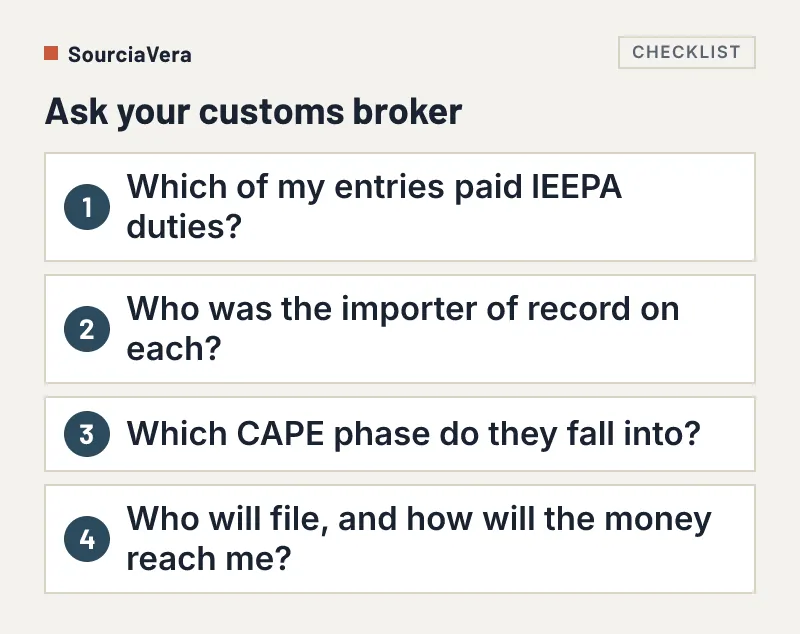
- Ask your customs broker for a list of your entries with IEEPA duties and who the importer of record was.
- Check that the importer of record has an ACE Portal account with refund bank details, if that is you.
- Ask your forwarder or seller in writing whether it will file claims on entries where it was the importer.
- Keep supplier invoices, payment records and descriptions in one folder with the entry numbers.
- Ignore unsolicited refund offers and confirm any message through CBP or your broker.
Frequently Asked Questions
What is CAPE?
CAPE is the function in CBP's ACE system through which importers of record and brokers request refunds of IEEPA duties, consolidated rather than entry by entry. CBP is adding it in phases.
Who can file a CAPE declaration?
Only the importer of record or the licensed customs broker who filed the entries, according to CBP's fact sheet. Refunds are paid by ACH to the importer of record or the party it designated on CBP Form 4811.
How long does a refund take?
CBP says valid refunds are generally issued within 60 to 90 days after a declaration is accepted, unless a compliance concern requires more review. Some entries, such as suspended or extended ones, are refunded at liquidation.
Can I claim a refund if I only bought the goods from a Chinese supplier?
Only if you were the importer of record or you can arrange with the importer of record to claim. Check who was named on your entries; with delivered terms or a forwarder acting as importer it may not have been you.
Do I need to sue at the Court of International Trade?
CBP says you do not need a case for Phase 1 entries and gives no legal guidance for other entries. For Phase 3, law-firm summaries say CBP limited access to plaintiffs. Ask your attorney.
Summary and Next Step
CBP's CAPE tool lets importers of record and brokers claim IEEPA refunds with interest. Phases 1 and 2 cover entries that are unliquidated, recently liquidated or flagged for reconciliation; Phase 3, per law-firm summaries, is limited to court plaintiffs. The first question is not "how do I claim", it is "who was the importer of record on my entries".
More on importing from China to the U.S.
In short, find your entries and your importer of record before anything else. Tell us about your order if you want help preparing the questions for your supplier and forwarder.
I provide supplier verification services, so you should treat my recommendation accordingly. SourciaVera is not a customs broker or a law firm, and nothing here is customs or legal advice.