The short answer: you can track a Chinese factory order by agreeing six milestones in writing and asking for dated evidence at each one. They run from order confirmation to loading. A supplier that cannot show evidence at a milestone is telling you something before you pay the balance.
This guide covers the six milestones, the evidence to ask for, the warning signs and what to do when a date slips. It is general advice for buyers, based on common practice, not on any single order or any first-hand case. Adjust it to your product and your order size.
Why Track Milestones at All?
- Problems show up while they are cheap to fix. A wrong material found at the start costs a message; found in the container it costs the order.
- Payment follows evidence. If the deposit and the balance are tied to milestones, you pay for progress you can see (see ten things to check before paying a deposit).
- Dates become facts. A date written in the proforma invoice and confirmed at each step is much harder to move quietly than a date said on a call.
What Are the Six Milestones to Agree?
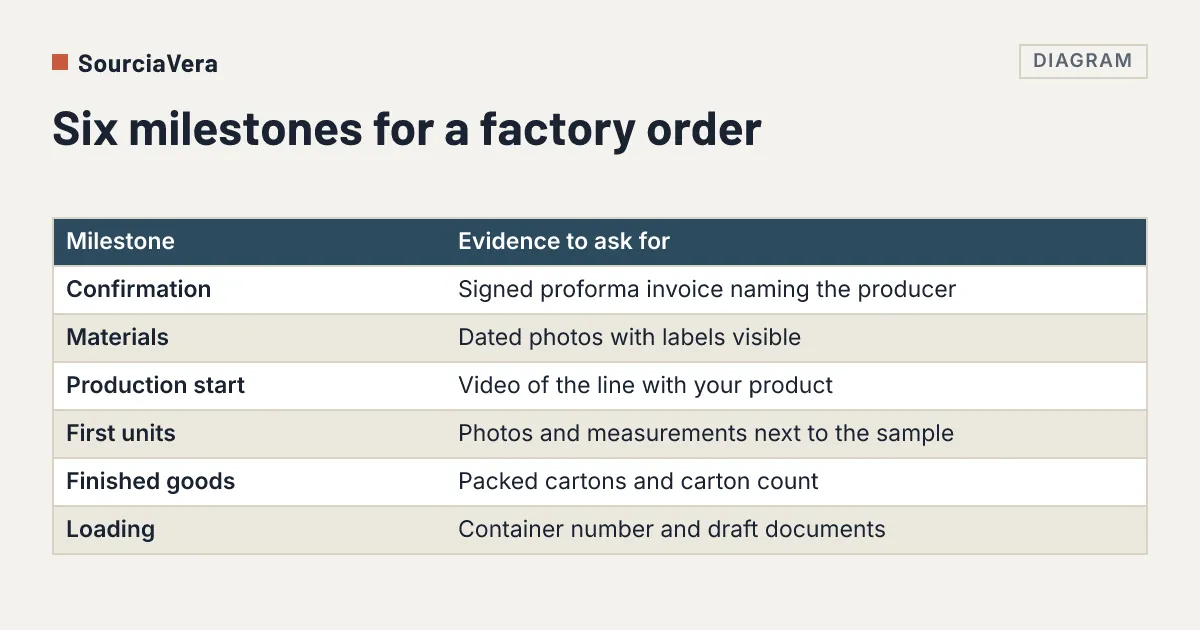
- Order confirmation. The supplier confirms the specification, quantity, price and shipping date in writing, on a proforma invoice that names the producing company.
- Materials and components in the factory. The raw materials or bought-in parts for your order have arrived and match the specification.
- Production start. The line is running your order, with a date.
- First finished units. A small number of finished pieces exist and can be compared with the approved sample (see why bulk orders differ from the approved sample).
- Finished goods and packing. The full quantity is finished and packed, before the balance is paid. This is the point where an inspection fits (see what a pre-shipment inspection costs).
- Booking and loading. The shipment is booked, the goods are loaded and the shipping documents match the order (see the bill of lading or sea waybill).
What Evidence Should You Ask For at Each One?
- Confirmation: the signed or stamped proforma invoice, with the producer's legal name and the dates.
- Materials: dated photos of the materials with labels or supplier names visible, and the delivery notes if the supplier will share them.
- Production start: a short video of the line with your product on it, ideally on a live call so you can ask to see something specific (see what a live video call shows that photos cannot).
- First units: photos and measurements of two or three finished pieces next to the approved sample.
- Finished goods: a photo of the packed cartons with the quantity per carton, and the total carton count against the order.
- Loading: photos of the loading, the container number and the draft shipping documents before they are final.
What Are the Warning Signs?
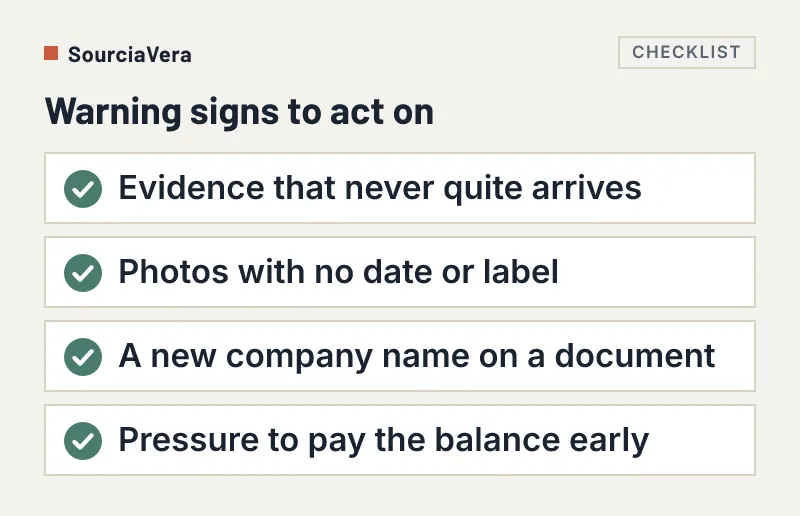
- Evidence that never quite arrives. Each request is answered with a promise instead of a photo.
- Photos that could belong to any order. No date, no label, nothing that ties them to your goods.
- A new company name appearing on a document or a bank account that was not on the proforma invoice (see a real factory from a trading company).
- Pressure to pay the balance early, before the finished goods have been seen.
How Do You Handle a Slipped Date?
Ask for the reason in writing, the new date for that milestone and the new shipping date, and ask what it changes: quality checks, packing or the booking. Do not accept a verbal "a few days". If the delay will cost you a booking, agree in writing who bears that cost. The earlier a slip is raised, the more options remain.
Where Does a Third-Party Check Help?
Tracking from a distance relies on what the supplier chooses to send. An independent person on the ground can see the line, count the cartons and compare the goods with the specification, and can tell you whether the company producing your order is the one on your invoice. It does not replace your own milestone list; it makes the evidence harder to stage.
What Should You Do Next?
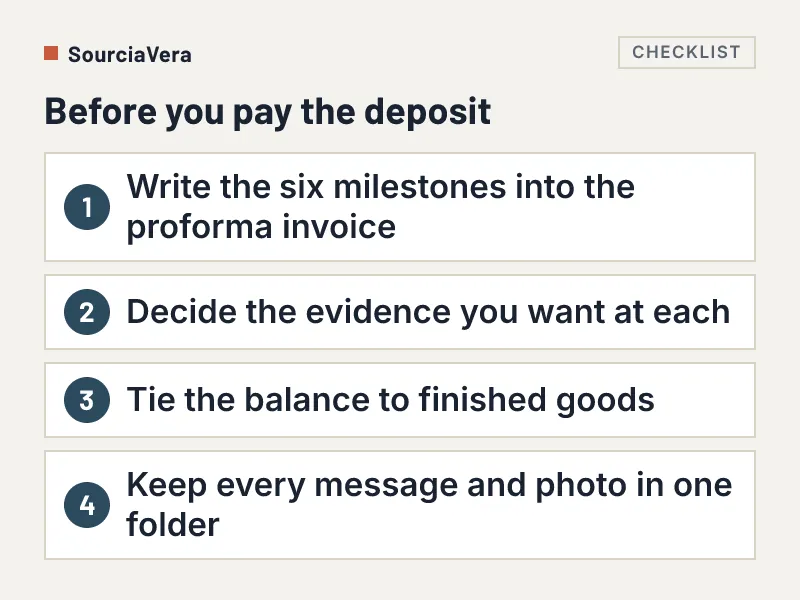
- Write the six milestones and their dates into the proforma invoice before you pay a deposit.
- Decide what evidence you want at each one and tell the supplier up front.
- Tie the balance to the finished-goods milestone, not to a date on a calendar.
- Keep every message and photo in one folder with the order number.
Frequently Asked Questions
How many milestones should an order have?
There is no fixed number. Six is a practical set for most manufactured goods: confirmation, materials, production start, first finished units, finished goods and loading. Simpler products may need fewer.
Should I pay the balance before or after seeing the finished goods?
Tie the balance to the finished-goods milestone, so you have seen the packed goods or had them inspected before the money moves. Agree this in the proforma invoice before the deposit.
What if the supplier refuses to share photos or video?
Treat it as information. A supplier with nothing to hide can usually show a line, a carton count and a packing photo. Repeated refusals are a reason to pause before paying more.
Is a pre-shipment inspection the same as milestone tracking?
No. Tracking follows the order from start to loading. An inspection checks the finished goods against the specification at one point, usually before the balance is paid.
Summary and Next Step
Six milestones, each with dated evidence, turn a distant factory order into something you can follow: confirmation, materials, production start, first units, finished goods and loading. Tie the balance to the finished-goods milestone and raise any slip early, in writing.
More on running an order from China
In short, agree the milestones before the deposit and ask for evidence at each one. Tell us about your order if you want help preparing the questions for your supplier.
I provide supplier verification services, so you should treat my recommendation accordingly. This article is general information, not legal advice.