The short answer: on October 28, 2026, Commerce issued antidumping and countervailing duty orders on van-type trailers and subassemblies from China. The cash deposit rates are 129.73% and 134.75%. If you import trailers, parts or kits from China, check whether your goods are in scope before the next entry.
Verified as of October 28, 2026 against Commerce's Federal Register notice (91 FR 67815) and the USITC news release of September 25, 2026. We did not find CBP's own guidance or the ITC's Federal Register notice.
This article covers what the notice orders, what is in scope, what is still unknown and what to ask your Chinese supplier and your forwarder. It is based on the notice itself, the ITC release and general good practice, not on any first-hand experience of these cases. Your customs broker or trade attorney decides how it applies to your entries.
Why Does It Matter to a U.S. Buyer?
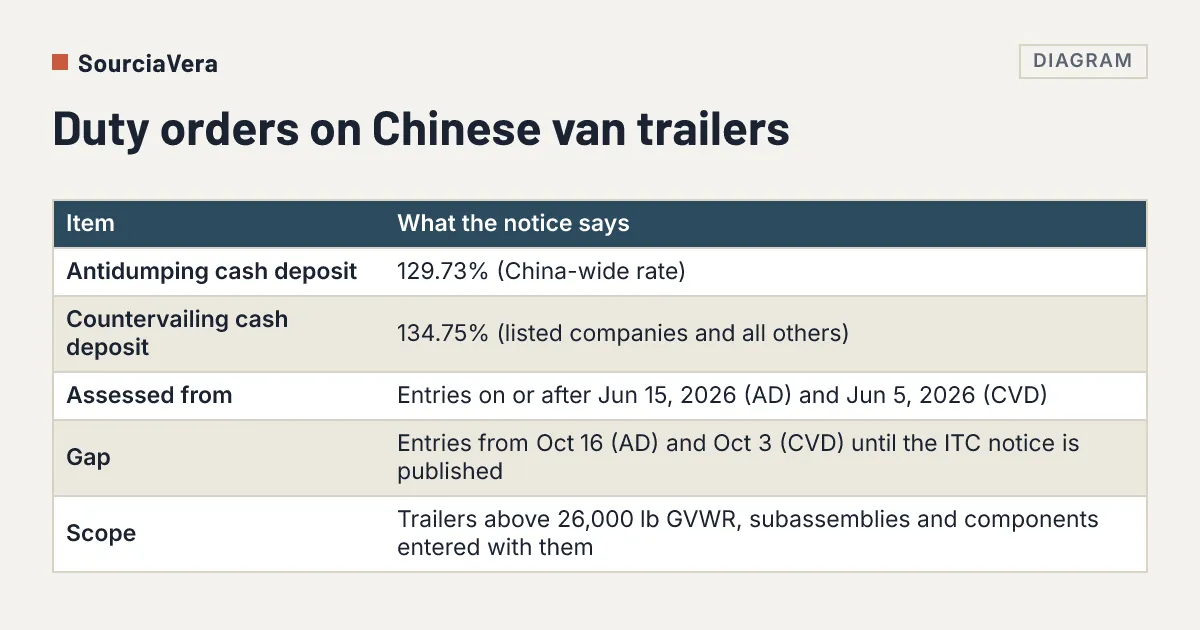
- The rates are very high. The notice sets a cash deposit of 129.73% for the antidumping order (the China-wide rate, adjusted for an export subsidy offset) and 134.75% for the countervailing order (every company listed and "all others"). Added together that is 264.48 percentage points, our arithmetic and not a CBP figure (Federal Register).
- The scope is wide. It covers finished and unfinished van-type trailers and their subassemblies, and components entered on the same bill of lading as the trailers. Processing in China or in a third country does not take a product out of scope (Federal Register).
- It can reach entries already made. Duties are to be assessed on unliquidated entries made on or after June 15, 2026 (antidumping) and June 5, 2026 (countervailing), with a gap described below (Federal Register).
What Did Commerce Order?
Commerce published its final dumping and subsidy determinations on August 31, 2026. On September 25, 2026 the USITC voted that a U.S. industry is materially injured by these imports, and on October 15, 2026 it notified Commerce of its final determinations. Because of that finding, Commerce issued the two orders (Federal Register; USITC).
Under an antidumping duty order (the extra duty on goods sold below their normal value) and a countervailing duty order (the extra duty that offsets a foreign subsidy), CBP collects a cash deposit at the time the importer would normally deposit estimated customs duties, and Commerce later instructs CBP on the amount to assess. The antidumping rate applies to all exporters because Commerce set only a China-wide rate. The countervailing rate is 134.75% for the companies it lists and for all others (Federal Register).
Which Products Are Covered?
The notice covers van-type trailers with a gross vehicle weight rating above 26,000 pounds, built as enclosed cargo bodies with a nose wall, side walls, a rear door, a floor and subframe, a roof, running gear, brakes, lighting, landing gear and a coupler. It also covers subassemblies "whether finished or unfinished, whether assembled or unassembled", such as subframes, wall and roof panels, rear door frames and doors, rear impact guards, coupler assemblies, running gear and axle assemblies and landing gear. Components entered together with a trailer or subassembly, such as hubs, brakes, axles, suspensions, wheels, tires, lighting and electrical systems, lift gates and refrigeration units, are also covered (Federal Register).
The notice says finished and unfinished trailers are typically classified under HTSUS 8716.39.0040, 8716.39.0090 and 8716.90.5060, and subassemblies may also enter under 7308.30.5050, 7308.90.9590, 7326.90.8688, 8708.29.1500, 8708.99.8180 and 8716.90.5010. It adds that the written scope is what counts, not the tariff number, and it excludes subassemblies already covered by the orders on chassis from China (Federal Register). For how tariff codes work, see how HS codes work.
Which Entries Pay, and From When?
- Assessment dates: antidumping duties apply to unliquidated entries made on or after June 15, 2026, and countervailing duties to those on or after June 5, 2026, except for entries in the gap below.
- The gap: the provisional measures lapsed after four months. For antidumping, entries from October 16, 2026, and for countervailing, entries from October 3, 2026, until the day before the ITC's final determination is published in the Federal Register are to be liquidated without regard to these duties.
- The restart: suspension of liquidation and cash deposits resume on the date the ITC's final affirmative determination is published in the Federal Register, and stay in effect until further notice.
All three points come from the notice, where Commerce says it "intends" to give CBP these instructions (Federal Register).
What Is Still Unknown?
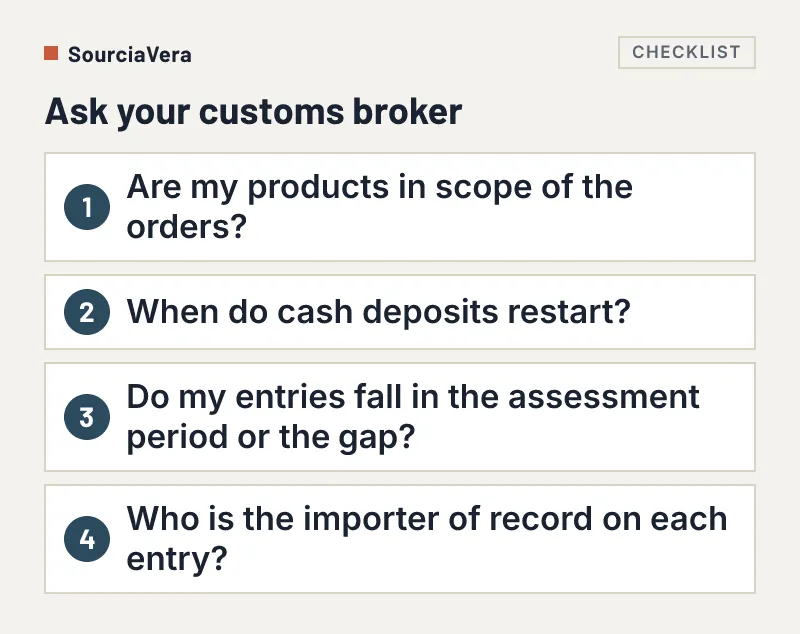
The exact date the cash deposits resume, because it depends on when the ITC's determination is published in the Federal Register and we did not find that notice. We also did not find CBP's guidance to the trade (a CSMS message) for these orders. The USITC says its public report will be available by November 5, 2026. The notice lists no company-specific antidumping rate, so every Chinese supplier is on the China-wide rate unless Commerce says otherwise later. Ask your broker for the restart date and whether your entries fall in the assessment period or the gap.
What Should a Buyer Ask the Supplier and the Forwarder For?
This section is general advice, not a rule from the notice.
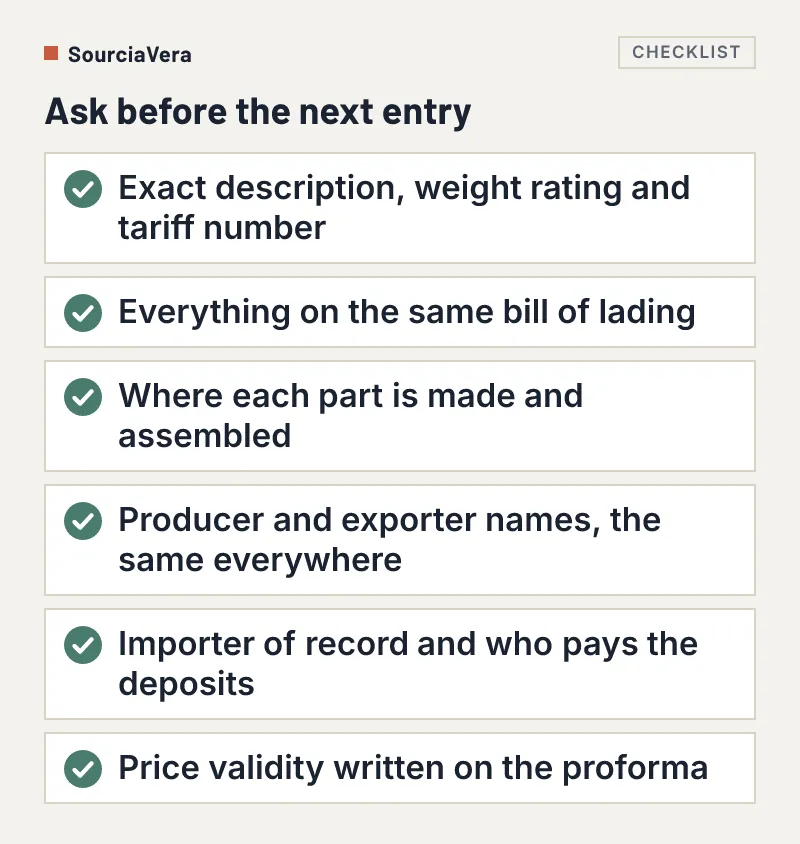
- The exact product description, including the gross vehicle weight rating, a parts list and the tariff number the supplier uses, so your broker can compare it with the scope (see documents to request from a Chinese manufacturer).
- What ships on the same bill of lading. Components entered with a trailer or subassembly are covered, so ask for the full packing list of every shipment.
- Where each part is made and where the unit is assembled, in writing. The notice says processing in a third country does not remove a product from scope.
- The legal name of the producer and the exporter, the same on the quote, the proforma invoice, the commercial invoice and the payment (see proforma invoice for a Chinese supplier and telling a real factory from a trading company).
- Who is the importer of record and who pays the deposits. With delivered terms the supplier may quote a price that leaves out duties, so ask what it includes (see FOB, EXW, CIF or DDP price terms).
- How long the price is valid, written on the proforma invoice, and who bears a change in duties.
Where Does a Third-Party Check Help?
It cannot decide whether your product is in scope or what tariff number applies. What it can do is check what is on the supplier's side of the paperwork: that the company is a real manufacturer or a trader, where the production actually happens, and that the unit and its parts match the description your broker will rely on. An inspection before the balance is paid (see what a pre-shipment inspection costs) compares the goods and the shipment with the order.
What Do the Sources Not Tell You?
They do not tell you whether your product is covered, what you will pay on a given entry or when the deposits restart. They do not say that any supplier is evading duties, and they say nothing about your supplier.
What Should You Do Next?
- Ask your customs broker whether your trailers, parts or kits are in scope and for the restart date of cash deposits.
- List your open orders for trailers, subassemblies and parts from China and their expected entry dates.
- Get the product description, parts list and production location from each supplier in writing.
- Write the price validity and duty responsibility into the proforma invoice.
- Check any new supplier before you pay. For other U.S. changes, see how importers claim IEEPA tariff refunds, CBP's proposed rule on low-value imports and China-US ocean and air freight in October 2026.
Frequently Asked Questions
What did Commerce order on October 28, 2026?
Antidumping and countervailing duty orders on van-type trailers and subassemblies from China, with cash deposit rates of 129.73% (antidumping, China-wide) and 134.75% (countervailing), according to the Federal Register notice.
Which trailers are covered?
Van-type trailers with a gross vehicle weight rating above 26,000 pounds, finished or unfinished, plus subassemblies such as subframes, walls, doors, axle assemblies and landing gear. The written scope controls, not the tariff number.
Does assembling the trailer in another country avoid the duties?
Not according to the notice: processing or assembly in the country of manufacture or in a third country does not remove a product from the scope. Ask your broker how it applies to your goods.
Do the duties apply to entries I already made?
Possibly. Duties are to be assessed on unliquidated entries made on or after June 15, 2026 (antidumping) and June 5, 2026 (countervailing), except entries in the gap between the end of the provisional measures and the Federal Register notice of the ITC's final determination.
When do cash deposits restart?
On the date the ITC's final affirmative determination is published in the Federal Register, according to the notice. We did not find that date, so ask your broker.
Summary and Next Step
Commerce issued antidumping and countervailing duty orders on van-type trailers and subassemblies from China on October 28, 2026, with cash deposit rates of 129.73% and 134.75%. The scope reaches subassemblies and components shipped with the trailer, and processing elsewhere does not take a product out of it. The first step is to confirm the scope and the restart date with your broker.
More on importing from China to the U.S.
In short, check your product against the written scope before the next entry. Tell us about your order if you want help preparing the questions for your supplier and forwarder.
I provide supplier verification services, so you should treat my recommendation accordingly. SourciaVera is not a customs broker or a law firm, and nothing here is customs or legal advice.