The short answer: China is not one place: where a product is made decides who can realistically go and look at the factory. A phone, a brake caliper and an LED panel can all say "Made in China" and come from factory clusters hundreds of kilometers apart.
The short answer: Mexico's biggest imports from China are electrical and electronic equipment, machinery, vehicles, phones and auto parts. Of those, auto parts, automotive LED lighting and much general LED lighting are made in and around Guangzhou; phones and most consumer electronics are concentrated in Shenzhen, and other machinery depends on the specific product. Knowing where your product is actually made tells you who can verify the factory in person.
The scale is not in question. According to INEGI, Mexico imported about $129.8 billion from China in 2024, roughly 20% of everything Mexico buys from the rest of the world. China isn't just one supplier among many; it's Mexico's second-largest source of imported goods, after the United States. But some categories are manufactured heavily in Guangzhou, where our team and I are based. Others are concentrated in other regions of China, and there we can't offer you the same in-person verification advantage.
So this guide separates the two: what Mexico actually buys from China based on real trade figures, and in which of those categories it makes sense to work with Chinese suppliers through Guangzhou specifically.
1. What Does Mexico Import From China? The Real Numbers
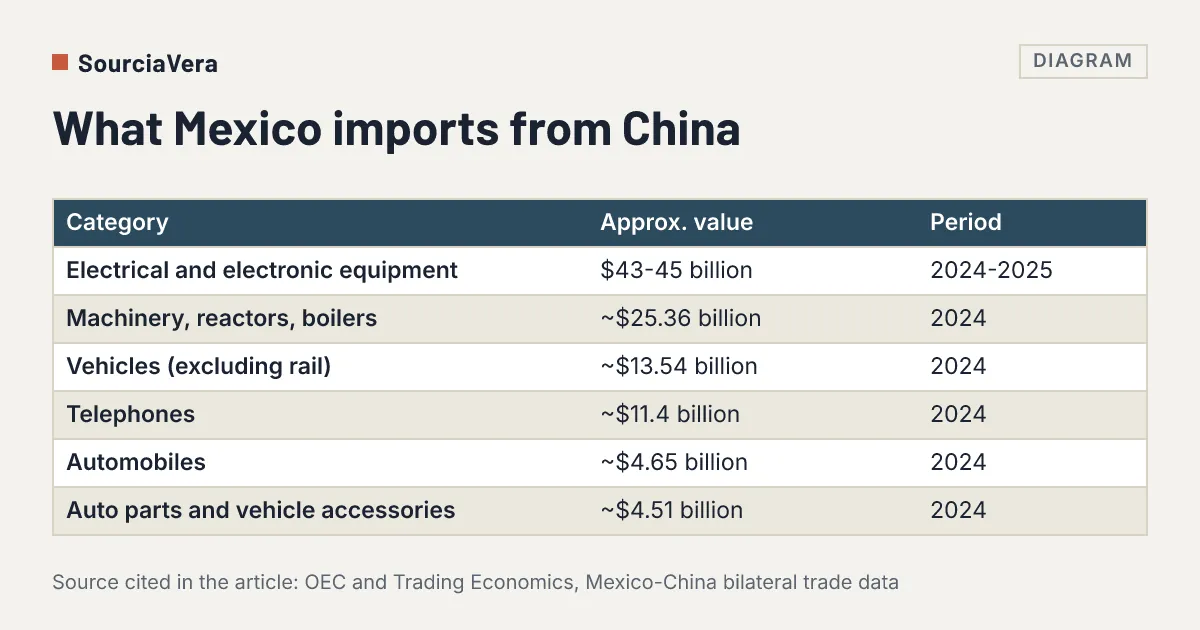
According to bilateral trade data, these are the categories that dominate Mexican imports from China:
| Category | Approximate Value | Period |
|---|---|---|
| Electrical and electronic equipment | $43–45 billion | 2024–2025 |
| Machinery, reactors, boilers | ~$25.36 billion | 2024 |
| Vehicles (excluding rail) | ~$13.54 billion | 2024 |
| Telephones | ~$11.4 billion | 2024 |
| Automobiles | ~$4.65 billion | 2024 |
| Auto parts and vehicle accessories | ~$4.51 billion | 2024 |
Source: The Observatory of Economic Complexity (OEC) and Trading Economics, Mexico–China bilateral trade data 2024–2025.
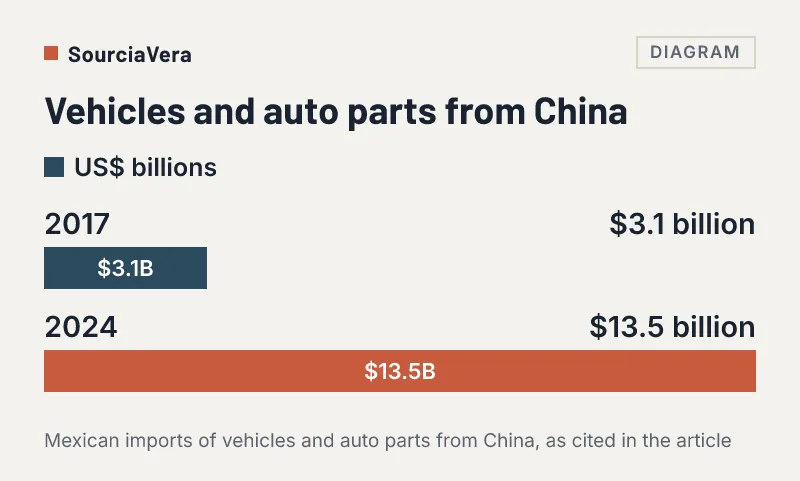
Mexican imports of vehicles and auto parts from China went from $3.1 billion in 2017 to $13.5 billion in 2024. This isn't a stable category — it's growing fast, and with it the demand for buyers who know how to source wholesale from Chinese suppliers without losing margin along the way.
2. Which of These Products Are Actually Made in Guangzhou?
This is where most generic import guides fall short. Picture a typical Mexican importer with a list of five products and one sourcing budget. The first question I'd ask isn't "which supplier?" but "which city?" Here's how I answer it from direct experience, not from a generic list:
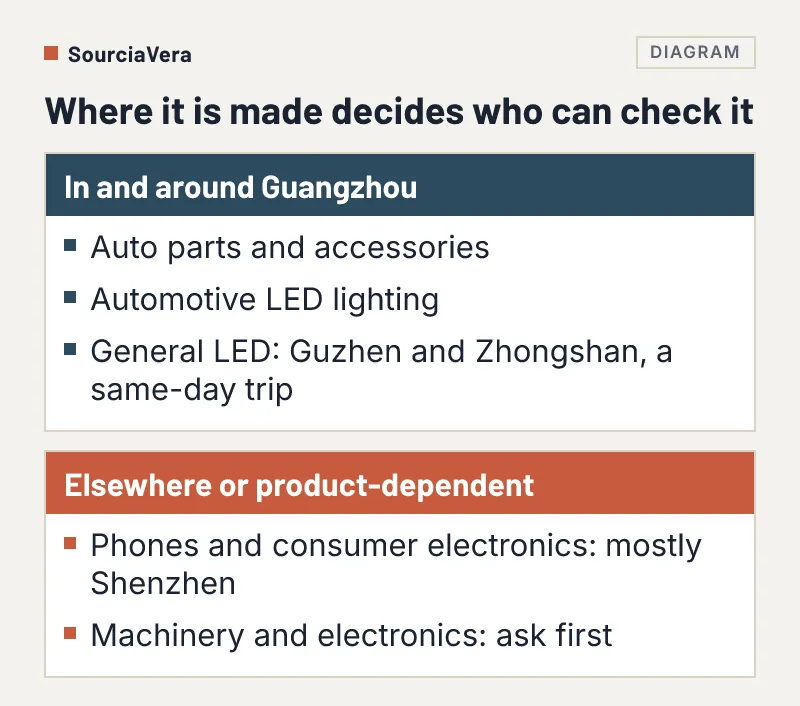
Auto Parts and Accessories — Yes, a Real Guangzhou Strength
Guangzhou is one of China's most important automotive production bases. This is where OEM and replacement parts factories, LED automotive lighting, suspension components, and interior trim and accessories concentrate. If your business imports auto parts, Guangzhou is exactly where you should have someone verifying factories in person. Our team visits factories in person, and the founder still joins many of the visits.
LED Lighting — Guangzhou and Its Surroundings, Same-Day Travel
Automotive LED lighting concentrates in Guangzhou; general LED lighting (residential, commercial, decorative) has another strong hub in Guzhen and Zhongshan, both within the same Guangdong province — a same-day trip from Guangzhou. Our team can cover both without you having to coordinate with two different agents.
Machinery and Electrical Equipment — Depends on the Specific Product
This is the largest category by value ($43+ billion), but also the broadest: it ranges from industrial components to household appliances. Guangzhou has real manufacturers in several segments, but this is where it's worth asking first — not assuming that any product in this category is manufactured nearby.
Phones and Consumer Electronics — Honestly, Not Our Strong Zone
Phones are one of the largest product lines Mexico imports from China (about $11.4 billion in 2024), but that manufacturing concentrates more in Shenzhen than in Guangzhou. I'd rather tell you that directly than sell you a service we can't back up with real factory visits.
Categories Where We Have Direct Experience: Steel, Carbon Fiber, and Container Homes
Beyond the highest-volume categories, at SourciaVera we've specialized in verifying suppliers for steel and construction materials, custom carbon fiber components, and even expandable container homes — products where the Latin American buyer needs to see the real factory before committing to a large order, not just trust photos.
- Auto parts and automotive LED: a real Guangzhou strength, same-day in-person verification.
- General LED: Guangzhou + Guzhen/Zhongshan, same-day travel.
- Machinery and electronics: depends on the product — ask us before assuming.
- Phones and consumer electronics: outside our direct coverage zone, and I'll tell you so honestly.
$49
Written report in 48 hours: company registration, manufacturer vs. trader, and payment-account match.
Request the $49 check3. Alibaba vs. 1688: Which Platform Shows the Real Factory Price?
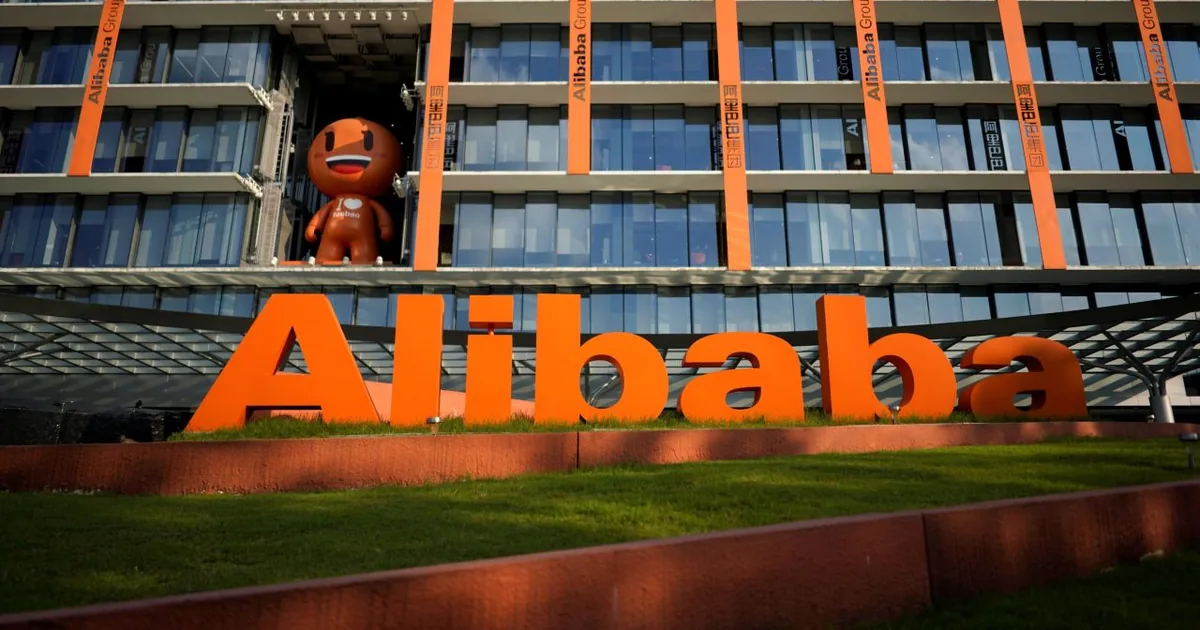
Almost every buyer starting to import from China knows Alibaba. Very few know 1688, Alibaba's sister platform operated by the same group (Alibaba Group), but built for China's domestic market — that is, for wholesale trade between factories and buyers inside China.
| Platform | Who It's Built For | What That Means for You |
|---|---|---|
| Alibaba | International buyers | English interface, prices already adjusted for export, MOQs built for international orders |
| 1688 | Buyers inside China | Chinese interface, factory pricing with no export margin built in, but no support for foreign buyers |
Here's the part almost nobody explains: many of the same Chinese suppliers you see on Alibaba also sell on 1688 — often at a different price, because on 1688 they're competing for wholesale purchases from Chinese customers negotiating with no middleman. An agent who knows how to work both platforms can confirm whether the price you were quoted on Alibaba actually reflects factory cost, or whether there's additional margin that can be negotiated.
In my view it's not about choosing Alibaba or 1688. It's about having someone in China who can cross-reference both sources, talk directly to the factory in Chinese, and confirm what's real factory pricing versus middleman margin before you send a deposit.
4. How Does a Wholesale Purchase From China Actually Work, Step by Step?
When an importer comes to us with a product list, this is the sequence the work usually follows:
- You confirm what you need: product, target quantity, budget, and deadline.
- We find and compare real suppliers in Guangzhou (and on 1688/Alibaba when it applies) — not just the first search result.
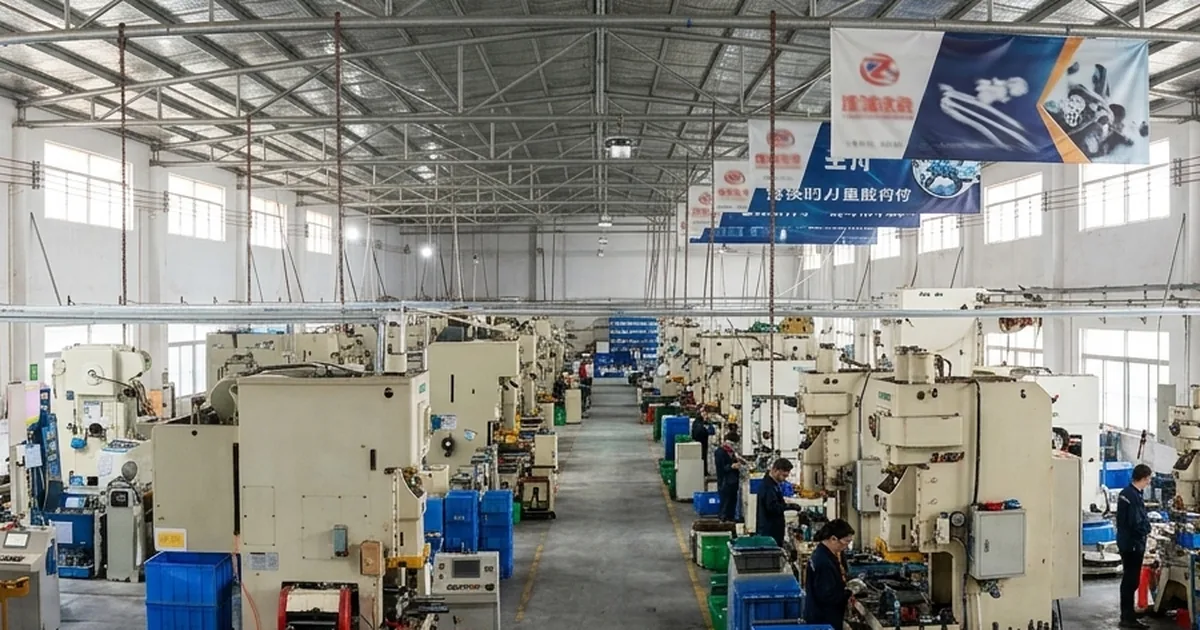
- We verify the factory in person: business license, real production capacity, unedited video of the line.
- We negotiate directly with the factory in Chinese — no machine translation, no hidden middleman margin.
- We coordinate production, quality control, and inspection before the order leaves China.
Before you release the next payment, it helps to know what evidence to ask for: open the sample report, and read how to choose a verification provider if you want someone independent to check.
If one of these products is your next order, China supplier verification for Mexican importers checks the factory behind the quote before the deposit moves.
Summary: Ask Where It Is Made Before You Ask How Much It Costs
Mexico buys roughly $130 billion a year from China, but that doesn't mean it's all manufactured in the same place, or that every platform works the same way. Auto parts, automotive LED and the categories where we have direct experience (steel, carbon fiber, container homes) are known territory for our team in Guangzhou. For everything else, the honest approach is to say so before charging you for a service we can't back with a real factory visit.
The most useful habit I can pass on is to ask "where is this made?" before "how much does it cost?" The answer tells you who can realistically visit the factory, whether the Alibaba price has room in it, and how much of the deal you'll be taking on trust. At SourciaVera we verify Chinese suppliers in Guangzhou in person, cross-reference Alibaba and 1688 to confirm real pricing, and coordinate wholesale purchases from start to finish, with evidence rather than promises.
In short, where a product is made decides who can realistically visit the factory and how much of the deal rests on trust. If you ask only about price, you may rely on an Alibaba quote that has no room in it, or on a supplier no one could check in person. Tell us what you are sourcing and we will say honestly whether we can verify it in person, and a $49 remote check covers the basic company questions for any category.
I provide supplier verification services, so you should treat my recommendation accordingly.
 Buyer's Guide
 Supplier Verification
 Due Diligence
 Buyer's Guide