The short answer: On November 6, 2026, U.S. officials told China's vice premier to fully implement its Busan commitments, citing agriculture and rare earths. China said it has "serious concern" over recent U.S. trade restrictions, according to Xinhua. The readouts we read announce no tariff change or new deadline.
Verified as of November 7, 2026 against the USTR readout and the Treasury readout, both of November 6, 2026, and against SCMP and Reuters (via The Standard), which quote Xinhua. We did not open Xinhua's own text, so China's side is attributed to those outlets.
This article sets out what each side said, what it does not say and what an importer can check while the talks continue. It does not predict the outcome. It is based on the documents cited and on general good practice, not on any first-hand experience of these talks. Your customs broker or trade attorney decides how any rule applies to your entries.
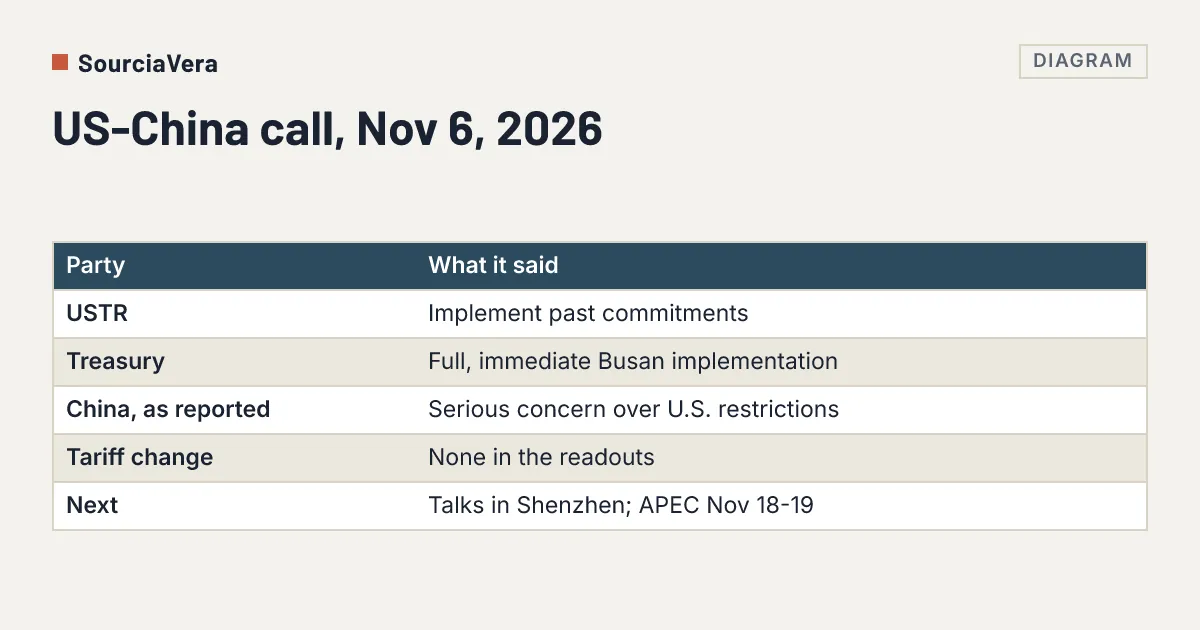
What Did Each Side Say?
| Party | What it said | Source |
|---|---|---|
| USTR (Greer) | Stressed the importance of China taking concrete actions to fully implement its past commitments, particularly on agricultural purchases, rare earths and other critical minerals; the U.S. will keep monitoring compliance | USTR |
| Treasury (Bessent) | Stressed China fully and immediately implementing its Busan commitments, raised concerns about recent Chinese actions and said further progress depends on concrete results | Treasury |
| China (He Lifeng), as reported | Frank, in-depth and constructive exchanges; "serious concern" over recent U.S. trade restrictions; both sides agreed to keep using the consultation mechanism and manage differences | SCMP; Reuters via The Standard |
Treasury describes the call as covering the bilateral economic relationship and implementation of the Busan arrangement (Treasury). Neither U.S. readout lists the "recent Chinese actions" or names a product, a tariff rate or a date. According to SCMP, Xinhua said Beijing urged Washington to correct its "wrongful practices as soon as possible" (SCMP). Reuters, citing Xinhua, links China's concern to new U.S. tariffs of 10% and 12.5% on goods from 60 trading partners over forced labor enforcement, with a 12.5% rate for China (Reuters via The Standard); we did not verify that figure in the official notice.
What Happens Next?
- New talks in Shenzhen. According to SCMP, a new round of U.S.-China trade talks is expected in Shenzhen later in November, where He Lifeng and Bessent are due to meet before the leaders' meeting on the sidelines of APEC (SCMP).
- APEC dates. The Economic Leaders' Meeting is November 18-19, 2026 in Shenzhen (apec.org). Reuters adds that a G20 summit in Miami is on December 14-15 (Reuters via AsiaOne).
What Is Still Unknown?
- Any change to tariffs. The readouts announce none, and we found no official text that extends or changes the Busan arrangement.
- Which restrictions China means. The Chinese statement as reported refers to "recent U.S. trade and economic restrictions" without a list we could read.
- Xinhua's original text. We read it only as quoted by SCMP and Reuters.
- Results of the Shenzhen talks. They had not happened as of November 7, 2026.
What Does Not Change in the Meantime?
A call changes no duty by itself. The rules already published stay in force until an official notice changes them. For example, USTR's 178 Section 301 exclusions run through the end of November 9, 2026 and we found no extension notice (see the Section 301 exclusions ending November 9, 2026), and the duties in the antidumping and countervailing cases follow their own schedules (see the investigations of wooden fence components from China).
What Should a Buyer Ask the Supplier and the Forwarder to Confirm?
This section is general advice, not a rule from the documents.
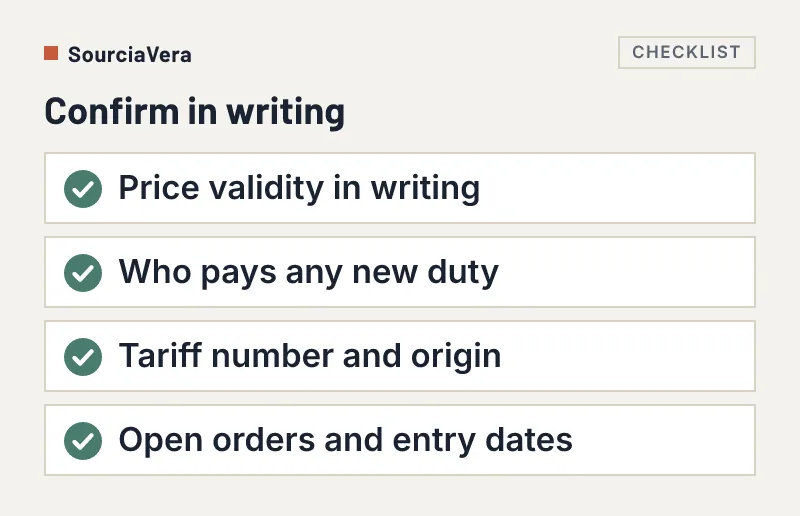
- The price validity and who pays any new duty, written into the proforma invoice, since the policy can change between the order and the entry (see what to check on a proforma invoice and which price term to ask a Chinese supplier to quote).
- The tariff number and the origin of each component, especially if a product contains rare-earth magnets or other critical minerals, so your broker can check it against any later notice (see the documents to request from a Chinese manufacturer).
- Your open orders and their expected entry dates, so you can tell which entries could fall before or after a change.
- Delivery dates with a buffer, and a second source for any part that depends on a controlled material (see the supplier verification checklist).
$49
Written report in 48 hours: company registration, manufacturer vs. trader, and payment-account match.
Request the $49 checkWhere Does a Third-Party Check Help?
It cannot predict tariffs or decide what duty applies. It can confirm what is on the supplier's side of the paperwork: that the company is a real manufacturer, where the production happens and that the goods and their components match the documents your broker will use. See our factory supervision service for orders in production and our auto parts category page if you buy vehicle components.
What Do the Documents Not Tell You?
They do not tell you whether your product will face a higher or lower duty, or whether the talks will end in a new agreement. They say nothing about any supplier.
What Should You Do Next?
- List your open orders from China with expected entry dates.
- Ask your customs broker which of them depend on the exclusions and measures that end or change in November.
- Write the price validity and duty responsibility into each proforma invoice.
- Get the tariff number and component origin from each supplier in writing.
- Check the USTR and Treasury pages after the Shenzhen meetings before you commit to new orders.
Frequently Asked Questions
What did the U.S. say after the November 6, 2026 call with China's vice premier?
USTR said Greer stressed China taking concrete actions to fully implement past commitments, particularly on agricultural purchases, rare earths and other critical minerals. Treasury said Bessent stressed full and immediate implementation of the Busan commitments.
What did China say about the call?
According to Xinhua as quoted by SCMP and Reuters, the exchanges were frank, in-depth and constructive, and China expressed serious concern over recent U.S. trade restrictions. Both sides agreed to keep using the consultation mechanism.
Did the call change any tariffs?
The two U.S. readouts announce no tariff change and no new deadline, and we found no official text changing the Busan arrangement. Duties already published stay in force until an official notice changes them.
When is the next U.S.-China meeting?
According to SCMP, new trade talks are expected in Shenzhen later in November, before the leaders' meeting at APEC. The APEC Economic Leaders' Meeting is November 18-19, 2026, according to apec.org.
What should an importer do while the talks continue?
List open orders with entry dates, write price validity and duty responsibility into the proforma invoice, get the tariff number and component origin from the supplier, and ask your broker about measures ending in November.
Summary and Next Step
The official U.S. readouts of the November 6, 2026 call press China to implement its Busan commitments on agriculture and rare earths; China, as reported, raised serious concern over U.S. restrictions. No tariff change was announced. The first step is to confirm price validity and duty responsibility on every open order.
More on importing from China to the U.S.
In short, a call is not a rule. Tell us about your order if you want help preparing the questions for your supplier and forwarder.
I provide supplier verification services, so you should treat my recommendation accordingly. SourciaVera is not a customs broker or a law firm, and nothing here is customs or legal advice.
 Market News
 Market News
 Due Diligence
 Market News