The short answer: Asia-to-U.S. ocean spot rates were flat to lower in the latest weekly readings, while air rates rose. Freightos had the West Coast level at about USD 8,300 per 40-foot container on November 3 and China-to-North America air up 9% to USD 7.76 per kilogram. Ask your supplier for a written cargo-ready date.
Verified as of November 4, 2026 against the Drewry World Container Index of October 29, Xeneta's weekly update of October 23, Freightos' update of November 3 and Flexport's update of October 29. Xeneta's October 23 update was the newest one we could open. These are market averages from four secondary sources, not quotes.
This article covers what the four sources report, what is still unknown and what to ask your Chinese supplier and your forwarder to confirm in writing. It is based on those reports and on general good practice, not on any first-hand experience of these bookings. It is not a quotation: ask your forwarder for yours. For the readings of October 16 to 22, see China-US freight in October 2026.
Why Does It Matter to a U.S. Buyer?
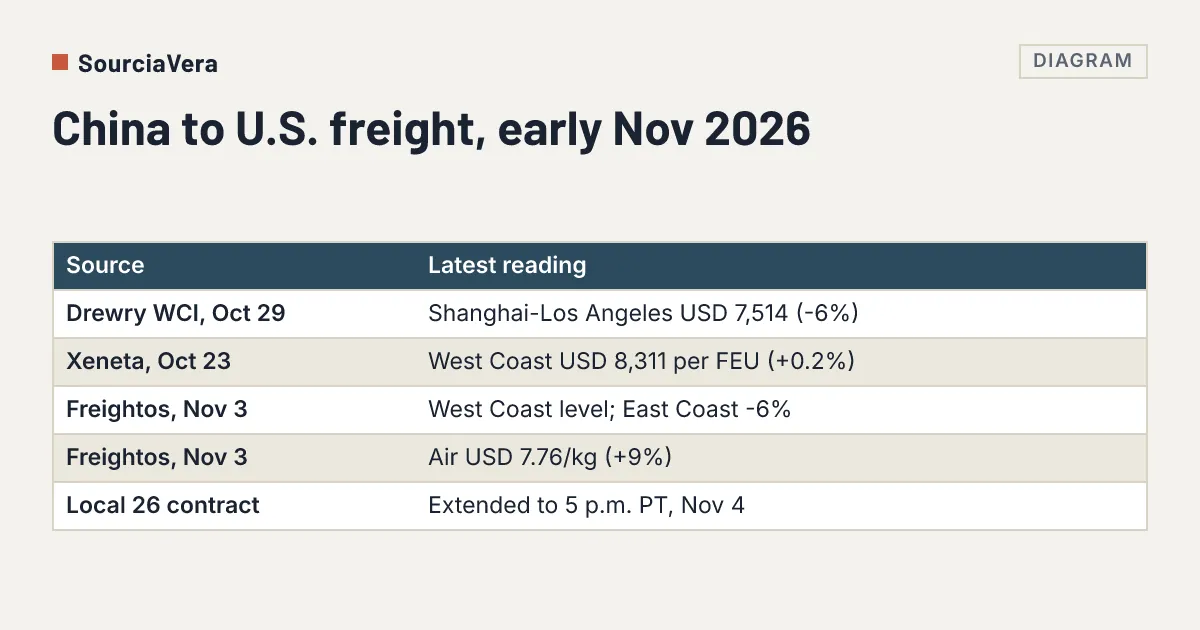
- Ocean is high but not rising. Freightos says West Coast prices were about level at roughly USD 8,300 per 40-foot container (FEU) and East Coast prices fell 6% to about USD 9,900 (Freightos). Drewry's index for Shanghai to Los Angeles fell 6% to USD 7,514 (Drewry).
- Carriers announced increases that have not stuck so far. Freightos reports general rate increases of USD 2,000 to 3,000 per FEU planned for the start of November, with daily rates not climbing in the first days of the week and some forwarders expecting no further increases as the slow season starts (Freightos).
- Air is near last year's high. Freightos puts Far East to North America air at USD 7.76 per kilogram, up 9% in the week, 40% above a year earlier and close to the 2025 peak of USD 8.00 (Freightos).
- A port strike is possible. The Local 26 watchmen union at the Los Angeles and Long Beach ports, part of the ILWU, voted to authorize a strike; Freightos says the contract was extended to 5 p.m. Pacific Time on November 4 while talks continue (Freightos).
What Do the Sources Report?
| Source and date | Ocean | Air |
|---|---|---|
| Drewry WCI, October 29 | Composite USD 4,429 per 40-foot container, down 3%; Shanghai to Los Angeles USD 7,514 (-6%); Shanghai to New York USD 9,631 (-5%) | Not covered |
| Xeneta, October 23 | Far East to U.S. West Coast USD 8,311 per FEU; East Coast USD 11,525; both up 0.2% on the week | Not covered |
| Freightos, November 3 | West Coast level at about USD 8,300; East Coast down 6% to about USD 9,900 | China to North America up 9% to USD 7.76/kg |
| Flexport, October 29 | Record 393,000 TEU of weekly Asia-to-West Coast capacity; the planned November 1 increase faces pressure | Asia Pacific to U.S. rates about 41% above a year earlier |
Drewry's World Container Index is an assessment of rates from Shanghai on specific routes; Xeneta reports market averages for the Far East; Freightos publishes its own Baltic Index for Asia to each coast. That is why the West Coast reads USD 7,514, 8,311 and about 8,300 at nearly the same time. Drewry expects rates to decrease the following week, citing six blank sailings (cancelled sailings) announced, up from five, and a forecast from the National Retail Federation that U.S. ocean imports fall 11% in November from October (Drewry).
Xeneta says its October 23 readings confirm that U.S. trades have peaked and that it expects them to soften through the rest of 2026; rates to the West Coast were still 18.9% above July 1 (Xeneta). Flexport adds that, with the slack season starting, carriers are matching capacity to softer demand to protect rates, and that shippers should add buffer to cargo-ready dates out of Shanghai and Ningbo for the next few weeks and avoid relying on a single sailing (Flexport).
What Is Still Unknown?
- The strike. Whether the Local 26 contract is renewed or extended again after 5 p.m. Pacific Time on November 4, and what a strike by that small union would do to terminal operations. Freightos notes it could have an outsized impact because these workers provide required security services at many terminals.
- Port fees on China-linked vessels. Flexport says the U.S. has proposed extending its suspension of added port fees to January 9, 2027, and that the current suspension expires on November 10. We did not find the official notice, so treat the proposal as unconfirmed.
- Whether the November increases hold. Freightos says the coming days will show; Drewry expects a decrease the next week.
- Newer Xeneta data. We could not open a Xeneta update after October 23.
What Should a Buyer Ask the Supplier and the Forwarder to Confirm?
This section is general advice, not a rule from the sources. The rate can move; the date your goods are ready is the part you can control.
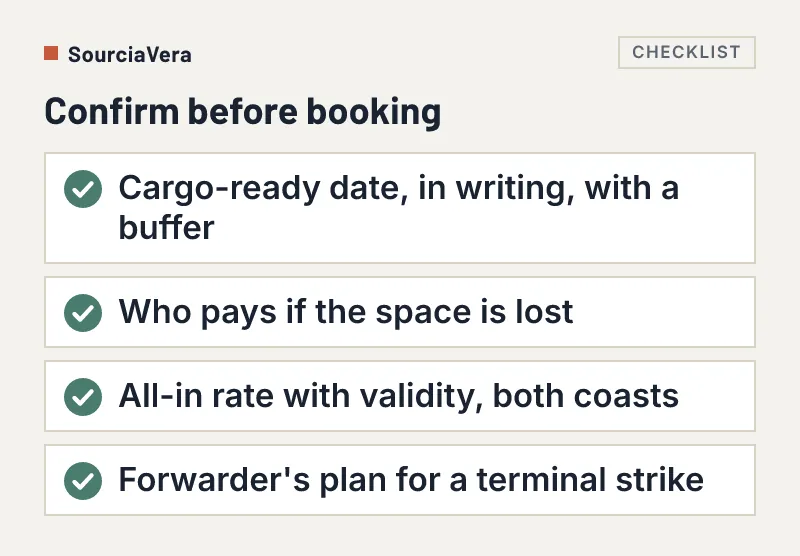
- A cargo-ready date the supplier commits to in writing, with the production schedule behind it and an early warning if it slips. Add a buffer, as Flexport advises, if you ship from Shanghai or Ningbo.
- Who pays if the space is lost because the goods were not ready: re-booking, storage and any rate difference. Put it on the proforma invoice.
- The price term and what it includes. With an ex-works or FOB price you book and pay the freight; with a price that includes freight, ask until when it is valid and who absorbs an increase (see which price term to ask a Chinese supplier to quote).
- From the forwarder: the all-in rate with validity and surcharges, both coasts if possible, and its plan if a terminal strike or a blanked sailing delays your container.
- An air versus ocean decision made with numbers. Compare the landed cost, including what a delay would cost you (see FCL, LCL or air from China), before you accept an air quote at a near-record level.
$49
Written report in 48 hours: company registration, manufacturer vs. trader, and payment-account match.
Request the $49 checkWhere Does a Third-Party Check Help?
It cannot lower a freight rate or prevent a strike. It can reduce the risk you do control: that the goods are really ready, complete and as ordered on the day the space is booked. See our factory supervision service for orders in production and our auto parts sourcing page if you buy parts. An inspection before the balance is paid (see what a pre-shipment inspection costs) compares quantities, packing and labels with the order and leaves time to fix what does not match before a booking is lost. The ten things to check before paying a deposit cover the rest.
What Do the Sources Not Tell You?
They do not tell you what you will pay, whether your sailing will be blanked or whether rates will be lower when your goods are ready. The indexes are averages or assessments for specific routes, and none of them mentions your supplier.
What Should You Do Next?
- Ask your forwarder for an all-in quote with validity for both coasts.
- Close a written cargo-ready date with each supplier, with a buffer.
- Write on the proforma invoice who bears the cost of a lost booking.
- Ask your forwarder about the Local 26 outcome and its plan for terminal delays.
- Compare air and ocean landed cost before paying a near-record air rate. For other U.S. changes, see the Section 301 exclusions ending November 9, 2026.
Frequently Asked Questions
What are China-to-U.S. ocean freight rates in early November 2026?
Freightos had Asia-to-U.S. West Coast prices level at about USD 8,300 per 40-foot container and East Coast prices down 6% to about USD 9,900 on November 3. Drewry's Shanghai to Los Angeles rate was USD 7,514 on October 29.
Why do Drewry, Xeneta and Freightos show different numbers?
They use different methods: Drewry assesses specific routes from Shanghai, Xeneta reports market averages for the Far East and Freightos publishes its own Baltic Index. Read each as context, not as your quote.
Are air freight rates from China rising?
Yes. Freightos reports Far East to North America air up 9% in the week to USD 7.76 per kilogram, 40% above a year earlier and close to the 2025 peak of USD 8.00.
Could a port strike delay my container?
Possibly. Freightos says the Local 26 union at Los Angeles and Long Beach authorized a strike and extended its contract to 5 p.m. Pacific Time on November 4. The outcome was unknown when we checked.
What should I ask my supplier about freight?
A written cargo-ready date with the production schedule behind it, a buffer if you ship from Shanghai or Ningbo, and who pays if the space is lost because the goods were not ready.
Summary and Next Step
The latest weekly readings show U.S.-bound ocean rates flat to lower at a high level and air rates near last year's peak, with a possible terminal strike in Los Angeles and Long Beach still open on November 4, 2026. The first step is a written cargo-ready date and an all-in quote from your forwarder.
More on importing from China to the U.S.
In short, plan around the date your goods are ready, not around the index. Tell us about your order if you want help preparing the questions for your supplier and forwarder.
I provide supplier verification services, so you should treat my recommendation accordingly. This article is general information, not a freight quotation or legal advice.
 Market News
 Market News
 Buyer's Guide
 Market News